
A lot of storage decisions get made too late. The truck is booked, settlement dates stop lining up, and suddenly you're trying to work out whether storaway self storage fits the move, the access hours, and the amount of furniture you need to park somewhere safe.
Around the Central Coast, Sydney, Newcastle and Lake Macquarie, that happens all the time. A house sells faster than expected in Terrigal. A unit in Gosford isn't ready because the lift booking changed. An office in Newcastle has to vacate before the new fit-out is finished. Temporary storage can solve those gaps, but only if it's planned like part of the relocation, not treated as an afterthought.
Why You Might Need Storage During Your Move
The most common reason people use storage is simple. Their dates don't match.
You might be leaving a family home on the Central Coast before your new place in Newcastle settles. You might be downsizing from Sydney into an apartment near Gosford and realise the furniture that worked in a freestanding house won't all fit in a strata building with tighter rooms, shared access, and booked lift times. In both cases, temporary storage gives you breathing room.
Storage also helps when the move itself needs to be split. That can happen when a renovation runs over time, when a property needs to be presented for sale, or when a business needs to clear furniture and archive material before the next premises is ready. It's not unusual. It's part of how many relocations work.
When storage is the practical option
A storage unit usually makes sense when one of these problems shows up:
- Settlement dates are out of sync: You need to vacate before you can move in.
- You're downsizing: Some items need a holding place while you decide what stays.
- Access is restricted: Apartment buildings in Sydney or Newcastle may require lift bookings, loading zone coordination, and body corporate approval.
- Renovation dust and trades are still onsite: Stored furniture stays cleaner and safer than furniture pushed room to room.
- You need staging space: Clearing bulky items can make a property easier to present.
If you're sorting through what to keep before the move, MORALVE's space-saving storage tips are useful for deciding what should stay accessible and what can be packed away first.
Practical rule: If your move has a timing gap, an access problem, or a space problem, storage can be the cleaner answer than trying to force everything into one long day.
There's also a big difference between “I need storage” and “I need a storage plan”. Short-term storage works best when you've already decided what goes in, how it's packed, and when you'll need it back out. If you're weighing the basics, this guide to short-term storage during a move is a good place to start.
What is Storaway Self Storage An Overview for Movers
storaway self storage is the type of service many people use when they need their own rented space for furniture, cartons, business stock, or household overflow during a relocation. In practical terms, you rent a private unit for a period that suits your move, load it with your belongings, and access it according to that facility's rules.
For movers, the important part isn't the label “self-storage”. It's how the unit functions in real life. You need enough room for the belongings you're storing, clear access for unloading, and a layout that won't turn retrieval into a half-day exercise.

Why self-storage is a normal part of moving
Self-storage isn't a niche option in Australia. Australia's self-storage sector is substantial, with about 1,300 locations and over 2.5 million individual storage spaces nationally, which shows that using a service like storaway self storage is a mainstream part of moving and relocation planning in Australia, not a niche requirement, according to Australian self-storage industry statistics.
That matters because it changes how you should think about storage. It's not a sign that the move has gone off the rails. It's often just a sensible bridge between one address and the next.
What movers should understand before booking
A few terms come up often when people compare storage options:
| Term | Plain-English meaning | Why it matters |
|---|---|---|
| Unit size | The amount of space inside the unit | Too small and items get crushed or stacked badly. Too large and you pay for space you don't use. |
| Access hours | The times you can enter the facility or your unit | Critical if your unloading runs late or you need something urgently. |
| Short-term or long-term hire | How long you'll keep the unit | Useful when your dates are uncertain or your renovation timeline shifts. |
| Drive-up or internal access | Whether the truck can get close, or items travel further by trolley | This affects unloading time, labour, and handling. |
People often focus on monthly rent first. The better approach is to start with logistics. If the unit is hard to reach, awkward to load, or available only within a narrow time window, the move gets more complicated even if the storage itself looks fine on paper.
A good storage unit doesn't just hold your belongings. It fits the timing, access, and handling requirements of the relocation.
Evaluating Storaway For Your Central Coast Sydney or Newcastle Move
When you assess storaway self storage for a local or regional move, the right question isn't “is it good?” It's “does it suit this specific relocation?”
That answer depends on your route, your property type, and how tight the schedule is. A house move from Wamberal to Charlestown has different pressure points than an apartment relocation from Sydney to Gosford or an office shift within Newcastle's busier commercial streets.
Access hours can make or break the day
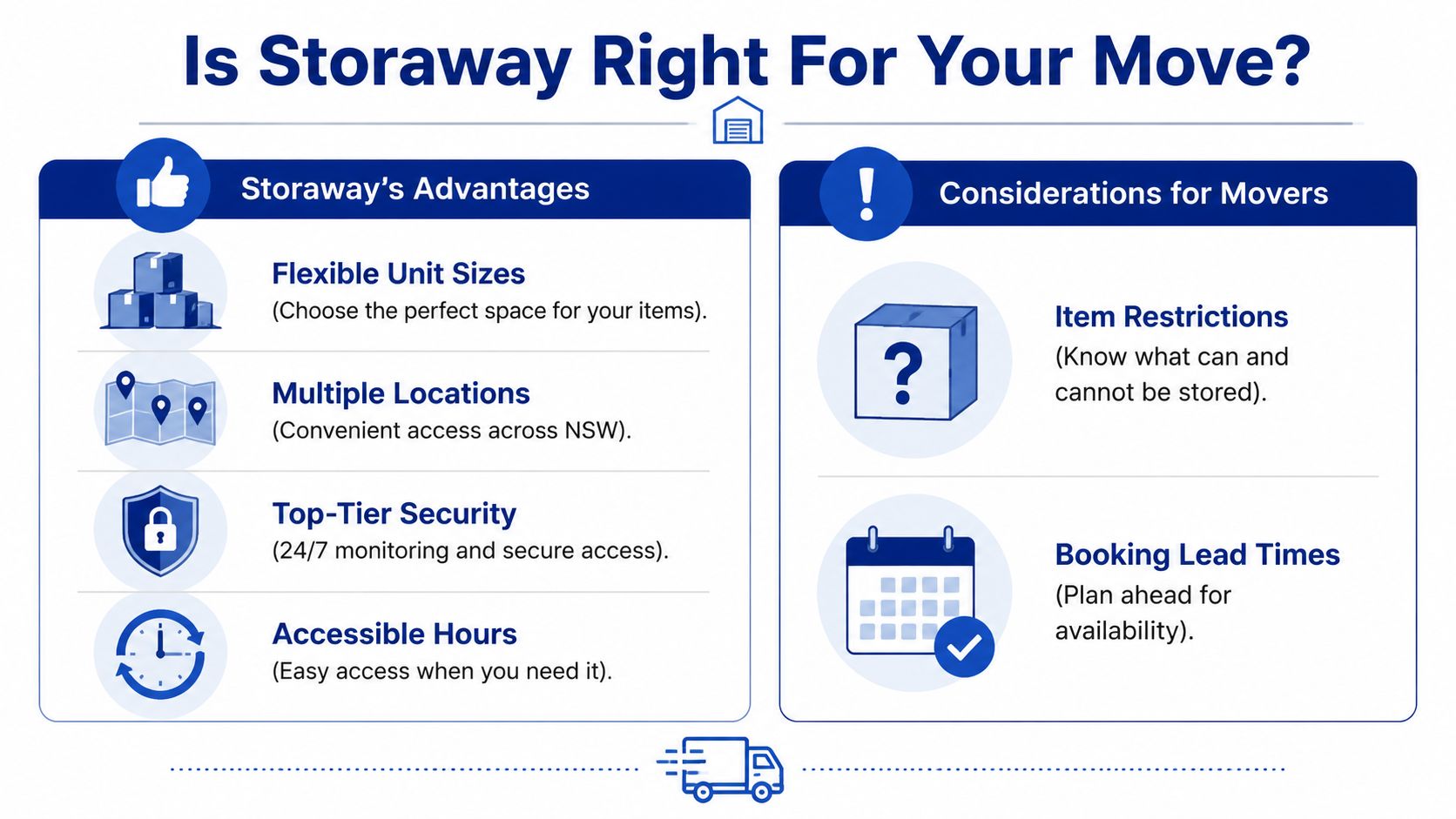
One of the most important details is access timing. Storaway's facilities often have specific access windows, such as 6:00 AM to 10:00 PM at their gated locations. For a move, this is a critical detail. We must plan truck arrival and unloading to ensure we don't get locked out, especially if there are traffic delays coming from Sydney or Newcastle, as noted on Stor-A-Way's facility information.
That sounds straightforward until real-world delays creep in. Friday traffic out of Sydney can blow out quickly. Newcastle streets near older apartment blocks can slow a truck if parking is tight. If the destination building also requires a booked lift or loading bay, your margin gets even thinner.
Here's the practical takeaway. If the storage site has a gate cut-off, your unloading window needs buffer time. Don't schedule to arrive “just before closing”. That's how belongings end up staying on the truck longer than planned.
What to assess before you commit
You don't need a complicated scoring system. You need a simple mover's checklist.
- Check access conditions first: Ask whether the facility is gated, whether the truck can pull in easily, and whether there are any after-hours restrictions that affect unloading.
- Match the unit to the actual volume: Furniture for a one-bedroom flat behaves differently to furniture from a multi-level family home. Bulky lounges, whitegoods and long dining tables change the layout fast.
- Think about retrieval, not just storage: If you'll need files, seasonal items, spare stock or baby furniture, leave a walkway and keep those items near the front.
- Review the approach roads: Tight turns, narrow entries, steep ramps and busy surrounding streets all matter on move day.
If you're comparing local options in more detail, this overview of self-storage in Gosford gives useful context for Central Coast conditions.
Security matters, but layout matters too
People understandably ask about locks, gates and surveillance. Those matter. So does the way the unit is packed.
A secure site won't stop damage caused by poor stacking, overloaded cartons, or furniture wedged too tightly against rough surfaces. The best storage outcomes come from both sides working properly. Safe site access and careful internal loading.
Coordinating Your Gentle Giant Move With Storaway
The easiest storage moves are the ones planned as one job from the start. Not a house move first, then a scramble to work out where everything goes.
That's especially true around the Central Coast, where one move might involve a suburban home, a narrow driveway, coastal weather, and then a second stop at storage before final delivery later on. Timing, vehicle choice, and access all need to line up.
Start with volume and access
The first step is always understanding what's being stored. Volume matters because it affects both the truck and the unit. In moving terms, cubic metres means the space your belongings take up inside the truck or unit.
That assessment is more accurate when it includes the awkward items people forget to count properly. Outdoor furniture, garage shelving, gym gear, pot plants, surfboards, office chairs, and boxed linen all add up. In apartment moves, we also look at stairs, lifts, loading dock rules, body corporate requirements, and where the truck can safely park without blocking access or risking property damage.
With our fleet of 12 trucks, ranging from smaller Pantechs for tight Newcastle laneways to large trucks for full household relocations, we can select the right vehicle to match both the size of your move and the access constraints of any specific Storaway facility, as outlined on our company overview.
For local planning, this guide to working with a Central Coast removalist helps clarify what should be sorted before the day arrives.
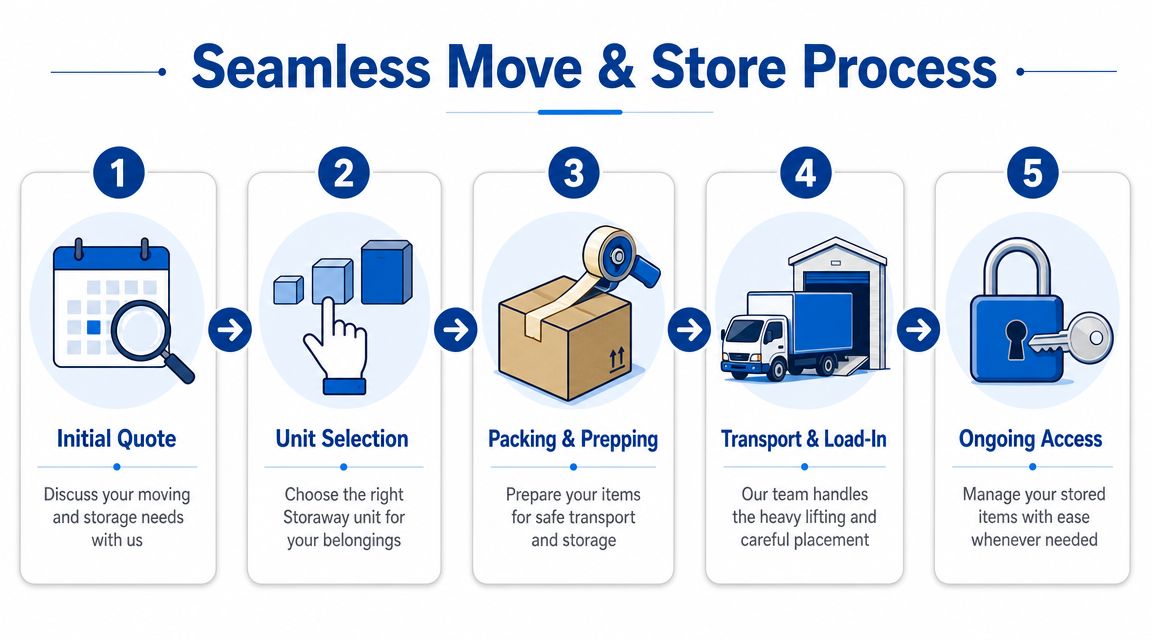
A quick visual guide can help if you're still mapping the sequence from booking to unloading.
How the move-to-storage day works best
Once dates and access are clear, the job usually runs more smoothly if you treat the storage leg like a proper destination, not a temporary stop.
A good process often looks like this:
- Confirm your storage booking early. Don't leave unit reservation and access details until the week of the move.
- Pack for storage, not just transport. Items sitting for weeks need better protection than items going straight into a house.
- Separate what you'll need soon. Keep documents, chargers, medication, work items, school gear, and basic kitchen pieces out of deep storage.
- Allow buffer time at both ends. That includes pickup delays, traffic, building management requirements, and the unloading window at the facility.
If your building has a booked lift from 1:00 PM to 3:00 PM and the storage facility gate closes later that evening, the whole day has to be planned backward from those fixed points.
Apartment and office storage needs extra coordination
Strata jobs usually need more paperwork and tighter timing than house moves. Sydney apartment buildings often have move-in restrictions, lift protection rules, and loading bay bookings. Newcastle's heritage buildings can have narrow stairwells and limited kerbside space. Offices add another layer because downtime affects staff, customers, and trading.
For those jobs, the storage plan should identify what must remain accessible. Files, reception equipment, spare stock, IT peripherals and archived records shouldn't all be buried behind boardroom tables and cabinets.
Advanced Packing and Security For Stored Belongings
Packing for storage is different from packing for a same-day relocation. A truck journey might last hours. Storage can last weeks or longer. That changes how you protect furniture, cartons, and anything sensitive to pressure, dust, or moisture.
The biggest mistake is assuming that if something survives the drive, it's ready for storage. It often isn't.
Pack for time, not just transport
Furniture should be clean and dry before it goes into the unit. Timber pieces need breathing room and protective wrapping that won't trap moisture against the finish. Mattresses should be covered properly. Whitegoods need to be emptied, cleaned and left ready so they don't develop odours while sitting closed up.
For cartons, stronger packing materials make a difference. Cheap recycled cartons can soften or bow under stacking weight. Plastic tubs can be useful for selected items, especially papers, toys, hardware, or things that may be moved in and out more than once, but they still need to be packed carefully so weight is spread properly.
A few habits save a lot of grief later:
- Label on more than one side: You should be able to identify a carton even when it's stacked.
- Create an inventory: A simple room-by-room list on your phone is enough.
- Keep fragile items grouped: Don't scatter glassware, artwork hardware, and electronics through mixed cartons.
- Leave a narrow access path: If retrieval is likely, don't load the unit wall to wall.
Security starts before the lock goes on
Physical security matters, but item protection starts earlier than that. The way goods are wrapped, stacked and positioned has a direct effect on whether they come out clean and intact.
For a broader security perspective, ABCO Security asset protection is a useful reference point because it reinforces the bigger idea that protecting assets is about systems, not just one lock or one camera.
Store the items you're most likely to need near the front, and put the heaviest, most stable pieces down first. That keeps the unit safer to access and less likely to shift over time.
If you're sourcing materials yourself, this guide on finding boxes for moving can help you avoid the flimsy cartons that tend to fail under storage weight.
What usually works best
Clothing stores well in porta robes if you want garments hanging and protected. Quilted pads are excellent for furniture because they reduce rubbing and minor impact damage. Smaller cartons are better for books and tools. Larger cartons suit lighter items like linen, pillows and soft furnishings.
The goal is simple. Your belongings should come back out in the same condition they went in, without a scavenger hunt to find them.
Smart Strategies for Managing Move and Storage Costs
Storage can be a smart tool. It can also become an unnecessary extra bill if it's solving the wrong problem.
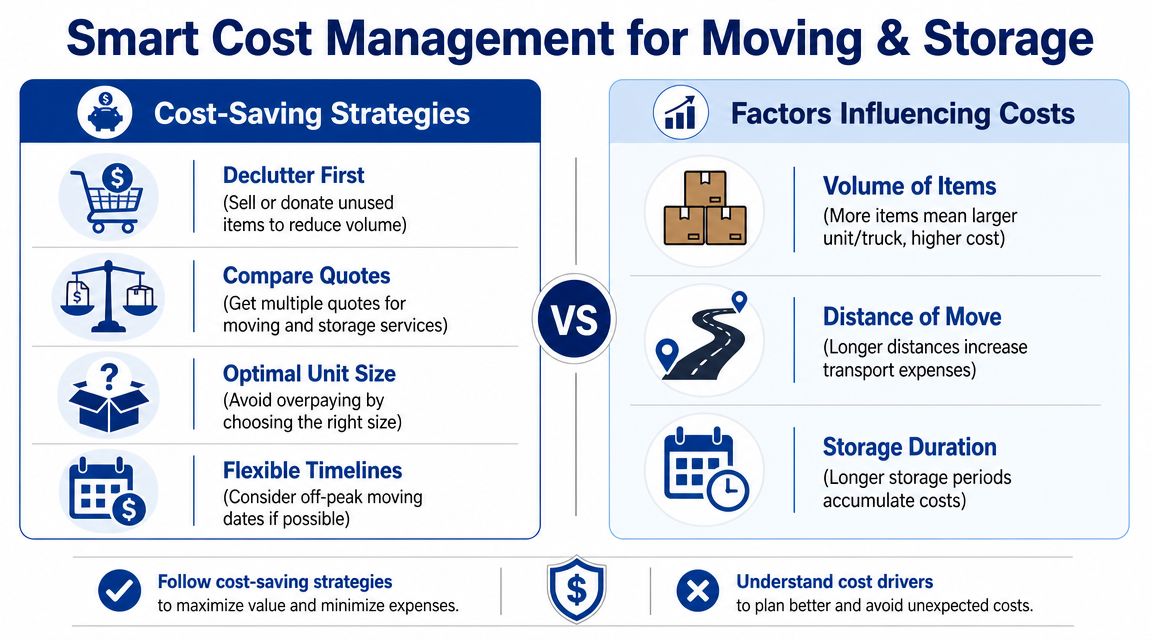
The right question isn't “how do I get the cheapest unit?” It's “does storage save money and hassle in this move, or does it add a layer I could avoid with better scheduling?”
When storage earns its keep
Sometimes a month of storage is the sensible option. It can protect you from rushed decisions, failed timing, or the chaos of trying to cram a staged relocation into one exhausting day.
That matters in a shifting market. Recent analysis shows the self-storage market is shifting. While resilient, it's important to weigh if storage is necessary. We help you compare the cost of a month's storage against the potential cost of a delayed or complex move to determine the most economical path for your situation, based on industry commentary about changing self-storage conditions.
If you're trying to weigh the moving side of that equation, a moving cost calculator guide is a useful way to think through volume, access, distance and labour time.
Where people overspend
The most common cost mistakes aren't dramatic. They're small planning errors that stack up.
| Decision | What goes wrong | Better approach |
|---|---|---|
| Choosing too much space | You pay for unused room | Size the unit to the items actually being stored |
| Storing low-value clutter | You keep paying to hold items you don't want back | Declutter before packing |
| Ignoring access logistics | Delays increase labour and complicate unloading | Check gate times, parking, lifts and route access early |
| Treating storage as indefinite | A short-term plan turns into ongoing monthly spend | Set a review date before move-in |
Cost check: If an item is cheap to replace, awkward to store, and unlikely to be used again, it may not deserve paid storage space.
The balanced way to decide
There's no single rule. For some households, storage avoids double handling at the home and gives time to sort properly after settlement. For others, it makes more sense to consolidate, reduce what's being moved, and go direct.
A good decision usually comes down to four things:
- Your timing certainty
- How much you're storing
- How difficult the property access is
- How soon you'll need the stored items back
If those answers point toward flexibility and staging, storage probably helps. If they point toward a clean direct relocation, keep it simple and skip the extra stop.
Your Move and Store FAQ and Final Checklist
The last part of planning is usually where people have the most practical questions. Not broad ones. Specific ones that affect the day.
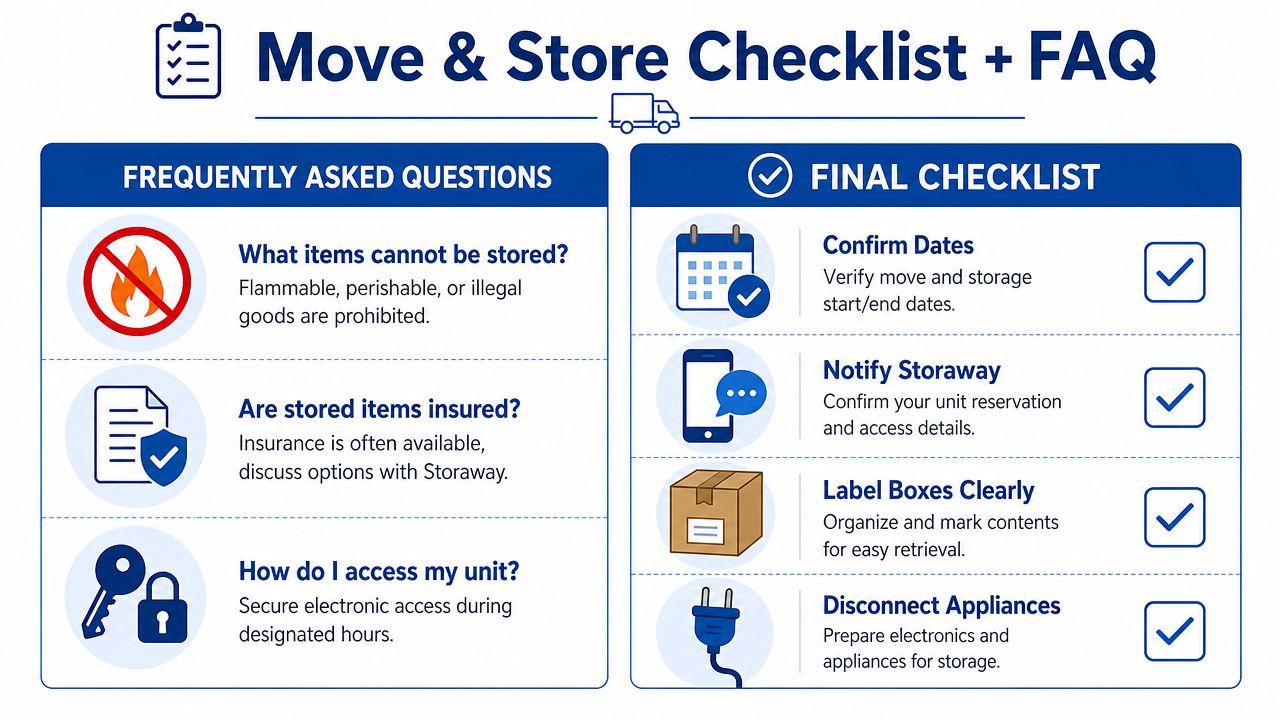
Common questions people ask
Do I need to be there when the unit is unloaded?
Usually, it helps. You can direct what stays accessible and what can go deeper into the unit. If you can't attend, a clear loading plan and access instructions matter even more.
What if my settlement date changes again?
That's one of the most common reasons people use storage in the first place. The key is making sure your unit term, retrieval timing and onward move can be adjusted without everything becoming a rush job.
Should I store everything or only part of the home?
Not always everything. Sometimes it's smarter to store only overflow furniture, seasonal items, business stock, or the pieces that won't suit the next property.
Do stored belongings need insurance?
Protection matters. When discussing stored goods, ask clearly about coverage and make sure your relocation provider also carries full insurance coverage for handling and transit. Those are related, but not identical, protections.
Final checklist before move day
Run through this list before the truck arrives:
- Confirm all dates: Pickup day, storage start date, expected retrieval window, and any revised settlement details.
- Verify access: Check facility hours, gate procedures, apartment lift bookings, loading bay rules, and parking permits if needed.
- Prepare the right items: Separate essentials you'll need immediately from goods going into storage.
- Pack for storage conditions: Use suitable packing materials, label cartons clearly, and protect fragile furniture properly.
- Plan the unit layout: Keep high-use items at the front and leave a walkway if access will be needed.
- Check appliances: Empty, clean and dry fridges, washing machines and other appliances before storage.
The best move-and-store jobs aren't improvised. They're organised early, packed properly, and timed with enough buffer to protect your belongings and your day.
If you're planning a move that may involve temporary storage, Gentle Giant Removals & Relocations can help you map out the logistics clearly. We service the Central Coast, Sydney, Newcastle and surrounding areas, with full insurance coverage, packing support, and the right truck for the access conditions at both ends. For urgent moves, call us on 02 4390 5890. For everything else, get a free moving quote or request a free in-home assessment so we can help you work out whether storage is the right fit for your relocation.