
Planning a move often starts with one practical question. What truck do you need?
If you’re moving from Gosford to Newcastle, downsizing from a family home in Wamberal, or relocating an office from the Central Coast into Sydney, the truck size affects almost everything on the day. It influences loading time, street access, parking, labour, and whether the whole job happens in one clean run or turns into a long day of back-and-forth trips.
For many household relocations, the 12 tonne truck sits in the middle ground that works best. It’s large enough for a substantial home move, but still manageable on suburban streets, apartment loading areas, and the tighter access points we see across the Central Coast, Lake Macquarie, Newcastle, and Sydney. That balance is why it remains such a common choice for real Australian moves.
Your Guide to Choosing the Right Removalist Truck
A lot of people ring up assuming the truck question is simple. Bigger must be better. In practice, that’s not how removals work.
If you book a truck that’s too small, the day can drag out because the crew has to make extra trips or spend too long trying to pack around a lack of space. If you book something too large for the property, you can create access headaches at both ends of the move. Driveways, turning room, overhanging trees, apartment loading bays, and local parking restrictions all matter.
A 12 tonne truck became a staple of removals work in NSW after the 1984 Heavy Vehicle Registration reforms, and by 2023 these trucks were handling 15% of NSW’s domestic moves, with utilisation on intrastate routes rising 28% during the 2020 to 2022 supply chain disruptions because of their flexibility, according to the data provided in this reference from Car and Driver’s illustrated history page. The source itself is unusual for Australian freight data, so the practical takeaway matters more than the headline. The 12-tonner has earned its place because it suits the sort of trips people make every day between the Central Coast, Newcastle and Sydney.
If you’re still sorting out the basics, this guide on how to choose the right removalist is a useful place to start before you lock in dates.
A well-matched truck saves time twice. Once when loading, and again when unloading.
For a typical family move, that’s the key question. Not “what’s the biggest truck available?” but “what gets your belongings from A to B safely, legally, and efficiently?”
What Is a 12 Tonne Truck Really
The name trips people up all the time. A 12 tonne truck doesn’t mean you can load 12 tonnes of furniture into it.
Under National Heavy Vehicle Regulator guidelines in Australia, a 12-tonne truck is classed as a medium rigid vehicle, and for a 2-axle rigid the Gross Vehicle Mass is limited to 12,000 kg. That’s the truck’s maximum legal weight when fully loaded, not the payload alone. These trucks make up about 18% of the national heavy vehicle fleet, which shows how important they are in urban and regional logistics, according to this NHVR-related reference.
GVM in plain English
Visualize a lift in an apartment building. The sign tells you the maximum total weight the lift can carry. That figure includes everyone inside. A truck works the same way.
The full weight includes:
- The truck itself
- Fuel
- Crew
- Equipment such as dollies, straps, blankets and tail lifter
- Your household or office contents
That’s why a 12 tonne truck doesn’t equal 12 tonnes of payload.
What matters more on moving day
For a client, the more useful questions are usually these:
| Term | What it means | Why it matters |
|---|---|---|
| GVM | Maximum total legal weight of the loaded truck | Keeps the vehicle compliant and safe |
| Payload | The weight of your goods the truck can carry after its own weight is counted | Helps determine whether one trip is realistic |
| Cubic metres | The space your belongings take up | Often the clearest way to match truck size to your move |
Volume matters because couches, mattresses, fridges and dining settings take up space long before they become especially heavy. That’s why an experienced removalist looks at both weight and room, not just one or the other.
Practical rule: Most households run out of space before they run out of legal weight.
That’s one reason the 12 tonne truck is such a solid all-rounder for family homes, apartment relocations with decent access, and medium-sized office jobs.
Key Specs of a 12 Tonne Removalist Truck
A proper removalist truck isn’t just a big empty box on wheels. The useful part is how it’s set up to protect your things and let the crew work safely.
A typical Australian 12-tonne removalist truck features a 6×4 drive configuration, a 6-cylinder diesel engine, and ABS/VSC braking systems. The verified data also states these trucks can stop in under 50 metres from 60 km/h when fully loaded, which matters when driving through busy traffic between the Central Coast and Sydney. That information comes from this Raw Hire truck specification sheet.
What those specs mean for your belongings
The 6×4 setup means the truck has better traction and stability than a lighter-duty layout. On paper that sounds technical. On the road, it means steadier handling in wet weather, on sloped driveways, and on uneven access points around coastal homes or storage facilities.
A removals truck also needs the right body and loading equipment. For household work, the most useful setup is a fully enclosed pantech body with a hydraulic tail lifter. That combination protects furniture from weather and lets the crew raise heavy items safely instead of wrestling them up ramps.
Here’s what usually makes a truck suitable for removals work:
- Enclosed body: Keeps out rain, salt air, road grime and wind.
- Tail lifter: Safer for fridges, washing machines, buffets and commercial printers.
- Tie rails and straps: Stops load shift in transit.
- Quilted pads and blankets: Protect timber, whitegoods and polished surfaces.
- Dollies and trolleys: Make long carry distances manageable.
The difference between transport and removals
Anyone can put furniture in a truck. That isn’t the same as a professional relocation.
A good removals load is built in layers. Heavier pieces sit in stable positions. Fragile items are isolated. Mattresses are bagged or protected. Timber furniture is padded before it goes into the body. Appliances are restrained so they don’t creep or tip during braking.
If you’re comparing service levels, this guide on how to choose the right loading services helps explain what a proper loading plan should look like.
The truck matters. The load restraint inside it matters more.
That’s especially true on longer runs to Newcastle, Sydney, or interstate, where vibration and repeated braking can do damage if the load hasn’t been packed correctly.
When a 12 Tonne Truck Is the Perfect Fit
This truck size tends to suit the moves people make most often.
Take a three-bedroom house in Gosford with the usual mix of lounge furniture, beds, whitegoods, outdoor pieces, packed cartons, a garage shelf or two, and the kids’ bikes. In many cases, a 12 tonne truck gives enough room to keep the move to one main trip, which is usually the most efficient outcome for both time and handling.
Homes that suit this truck well
A 12 tonne truck is often the right call when you’re moving:
- A standard family home with full furniture, not just the basics
- A larger apartment with lift access and a proper loading area
- A townhouse where the contents are spread across multiple levels
- A home plus garage items such as tools, outdoor furniture and storage tubs
It also works well for regional runs. A move from Terrigal to Newcastle, or from Doyalson to Sydney, often benefits from getting the main load done in one go rather than splitting the day into multiple smaller runs.
Office and specialised relocations
This size can also suit office moves when the job includes desks, task chairs, shelving, IT equipment, archive cartons and reception furniture. The trick is not just volume. It’s the ability to keep business items separated, labelled and easy to unload in order.
For specialised work, access and handling usually matter more than truck size alone. Aged care relocations, piano work, apartment moves with strict strata rules, and Newcastle heritage buildings all need planning around:
| Move type | Why a 12 tonne truck may work | What can complicate it |
|---|---|---|
| Family house move | Good balance of capacity and road access | Long driveways, steep sites, poor parking |
| Apartment relocation | Can carry a larger load in one run | Lift bookings, loading docks, body corporate windows |
| Office move | Useful for grouped furniture and equipment | Need for staged unloading and minimal downtime |
| Regional relocation | Efficient for Central Coast, Newcastle, Sydney corridors | Site access at either end |
This is also where cost factors come in. Not exact price. Practical cost. If one larger truck completes the move cleanly, that can be better value than using a smaller vehicle that needs repeat trips.
If you’re weighing that up, a moving rates calculator can help you think through time, access, labour and travel rather than fixating on truck size alone.
The best truck is the one that fits your load and your property on the same day.
What doesn’t work? Using a 12 tonne truck for a very small unit move where access is tight and contents are modest. In that case, a smaller truck can be the smarter and more economical choice.
Comparing Removalist Truck Sizes for Your Move
Truck choice is really a balancing act between capacity, access, and efficiency.
A small truck is easier to place in a tight street and can suit a light apartment move. A semi-trailer offers huge room but can be awkward or impossible at many suburban homes. The 12 tonne truck sits in the middle. That’s why it so often becomes the default for family relocations around the Central Coast, Newcastle, Lake Macquarie and Sydney.
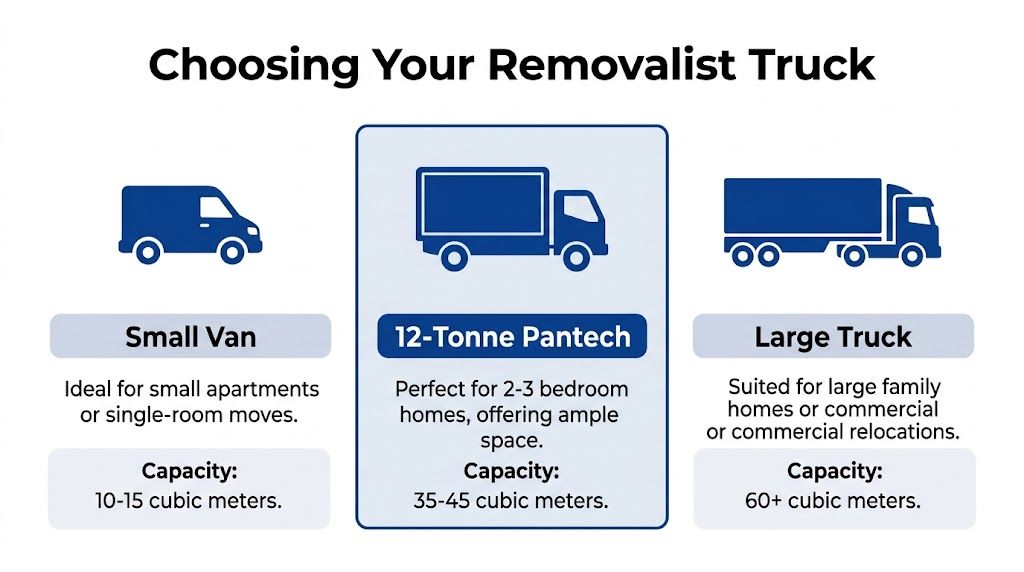
Removalist Truck Size Comparison
| Feature | Small Truck (4.5T GVM) | 12 Tonne Truck (12T GVM) | Large Semi-Trailer |
|---|---|---|---|
| Best suited to | Smaller apartments, partial loads, a few bulky items | Many household moves and medium office relocations | Large interstate loads and major relocations |
| Street access | Best in tight areas | Good in most suburbs with planning | Limited in residential streets |
| Loading efficiency | Lower for full homes | Strong balance of space and practicality | High capacity but site-dependent |
| Apartment suitability | Good where loading space is limited | Good if the building allows truck access | Often unsuitable |
| Regional runs | Can require extra trips | Commonly a practical one-trip option | Better for large linehaul work |
| Parking needs | Lower | Moderate | Higher |
What works and what doesn’t
A small truck works when the inventory is modest and access is poor. It doesn’t work well when a household has more furniture than expected, which happens often.
A semi works when the route and properties can accommodate it. It doesn’t work if the truck can’t legally or safely get near the front door.
The 12 tonne truck usually works because it avoids both problems. It gives enough carrying capacity for a substantial move without creating the same access headaches as a larger articulated vehicle.
That said, no truck solves a bad access plan. If there’s no legal parking, no room to turn, or a building has strict move-in hours, the right answer may be a staged approach with smaller support vehicles or a shuttle arrangement.
Navigating Licence Requirements and Access Challenges
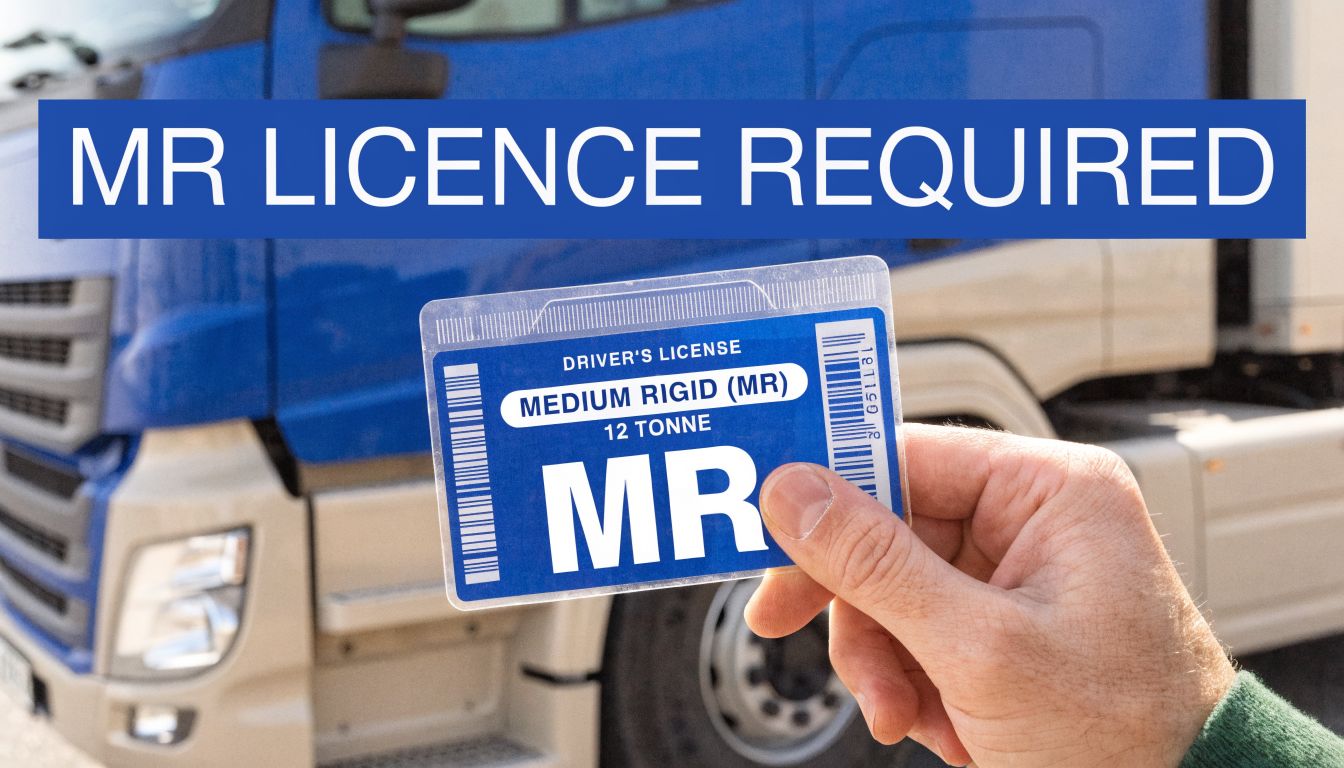
A 12 tonne truck isn't a typical casual weekend rental. In Australia, if you want to drive one yourself, you generally need the right class of heavy vehicle licence. For many, that means using a professional crew isn’t just convenient. It’s the realistic option.
The truck can fit the load and still fail the job
One of the biggest mistakes in move planning is assuming the truck choice is only about how much furniture you own. The second half of the puzzle is access.
Verified data states that 12-tonne trucks are engineered for 25 to 30% gradeability on inclines when fully loaded, and that some models achieve a turning circle of around 14 metres, which helps with tight residential streets and hilly areas from Doyalson North to Newcastle’s coastal rises. That comes from this BharatBenz truck specification reference.
That capability is useful, but it doesn’t mean every property is easy. Steep driveways, soft verges, narrow battle-axe access, low branches, and sharp apartment basement entries still need judgement.
Here are the local issues that come up most often:
- Central Coast coastal suburbs: Steeper sites, tighter driveways, wind exposure, and limited kerb space.
- Newcastle heritage areas: Narrower streets, older access layouts, and stairs.
- Sydney apartments: Lift bookings, loading dock windows, body corporate move rules, and parking permits.
- Lake Macquarie homes: Sloped blocks and longer carry distances from street to front door.
If your move runs between regions, this page on Central Coast to Sydney removalist planning gives a realistic picture of timing and access issues.
Building rules and local logistics
Apartment and strata moves need more than a truck booking. They usually need coordination.
Common requirements include:
| Access issue | Why it matters | What to organise early |
|---|---|---|
| Lift booking | Prevents delays and disputes with other residents | Confirm time slot with building management |
| Loading dock access | Ensures the truck can load close to the building | Reserve dock and confirm vehicle limits |
| Council parking | Protects legal kerb access on moving day | Apply early where required |
| Shared areas | Reduces damage risk in foyers and corridors | Use protection and follow building rules |
A short video can help if you’re trying to picture how this works in practice.
Access problems don’t usually start on the truck. They start in the driveway, the loading bay, or the strata office.
That’s why the best moves are planned from the property outward, not from the truck inward.
Hiring a 12 Tonne Truck What to Look For
When you hire a removalist with a 12 tonne truck, you’re not buying empty space in a vehicle. You’re trusting a team to handle your furniture, timing, access issues, and the dozens of small decisions that decide whether the day runs properly.
Reliability beats promises
The first thing to look for is whether the company runs a modern, maintained fleet. Clients often focus on the visible part of the quote, but fleet operators also deal with maintenance, compliance and long-term operating costs. Verified guidance from McKinsey notes that heavy truck emissions standards are tightening in overseas markets and may influence Australian policy over time, which is one reason a modern, compliant fleet matters for reliability and reduced operational risk, as outlined in this analysis of the road to zero-emission trucks.
An older truck can still look fine from the outside. That doesn’t tell you much about downtime risk.
Questions worth asking before you book
Ask practical questions, not sales questions.
- Insurance: Do they carry full insurance coverage, and what protection applies in transit?
- Fleet ownership: Do they own and maintain their trucks, or is the vehicle outsourced?
- Packing options: Can they supply packing materials and offer a full packing service if your schedule is tight?
- Access planning: Will they ask about stairs, lifts, narrow streets, permits, and body corporate rules?
- Communication: Will you know who is turning up and when?
For people comparing operators, it’s also worth understanding how vehicle tracking supports punctuality and route coordination. This New Zealand Vehicle GPS Tracker Guide gives a simple overview of how fleet tracking works and why it matters when timing, safety and visibility count.
Price matters. But a cheap booking that arrives late, sends the wrong truck, or lacks proper protection costs more in the end.
A good removalist should also speak plainly about what won’t work. If your apartment loading bay is too tight, they should say so. If the street in Sydney needs permit parking, they should raise it early. If your Newcastle unit has three flights of stairs and no lift, that should be part of the discussion from the start.
Frequently Asked Questions About 12 Tonne Truck Moves
A few questions come up again and again with this truck size. The answers below are the ones that tend to matter most on real moving days.
FAQ
| Question | Answer |
|---|---|
| Is a 12 tonne truck too big for a suburban street? | Not necessarily. It suits many suburban moves well, but access still depends on turning room, parked cars, driveways, low branches, and local parking conditions. |
| Can a 12 tonne truck handle an apartment move? | Yes, often. The key issues are usually lift bookings, loading dock access, body corporate rules, and whether the truck can park legally and close enough to the building. |
| Should I pack myself or use a packing service? | That depends on your time, budget and the type of items involved. DIY packing can work well for books, linen and non-fragile items. Fragile kitchenware, artwork, antiques and office equipment are usually safer with professional packing and proper packing materials. |
| Are my belongings protected in the truck? | They should be if the truck is properly equipped and the crew uses quilted pads, tie rails, straps and careful load restraint. Full insurance coverage also matters when discussing protection. |
| What about bad weather on the Central Coast or in Newcastle? | A fully enclosed removals truck helps protect contents from rain, wind and road grime. Wet conditions can still slow access, especially on sloped driveways or long outdoor carries, so good preparation helps. |
| How far ahead should I organise permits or strata approval? | As early as you can. Building managers, loading docks and councils all work to their own timing, especially during holiday periods and busy end-of-month dates. |
| Can a 12 tonne truck carry very heavy single items? | Often yes, but the handling method matters as much as the truck size. Pianos, safes, stone tops and commercial equipment may need special gear, extra crew, or a separate plan. |
If you’ve got a question that isn’t covered above, the quickest next step is to check the full moving FAQ page and then speak to a real person about your property, your access, and your inventory.
If you’d like practical advice on whether a 12 tonne truck is right for your move, Gentle Giant Removals & Relocations can help with a free moving quote or a free in-home assessment. For urgent moves across the Central Coast, Sydney, Newcastle or Lake Macquarie, give the team a call and talk through your access, timing, packing and truck options before moving day locks you into the wrong setup.