
You're probably reading this because you've seen the word backloading on a quote form, or a removalist has mentioned it as the cheaper interstate option, and you want to know what it means in real life. Fair question. Backloading can be a smart way to handle an interstate move from the Central Coast, Sydney, Newcastle or Lake Macquarie, but it isn't the right fit for every job.
The simple version is this. Backloading interstate removals works well when your timing is flexible and your load suits shared truck space. It can be less suitable when you've got a strict settlement day, tricky apartment access, or a large family home that needs precise handling from start to finish.
If you're weighing up options for a move from Gosford to Melbourne, Newcastle to Brisbane, or Sydney to Adelaide, it helps to understand where the savings come from, what the trade-offs look like, and how to prepare properly.
What Exactly Is Backloading The Simple Explanation
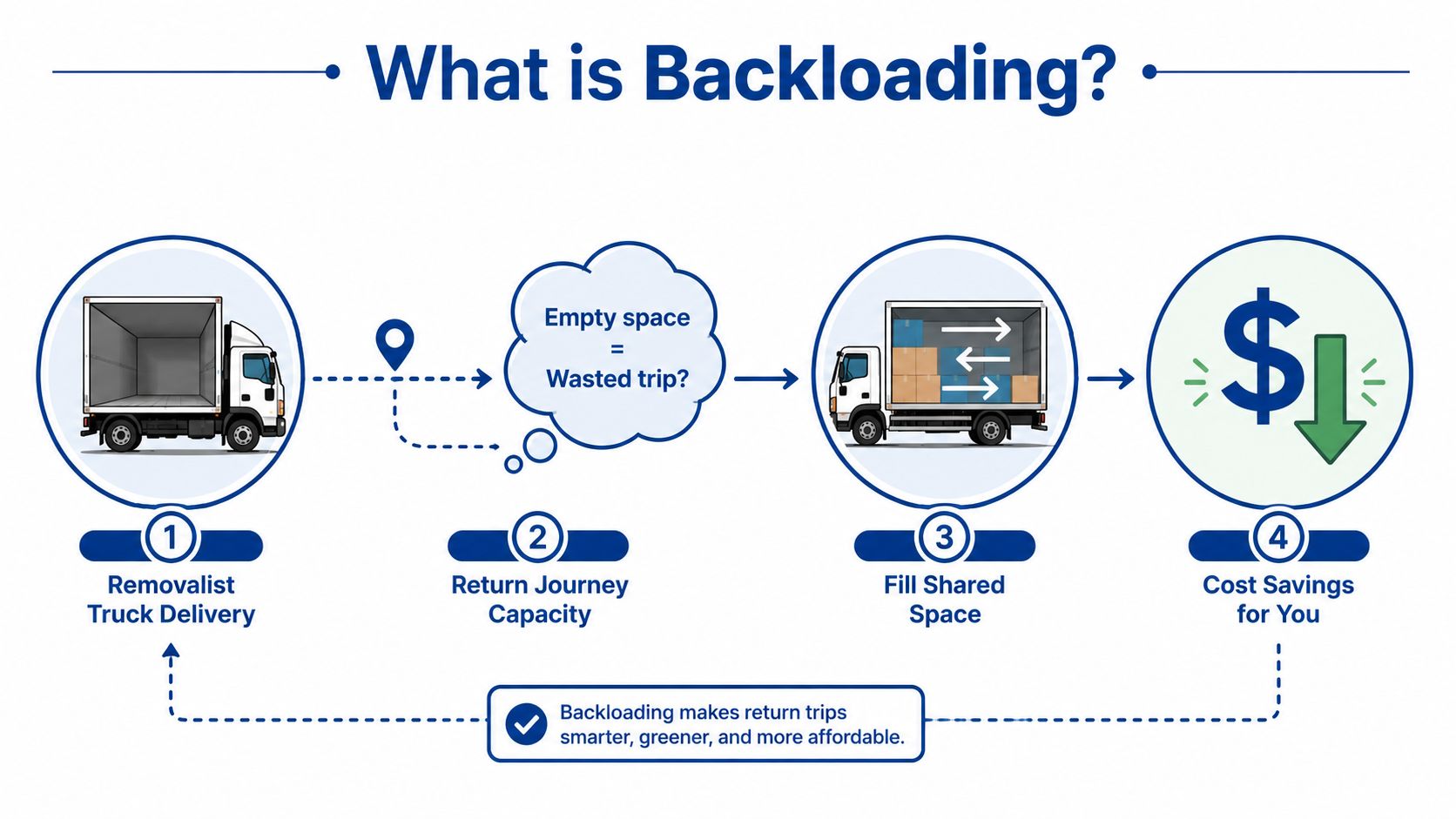
Backloading means using spare space on a truck that is already travelling along your route.
The easiest way to think about it is this. A truck delivers one client's goods from Sydney to Brisbane. On the way back, or on the next leg of its planned route, there's unused space in the truck. Rather than sending that space empty, the removalist books another customer's items into it.
That's why backloading interstate removals can cost less than hiring a whole truck for yourself. You're not paying for full-vehicle hire. You're paying for the cubic metres, which is the amount of space your belongings take up in the truck.
What cubic metres means in plain English
If you've never moved interstate before, cubic metres can sound technical. It's not. It's just a way of measuring volume.
A sofa, washing machine, dining table and packed cartons all take up a certain amount of room inside the truck. The more room your belongings need, the more space you book. For partial loads, that's often much better value than paying for a truck you don't fully use.
Australian removalist guidance explains that interstate backloading is efficient because linehaul trucks often return with unused capacity, and customers pay for the cubic space consumed rather than full-vehicle hire. The provider is matching separate freight loads to a planned interstate route, which is why the model works so well operationally for shared moves (Upmove on backloading removals).
Practical rule: Backloading isn't a lesser service. It's a logistics model. The truck is still doing a proper interstate run. The difference is that you're sharing space instead of booking the whole vehicle.
Why people choose it
Backloading is often considered because it helps keep interstate moving costs under control. That makes sense, especially if you're moving a smaller home, a unit, a retirement relocation, or a partial household load.
It also suits plenty of common NSW routes. A truck heading from the Central Coast to Melbourne, or from Sydney to Brisbane, may already be running that corridor. If your dates can line up with that schedule, you may be able to use the available capacity without paying for a dedicated truck.
There's one important thing to keep in mind. Lower cost usually comes from flexibility. If you need the truck at an exact hour on an exact date, backloading may stop being the best-value option.
How Backloading Interstate Removals Work in Practice
A lot of people assume a shared truck must mean a loose or improvised process. In a well-run move, it's the opposite. Backloading only works when planning, labelling, inventory control and communication are tight.
For Australian interstate removals, the model is structurally important because it matches jobs to trucks already on the road, with removalists offering coverage across all states and territories. It's shaped by route density and truck utilisation, which is why it suits major metro corridors where customers can be a bit more flexible on timing (Airtasker's Australian backloading guide).
Take a common example. You're moving from a two-bedroom apartment in Gosford to a house outside Melbourne. You've got standard household furniture, boxed kitchenware, bedroom furniture, and a few fragile pieces. You'd like to save money, but you still want the move handled properly.
What the booking process usually looks like
The first step is the quote. A good removalist will ask about the volume of goods, access at both properties, and your date range rather than just your ideal day. That date range matters because the load has to fit an existing route.
Then comes the inventory. For backloading, this is especially important. Every item needs to be accounted for clearly so the crew knows how much truck space is required, what needs special protection, and how to separate your goods from other consignments.
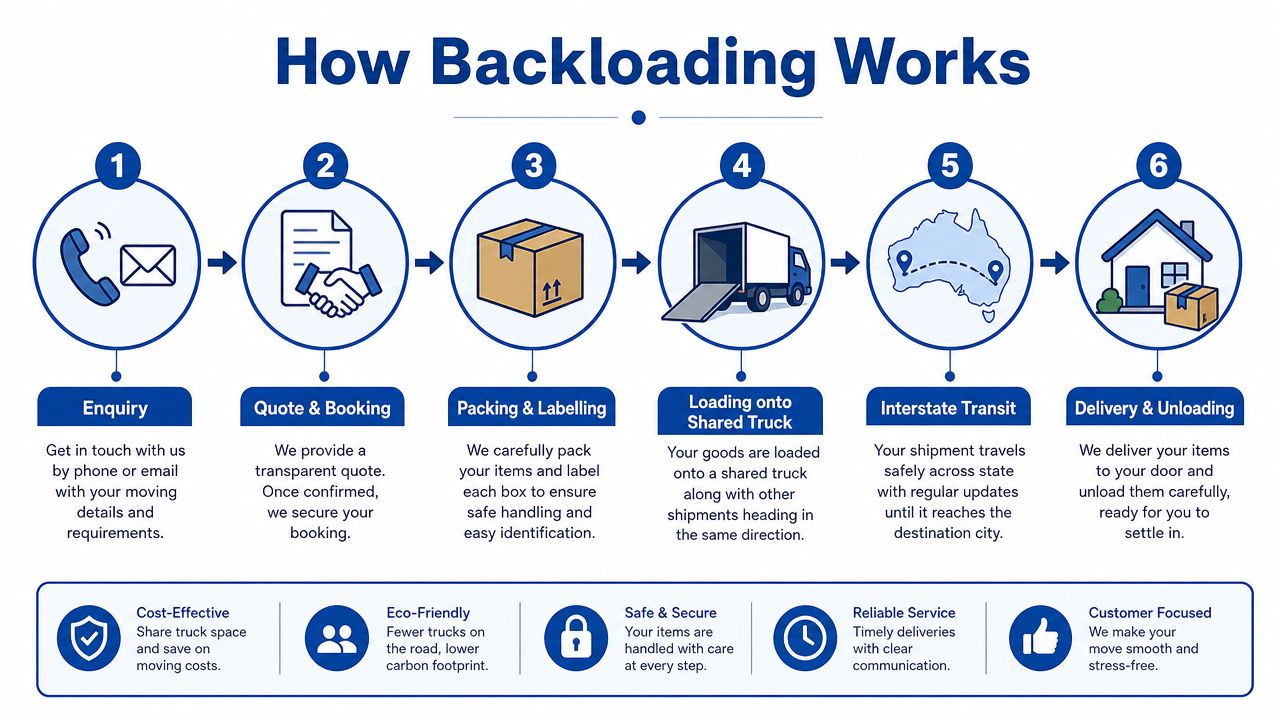
A straightforward process often looks like this:
Enquiry and route check
The removalist checks whether there's space available on the relevant interstate run.Volume assessment
Your goods are estimated in cubic metres, which helps determine both truck space and handling requirements.Access review
Apartment lifts, stair access, narrow driveways, body corporate rules, parking permits and loading zones all get flagged early.Packing and labelling
Goods are prepared so they can be loaded safely alongside other jobs.Shared linehaul transport
The truck follows its interstate route with multiple consignments organised inside it.Delivery window coordination
Delivery is scheduled around the route rather than around a dedicated one-client truck.
Later in your planning, it can also help to look at route-specific advice such as this guide to Sydney to Brisbane removalists and interstate planning.
Here's a useful visual overview of the process:
How shared loads stay organised
The key is separation and identification. Furniture is wrapped, cartons are labelled, and fragile pieces are noted clearly on the inventory. In apartment moves from places like Newcastle's heritage buildings or Sydney complexes with booked lift windows, timing and access notes need to travel with the job details from the start.
Shared truck space only works when the paperwork is just as organised as the loading plan.
When that's done properly, backloading feels much less like “sharing a truck” and much more like a planned interstate service with a wider delivery window.
Is Backloading Right for Your Interstate Move
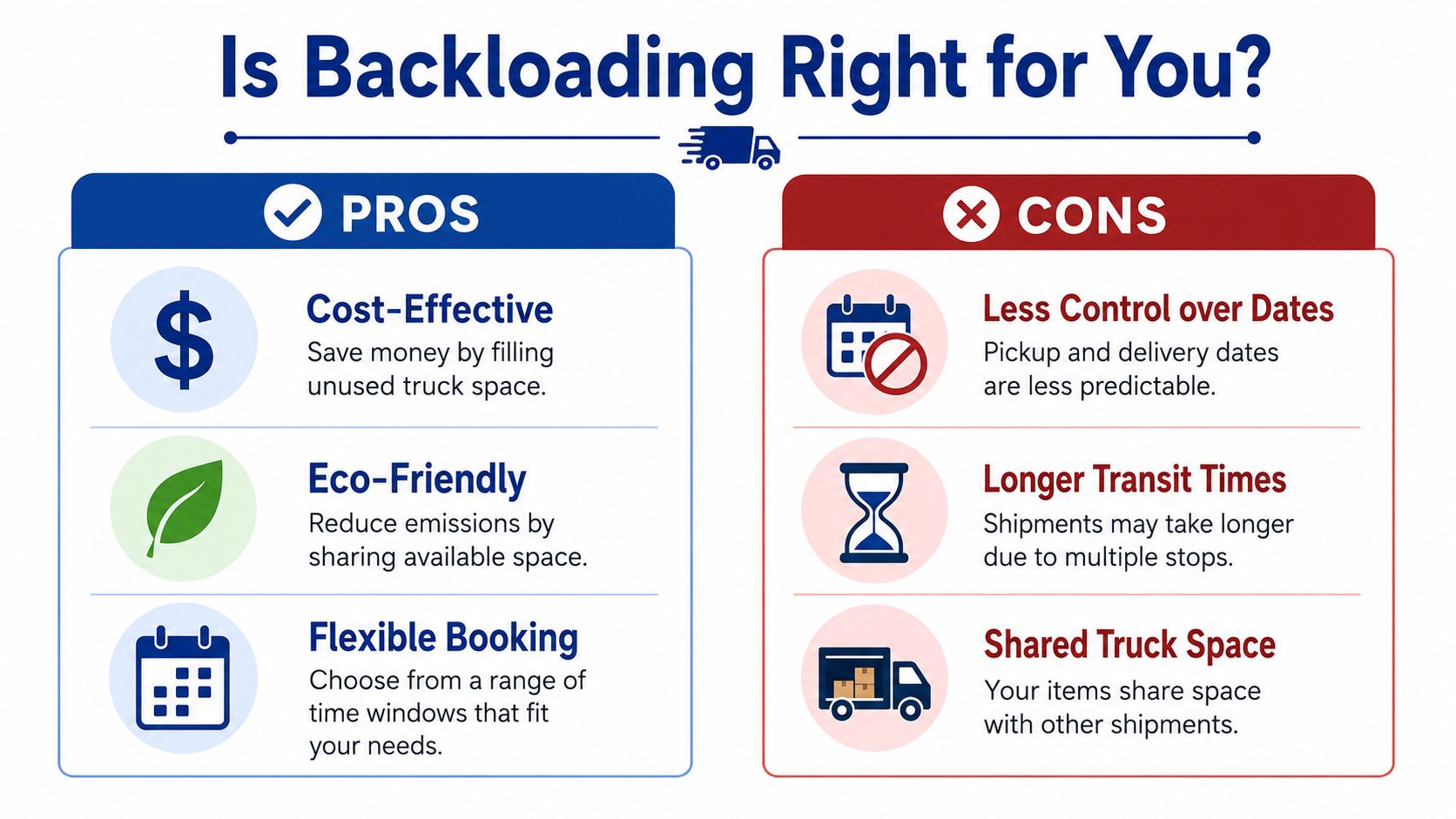
This is the part that matters most. Backloading is often marketed as the cheapest interstate option, but the cheapest option and the best option aren't always the same thing.
The main trade-off is schedule reliability versus cost. Australian guidance on cheap interstate backloads makes the point clearly. Savings often depend on flexibility, and if you must move on a fixed settlement day, the price advantage can shrink or disappear once storage or rescheduling enters the picture. The same guidance notes that backloading is most efficient for compact, non-urgent loads, and less compelling when the move needs precise timing or broader support (Bernard Movers on interstate backload removalists).
When backloading usually makes sense
If your move has a bit of breathing room, backloading can be a very sensible choice.
A good fit often looks like this:
You have flexible dates
You can work within a pickup or delivery window rather than needing one fixed hour.Your load is compact
A unit, small house, partial household, student relocation, retirement move, or selected furniture load often suits shared space well.Your goods are standard household items
Items that pack neatly and don't need unusual handling are easier to combine on a shared interstate run.You're focused on value
You want professional transport without paying for a truck capacity you don't need.
If you're trying to budget properly before choosing between backloading and a dedicated truck, a practical next step is using a moving cost estimator for removal planning.
When a dedicated interstate move may be the better call
There are jobs where a dedicated service gives better overall value, even if the quote is higher at first glance.
A dedicated truck is often the stronger option when:
| Situation | Why backloading can be harder |
|---|---|
| Fixed settlement day | The shared route may not match your deadline closely enough |
| Sydney CBD apartment | Lift bookings, loading dock times and strata rules often need tight timing |
| Large family home on the Central Coast | Bigger loads can fill a significant portion of truck space and need more controlled sequencing |
| Mixed home and office relocation | Inventory control is more complex and timing usually matters more |
| Fragile or high-value items | You may want more direct handling and fewer coordination points |
Real-world examples from NSW routes
A one-bedroom apartment moving from Woy Woy to Brisbane with flexible dates is often well suited to backloading. A family moving a full four-bedroom home from Terrigal to Adelaide on a firm handover day usually needs to think harder about whether the savings outweigh the scheduling limits.
The same goes for apartment jobs in Sydney. If your building only allows moves during a narrow weekday slot, or you need a loading dock booking confirmed with management, shared timing can become awkward quickly. In that case, a dedicated service may be more reliable and less stressful overall.
“Cheap” only works if the move still lands when you need it to.
The honest answer is that backloading works best for the right job, not every job. If your move is flexible, moderate in size and straightforward on access, it can be a smart option. If your move is tightly timed, access-heavy or highly detailed, it may not be.
Key Factors That Influence Cost and Timing
Backloading quotes vary because no two interstate moves are set up the same way. The biggest drivers are the amount of space you need, the route involved, and how easy it is to get your belongings safely in and out at each end.
The main variables removalists look at
Volume comes first. If your load takes up more cubic metres, it uses more of the shared truck. That affects both price and route planning.
Distance matters too. A Central Coast to Sydney relocation is one thing. A Central Coast to Adelaide or Newcastle to Melbourne run involves more linehaul planning, more handling stages, and a wider delivery window.
Access can change everything. A ground-floor house in Lake Macquarie with driveway parking is usually simpler than a top-floor walk-up apartment in Newcastle, or a Sydney unit with lift bookings, loading dock rules and limited kerbside space.
Local conditions that affect scheduling
In practice, NSW moves often run into issues that people don't allow for early enough:
Strata requirements
Some buildings need advance notice, lift protection, booked service lifts, and certificates of currency before move day.Parking constraints
Busy Sydney streets and some Newcastle pockets may require loading plans or permits, especially where truck access is tight.Coastal access and weather
Central Coast coastal areas can bring narrow streets, steep driveways and wet-weather handling issues.Holiday peaks
School holidays, public holiday periods and end-of-year demand can make route availability tighter.
A lot of customers also compare backloading against full-service quotes while researching the cost of removalists from Sydney and surrounding routes. That's useful, because it helps you judge value in context rather than chasing the lowest headline figure.
The quote isn't just about kilometres. It's about truck space, access time, labour, risk, and how tightly the route has to be coordinated.
If you want a smoother move, be upfront about stairs, lifts, narrow streets, difficult driveways, oversized furniture, and any body corporate rules. Surprises on move day usually cost more than honest planning at quote stage.
Packing and Preparing for a Shared Truck Journey
Packing matters on every move. On a shared interstate truck, it matters even more.
Your goods need to travel safely, stay clearly identifiable, and be easy to handle without confusion. That means stronger packing, clearer labelling, and a better inventory than many people use for a local move.
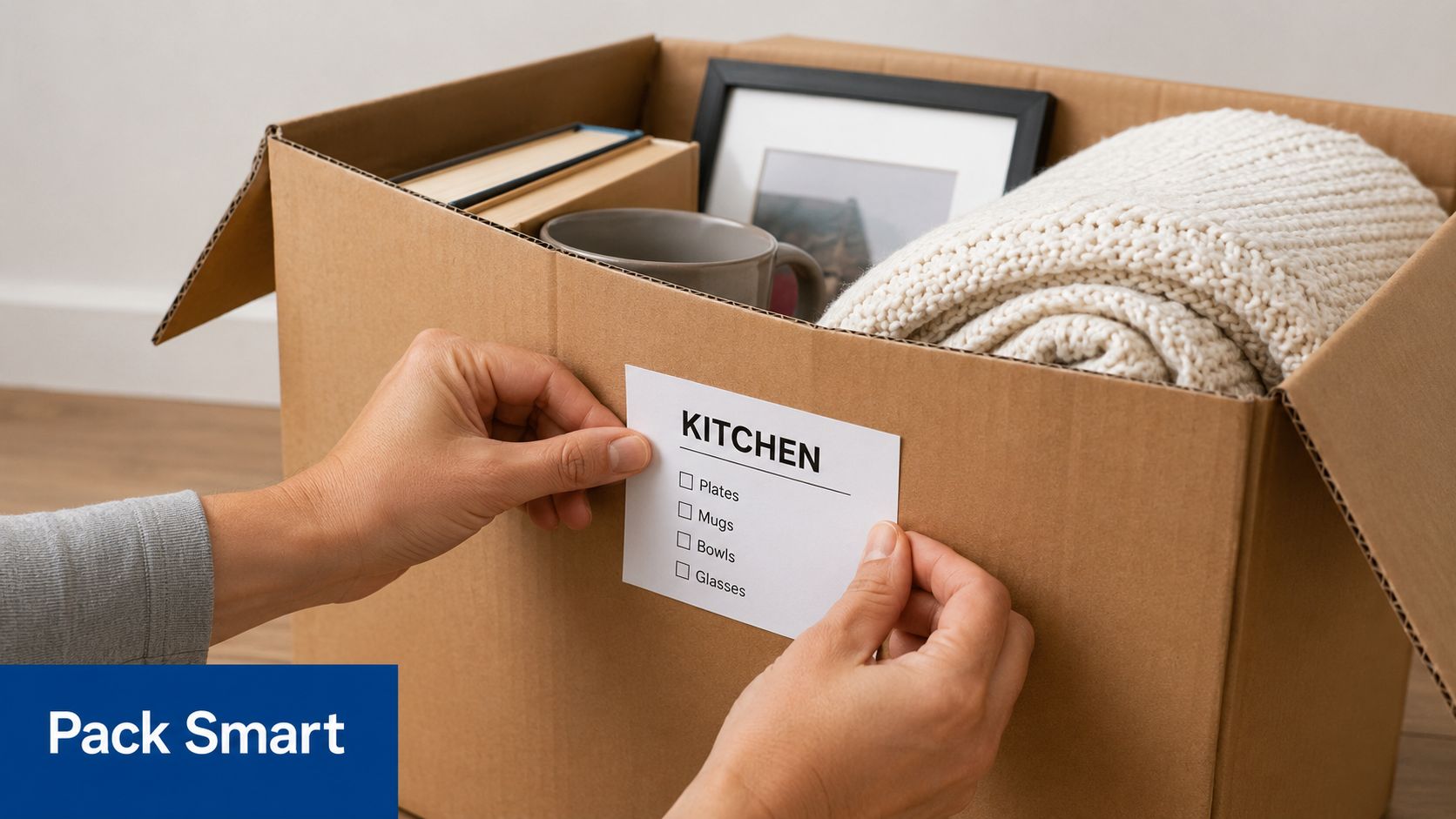
What good preparation looks like
Start with an inventory. Not a rough mental list. A proper written record of what's going, what's fragile, and what needs special handling.
Then label every carton clearly with your name, destination suburb, and the room it belongs in. “Kitchen” is better than nothing. “Smith family, kitchen, Gosford to Geelong” is far better on a shared load.
If you're sourcing your own packing materials, it helps to look at structured sets of moving boxes in house so you can judge what a complete room-by-room packing setup looks like.
DIY packing versus professional packing
DIY packing can work well if you're organised and you've got time to do it properly. Use durable cartons, wrapping paper, tape that won't fail in transit, mattress protectors, and furniture blankets where needed. Don't leave empty space in cartons, and don't overpack heavy items into oversized boxes.
Professional packing is usually the better choice when you have fragile items, limited time, or a more complex interstate move. It also helps when you want the load packed to a consistent standard before it goes into shared truck space.
A few practical packing rules make a big difference:
Heavy items low and small
Books, tools and pantry items belong in smaller cartons so they stay safe to lift.Fragile items individually wrapped
Glassware, artwork and ceramics need padding, separation and clear labels.Furniture prepped for transit
Drawers may need emptying, loose parts bagged and taped, and delicate surfaces protected with proper covers.Essentials kept separate
Medications, chargers, documents, keys, and a few days of clothing should travel with you, not in the truck.
You can also save time by checking practical options for free moving boxes and packing materials before buying everything from scratch.
Protection and insurance
Full insurance coverage matters. Ask exactly what cover applies in transit, what exclusions exist, and whether owner-packed cartons are treated differently from professionally packed items.
For apartment and strata moves, protect shared areas too. Lift walls, entry doors, hallway corners and common floors all need careful handling. Good preparation doesn't just protect your belongings. It protects the property you're leaving and the one you're moving into.
If a box can't survive being stacked, lifted and transported interstate, it isn't packed yet.
Booking Your Backload with Gentle Giant Removals
If backloading sounds like the right fit, the best next step is to get a proper assessment rather than guessing from a rough online form. Interstate moves work better when the route, volume, access and timing are looked at together.
For customers moving from the Central Coast, Sydney, Newcastle or Lake Macquarie, that usually means checking a few basics early. What are your preferred dates, and how flexible are they really. Are you moving from a house, unit, townhouse or office. Are there stairs, lifts, loading dock rules, steep driveways, or parking limits that need planning before the truck arrives.
A reliable backload booking should also cover the practical details people often miss. Lift bookings in strata buildings. Body corporate notice periods. Parking permits in busy metro streets. Protection for fragile furniture. Whether you need professional packing, storage coordination, vacate cleaning, or help with unpacking at the other end.
For urgent moves or early planning, it's worth requesting a proper interstate removal quote online so the job can be matched to the right route and truck capacity. The more accurate the information, the more accurate the advice.
Good backloading isn't about squeezing your goods into any spare gap. It's about matching the right move to the right run, with clear communication and careful handling from pickup to delivery. That's what keeps a lower-cost interstate move practical, safe and dependable.
If you're planning an interstate relocation and want honest advice on whether backloading is the right option, Gentle Giant Removals & Relocations can help. We handle moves across the Central Coast, Sydney, Newcastle and beyond with careful planning, strong communication, and full insurance coverage. Get a free moving quote, request a free in-home assessment, or call our team for urgent moves and time-sensitive bookings.