

Planning a move from the Central Coast to Newcastle often starts the same way. You look around the house, realise how much you own, and think, “I’ll save money if I can get free cardboard boxes.” That thinking is reasonable.
Free boxes can work. We see plenty of clients use them successfully for parts of a relocation, especially for lighter, non-fragile items. But in NSW, the situation is more complicated than many online guides make it sound. Box strength varies, hygiene matters, and some places you might assume are fair game are not legal collection points at all.
That matters even more on a run from suburbs like Terrigal, Gosford or Erina up to Newcastle, where boxes need to hold their shape in the truck, stack properly, and cope with handling through driveways, stairs, lifts, apartment corridors and loading zones. If your packing materials fail, the savings disappear quickly.
Your Guide to Finding Free Cardboard Boxes
A lot of people begin with the obvious places. They ask local supermarkets, check bottle shops, and scroll community listings late at night hoping someone in Lake Haven, Charlestown or Hornsby has just unpacked and wants the cartons gone. That approach can work, and it often does for basic household packing.
The catch is that not every “free” box is suitable for a relocation. Some have already done hard service. Others have sat in damp stockrooms, carried produce, or absorbed smells and residue you do not want near kitchenware, linen or children’s items. Before you collect anything, it helps to know what counts as useful and what is false economy.
If you want a baseline for what proper moving cartons should look like, compare what you find against purpose-made moving boxes. Even if you still choose second-hand cartons, that comparison helps you spot weak seams, poor sizing and inconsistent board quality before packing day.
Practical rule: If a box makes you hesitate before putting your crockery or books into it, leave it behind.
One more local point matters early. NSW rules around waste and recycling sites are stricter than many overseas articles suggest. Depot scavenging is not the easy shortcut people think it is, and for many households it becomes the first mistake of the move.
Where to Source Boxes on the Central Coast, in Newcastle and Sydney
The best free cardboard boxes usually come from businesses that receive steady stock deliveries and are willing to put cartons aside if you ask politely. On the Central Coast, that can mean a supermarket in Erina, a bottle shop in Terrigal, or a retailer with regular unpacking schedules. In Newcastle, think along the same lines in places like The Junction or Kotara. In Sydney, the same method applies, but timing matters more because staff are often busier and storage space is tighter.
For most households, the easiest wins come from three places:
- Supermarkets and grocery retailers: Good for sturdy produce cartons and general stock boxes, but inspect carefully.
- Bottle shops: Often useful for heavier board and compact box sizes that suit glassware and pantry items.
- Online listings: Facebook Marketplace and Gumtree regularly have “free moving boxes” posts from people who have just finished a relocation.
If you are planning a DIY pack, it also helps to read local advice from experienced Central Coast removalists so you can match your packing choices to access conditions, building rules and travel distance.
Ask at the right time
Morning is usually better than late afternoon. Staff have often unpacked deliveries, and you are more likely to catch a manager before the day gets away from them. Ask when stock is broken down and whether they can hold cartons for collection.
Keep the request simple. You are more likely to get a helpful answer if you make it easy for the store.
A useful approach is:
- Call first: Confirm whether they keep cartons aside at all.
- Ask about collection timing: Some stores flatten boxes immediately.
- Check box type: Produce cartons may be strong, but they are not always clean or dry.
- Collect promptly: If staff save cartons for you, do not leave them sitting there all day.
Know what to avoid
Not every free source is worth your time. Boxes that have held chilled produce, leaking items or cleaning products are poor candidates for household packing. The same goes for heavily crushed cartons or anything with soft corners.
There is also one source you should rule out in NSW. Do not remove cardboard from council transfer stations or recycling depots. Councils such as Central Coast Council can issue fines of $500 or more for removing materials from waste transfer stations under the Waste Avoidance Act, as noted in this guidance on finding free moving boxes in NSW. Beyond the legal risk, those rules exist because councils are trying to control contamination and misuse.
That point gets missed in a lot of US-based moving advice. Locally, it is not a clever shortcut. It is a poor one.
What a usable box looks like
When you are standing in a car park or stockroom sorting through a pile of cartons, do not overcomplicate it. You are looking for structure.
A better candidate will usually have:
- Rigid walls: The sides should stand upright without sagging.
- Clean seams: Glued or taped joins should still be intact.
- Square shape: Twisted or distorted cartons do not stack well in a truck.
- Dry board: Any sign of moisture weakens cardboard fast.
The more uniform your box sizes, the easier your relocation becomes. Mixed shapes create awkward gaps, unstable stacks and slower loading, especially when we are working around steep driveways, apartment lifts or limited kerb access in Newcastle and Sydney suburbs.
Local packing reality: A box that is “fine for storage in the garage” may not be fine for a relocation up the M1.
How to Inspect Every Box for Safety and Strength
Sourcing boxes is the easy part. Inspection is where you prevent trouble.
A used carton can look acceptable at first glance and still fail once it is loaded, stacked and carried through a home. We treat second-hand boxes the same way we treat access on moving day. Never assume. Check properly.
Start with hygiene before strength
Contamination is an issue often underestimated. A University of Sydney study found that 68% of recycled cardboard from retail sources tested positive for E. coli or chemical contaminants, which is a serious consideration if you are packing kitchenware, clothing or children’s belongings, as cited in this article on where to get moving boxes for free without wasting time.
That does not mean every used box is unusable. It means you need to separate clean household packing from risky cartons.
Do not use free cardboard boxes for these items unless the carton is clearly clean and odour-free:
- Kitchenware and pantry storage
- Baby items
- Linen and towels
- Clothing you do not want to rewash after the move
If the inside smells sour, musty, chemical or stale, it is out. If there are stains, insect signs, sticky patches or powdery residue, it is out.
Check the board and corners
A safe carton should feel firm when you press the side panels. If the walls flex too easily, it will not hold a stack well. Pay close attention to the bottom corners and any old fold lines. These are the points that usually let go first.
The basic inspection process is straightforward:
- Open the box fully so you can see all internal faces.
- Look for dark marks or water tide lines that suggest past moisture exposure.
- Run your hand along the seams to find splits, soft sections or lifting tape.
- Press the side walls and top edges to check whether the box still resists pressure.
- Inspect the base flaps because old crush damage often hides there.
If a carton has already been overfilled once, the shape often tells you. Bulging sides, stretched tape lines and rounded edges are common signs.
Use strength checks that reflect a real move
Good inspection is not theoretical. Think about what the box will do.
A box packed in Gosford has to be lifted out of a bedroom, turned through a hallway, carried down steps or into a lift, loaded into a truck, stacked with other items, then unloaded in Newcastle and carried into another property. If it is heading into a heritage apartment, a townhouse with stairs, or a unit with tight access, the handling is even less forgiving.
The practical checks we recommend are based on how a carton behaves, not just how it looks. Compare your box against basic moving-grade standards:
| Check | What to do | Why it matters |
|---|---|---|
| Edge condition | Squeeze the top edges and corners | Soft edges crush first in a stack |
| Base integrity | Fold the bottom closed and hold it by the sides | Loose flaps often signal a weak base |
| Shape retention | Set it upright empty | Leaning walls suggest prior damage |
| Surface condition | Check for moisture, mould or residue | Contamination and weakness often come together |
For stronger reusable cartons, trade guidance also points to details such as corrugated board quality and inspection before reuse. If you want a broader overview of what supports a safe pack, this guide to essential packing materials for a damage-free move is a useful reference alongside your box checks.
Use your nose as well as your eyes. Smell often reveals damp storage, food residue or chemical exposure before visible damage does.
Match the box to the item
Many DIY packers go off course by not matching the box to the item. People find a sturdy-looking carton and then use it for everything.
Free cardboard boxes are better for some categories than others. Books, shoes, folded linen and light décor are usually safer candidates than glassware, framed items or electronics. If a box has any doubt around cleanliness or compression strength, keep it for low-risk items only.
For Newcastle apartment relocations, this matters even more because cartons may sit in common areas during lift bookings or wait briefly in loading zones. You want boxes that stay square and closed, not cartons that start opening at the base while everyone is working around strata rules and time limits.
Preparing and Reinforcing Your Boxes Like a Professional
A used carton should never go straight from the back seat of your car into active packing. Preparation is what turns a maybe into a usable packing material.
Start with cleanliness. If the box passed inspection but you still have minor concerns about dust or general retail handling, wipe the inside lightly with a cloth and a suitable disinfectant solution, then let it air dry completely. Completely dry matters. Damp cardboard is weak cardboard.
Tape the base properly
Most failures start at the bottom seam. One strip of cheap tape down the centre is not enough.
For structural integrity, we recommend at least three strips of 50mm PVC packing tape across the bottom seams, and boxes should only be loaded to 60% of their volume capacity, with a 15 to 20kg maximum to reduce crushing and shifting on NSW roads, as outlined in this guidance on the risks of using free moving boxes.
That advice is simple because it works.
- Three strips across the base: This supports the main seam.
- Tape the side joins of the base as well: It stops the flaps from spreading under load.
- Do not overfill to the top: Empty space can be cushioned. Overweight cartons cannot be made safe after the fact.
If you want a fuller packing workflow, this article on how to pack for a move covers the wider process around wrapping, weight distribution and room-by-room preparation.
Free versus fit for purpose
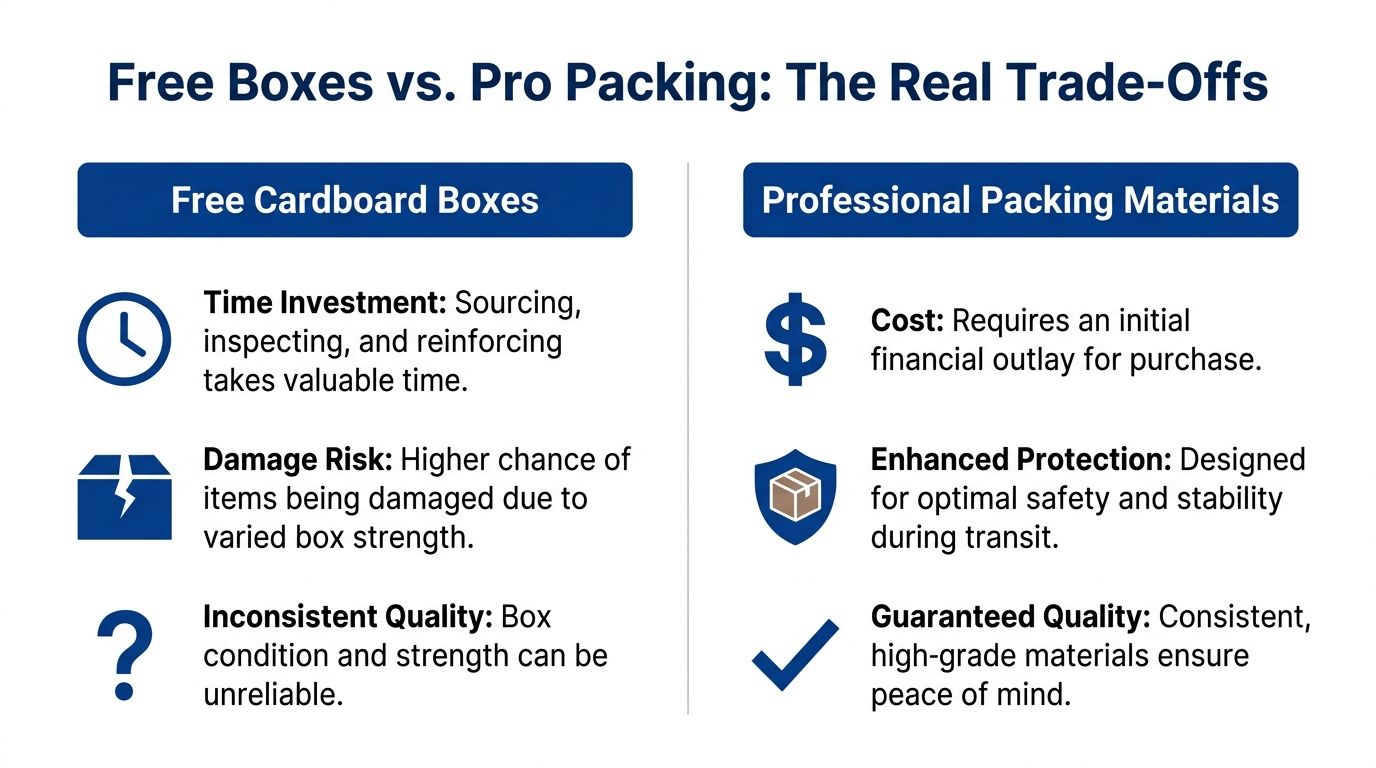
Here, the trade-off becomes practical. Free boxes reduce upfront spend, but they demand labour. You have to collect them, reject the bad ones, clean the acceptable ones and reinforce nearly all of them before use.
Professional packing materials remove much of that uncertainty. They arrive clean, uniform and ready to stack. That is not just about protecting items. It also helps with safe lifting, truck loading and unloading efficiency when access is tight or the weather turns.
A useful way to decide is to split your packing into two groups.
| Use free cartons for | Use professional materials for |
|---|---|
| Linen | Crockery |
| Toys | Glassware |
| Light pantry items | Artwork |
| Soft goods | Electronics |
| Shoes | Anything sentimental or high value |
If a failed carton would leave you upset, delayed or uninsured, do not put that item in a questionable box.
For some households, the best answer is mixed packing. Use second-hand cartons for low-risk contents, and use proper moving cartons, porta robes and protective packing materials for the items that need reliability.
Trade-Offs: Free Boxes vs Professional Packing Materials
The reason free cardboard boxes stay popular is obvious. They can reduce the immediate cost of a relocation. In NSW, sourcing free boxes can save a household $150 to $300 on average, but industry data also indicates that damage claims rise threefold when free boxes are used instead of new or professionally supplied materials, according to this cardboard handling reference from Inventionland Education.
That is the decision in plain terms. Lower upfront outlay. Higher risk.
What free really costs
Clients often calculate the savings and stop there. Fair enough. But the full cost of free boxes includes your time and the consequences of inconsistency.
You are not just collecting cartons. You are also:
- Driving around to collect them
- Sorting good from bad
- Re-taping weak seams
- Working around odd sizes
- Accepting more uncertainty on moving day
That matters in real homes. A three-bedroom house in Wamberal is different from a unit in Newcastle West with a booked lift and narrow common hallway. Uniform cartons help the crew stack safely and move quickly. Mixed cartons slow everything down because the stacks are less predictable.
Why professional materials change the job
Purpose-made cartons are designed to behave consistently. They stack cleanly, carry weight more predictably, and make it easier to protect breakables. That consistency becomes even more important if your relocation includes fragile pieces, long carry distances, apartment restrictions, or loading in poor weather.
When clients want alternatives to random second-hand cartons, one option is bulk supply from specialist packaging providers such as wholesale corrugated boxes, which gives you a sense of how standardised carton sizes and board quality are approached in commercial handling. For household relocations, the same principle applies. Consistency reduces surprises.
This is also where the single mention matters. Gentle Giant Removals & Relocations supplies refundable-deposit boxes and porta robes, which gives clients a clean, uniform option when they do not want to buy retail cartons outright. That kind of setup can suit households moving between the Central Coast, Sydney and Newcastle who want a middle ground between scavenged cartons and a full professional packing service.
The better way to decide
Do not make the decision based only on whether a box is free.
Make it based on:
- What is going inside
- How far it is travelling
- How difficult the access is
- Whether delays, moisture or repeated handling are likely
- How much time you have before moving day
If you are packing books from a dry study in Bateau Bay and heading to a ground-floor home in Newcastle, free cartons may be workable. If you are moving glassware, artwork and children’s belongings from a Sydney apartment with lift windows and loading restrictions, you are taking on more risk than many people realise.
Our Advice for a Secure and Efficient Relocation
For a local relocation, free cardboard boxes can still play a role. We just would not treat them as the whole strategy.
Use them where the risk is low. Linen, shoes, light toys and other non-breakable household items are the usual candidates. For fragile items, sentimental belongings, kitchenware, electronics and anything that will be awkward to replace, use stronger, cleaner packing materials from the outset.
Think beyond the box itself
Packing choices affect the whole move. Strong, similarly sized cartons stack better in the truck, protect shared areas in apartment buildings, and make carrying safer for everyone involved. That matters when your relocation includes stairs in hilly Central Coast suburbs, lift bookings in Newcastle apartments, or narrow access and timed loading zones in Sydney.
If you are packing yourself, combine your box plan with a proper room-by-room schedule. A practical resource is this ultimate moving house packing checklist, which helps you stay organised without leaving the awkward jobs until the last week.
Where DIY works and where it does not
DIY packing usually works well when the home is accessible, the items are straightforward, and you have time to inspect and prepare cartons properly. It becomes harder when there are strata conditions, body corporate rules, parking permit issues, restricted lift times, or weather pressure along the coast.
For apartment relocations, check these items early:
- Lift bookings: Some buildings only allow moves in set windows.
- Shared area protection: Corridors and foyers may need covers or strict handling.
- Parking access: Kerbside space may be limited or managed.
- Loading distance: A long carry changes how much strain cartons take.
If you are not sure what needs to happen before move day, this moving in checklist is a good starting point for the practical details around setup, utilities and access planning.
The honest recommendation
If your goal is the cheapest possible pack, free cartons can help. If your goal is a secure and efficient relocation, they should be used selectively.
The best results usually come from matching the material to the item and the property. Clean, sturdy cartons for valuables. Lower-risk second-hand cartons for soft goods. Proper tape. Sensible weights. Good labelling. And if the move involves difficult access, tight timing or fragile contents, getting professional packing support is often the safer call. It also helps protect your belongings under full insurance coverage because the packing standard is easier to control.
If you’re planning a move on the Central Coast, to Newcastle, or down to Sydney, Gentle Giant Removals & Relocations can help you work out which packing approach makes sense for your home, access conditions and timeline. You can request a free moving quote or a free in-home assessment, and for urgent relocations it’s worth calling the team directly so the planning can start quickly.