
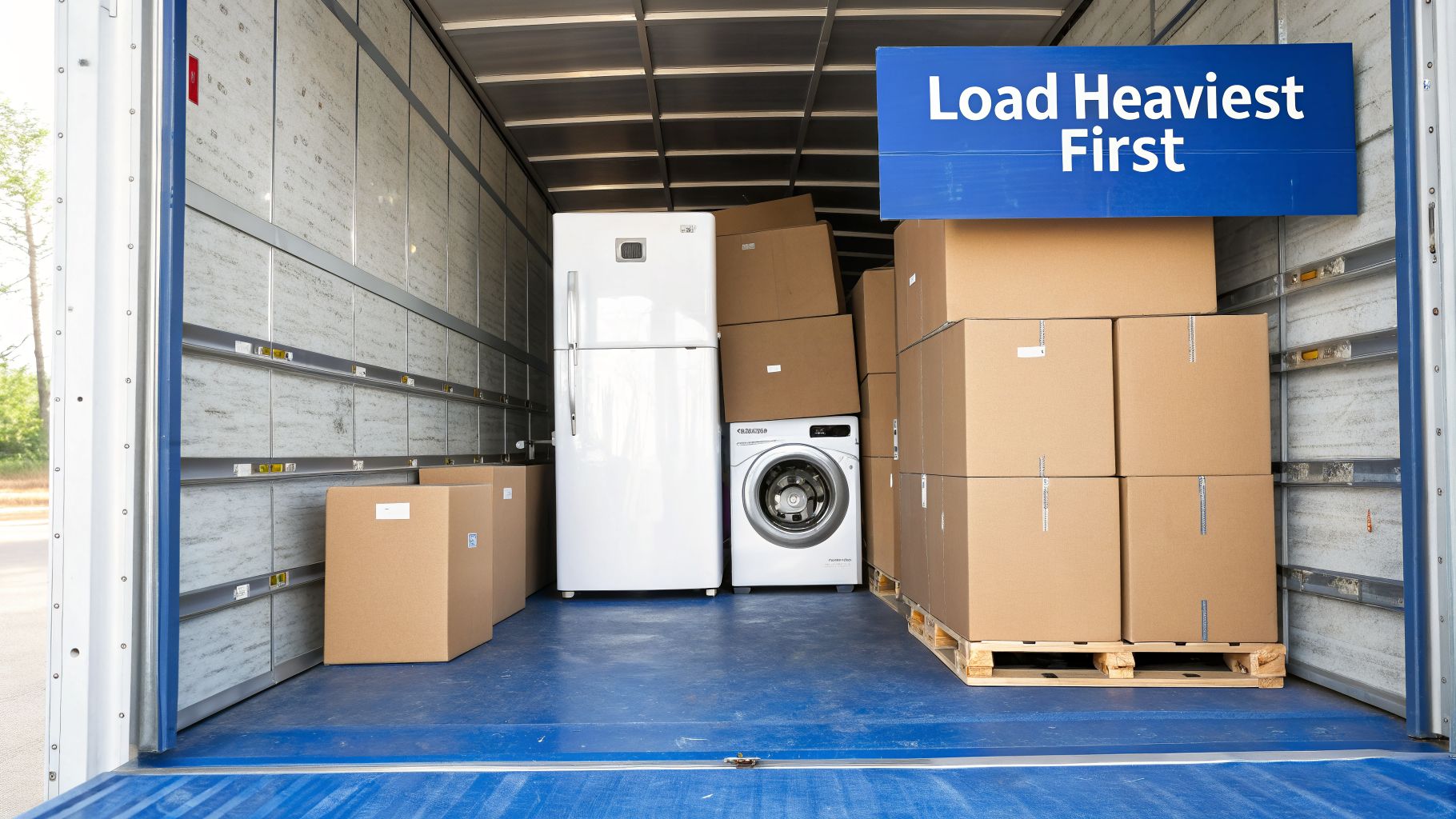
If you only learn one thing about how to pack a moving truck, make it this: load your heaviest items first, right at the front. After that, you build stable walls with your medium-weight boxes, and finally, place the lightest and most fragile things on top and near the back. This isn't just about squeezing everything in; it's a proven method our removalist team uses every day to keep your belongings—and our truck—safe on the road.
Your Essential Guide to Packing a Removalist Truck
Before a single box is lifted, your most valuable tool is a solid plan. As professional removalists with decades of experience here on the Central Coast, we know a well-packed truck is the key to a successful relocation. The strategy we rely on prevents damage, saves a huge amount of time and energy, and makes sure everything arrives in one piece.
Think of it less like a chaotic game of Tetris and more like building a house, one solid piece at a time. It all starts with a foundational plan that our team at Gentle Giant Removals uses for every single job, whether it’s a local relocation in Lake Macquarie or an interstate run down to Sydney.
Why a Packing Plan Matters
A proper packing strategy isn't just an industry trick; it has real-world benefits you'll be thankful for at the other end. The goals are simple but absolutely critical for any move.
- Protect Your Belongings: A securely packed truck means less movement, and movement is what causes scratches, dints, and breakages. While our full insurance coverage offers peace of mind, our expert packing is your best first line of defence.
- Ensure Road Safety: Correct weight distribution is a non-negotiable for safety. Getting heavy items to the front of the truck, centred over the axles, makes the vehicle far more stable and easier to handle. This is vital whether you're navigating Sydney's busy traffic or the winding coastal roads.
- Maximise Your Space: Packing efficiently often means you can use a smaller, more cost-effective truck. It also helps you avoid that frustrating second trip, which saves both time and money.
Expert Tip: The aim is to create solid 'tiers' or 'walls' inside the truck. By packing tightly from floor to ceiling and securing each section as you go, you get rid of empty space. This stops the whole load from shifting when the truck stops, starts, or turns.
For a quick overview, think about your items in three distinct tiers. This is the core principle we use to ensure a safe, balanced load every time.
Truck Loading at a Glance: The Three-Tier Packing Method
| Tier | What It Includes | Where It Goes in the Truck | Why It Matters |
|---|---|---|---|
| Heaviest | Fridges, washing machines, solid wood furniture, packed book boxes. | At the very front of the truck (against the cab), on the floor. | Creates a stable centre of gravity over the axles, preventing swaying and making the truck safer to drive. |
| Medium | Most cardboard boxes (kitchenware, clothes, toys), small furniture, electronics. | Stacked on top of heavy items and used to build stable "walls" from floor to ceiling. | Fills gaps, prevents shifting, and locks the heavy base layer into place. |
| Lightest | Fragile items, mirrors, picture frames, lampshades, cushions, odd-shaped items. | On the very top of your stacked tiers and in protected gaps. Loaded last, near the door. | Keeps delicate items safe from being crushed and makes them easy to access first when you unload. |
Following this method turns a mountain of belongings into a solid, secure block that's ready for the road.
Imagine you're moving a three-bedroom home from Terrigal to an older apartment in Newcastle. Your appliances and heavy oak furniture would go in first, forming that solid base. From there, we’d build walls of medium-weight boxes alongside and on top of them. This systematic approach is how we account for different road conditions and make sure everything arrives exactly as it left.
Understanding these fundamentals is the first step. Whether you decide to do it yourself or opt for our professional packing and loading services, this knowledge will make your relocation run smoother. If you're not sure about the best way to tackle your move, a quick call for a free in-home assessment can clear things up. For any urgent questions, you can always reach our team at 02 4358 3796.
Planning Your Pack and Gathering Packing Materials
A smooth relocation doesn't just happen on moving day. It's the result of smart planning that starts weeks before our truck even shows up. Getting this prep work right transforms what looks like a mountain of belongings into a totally manageable project.
The first job is always to get a real sense of just how much stuff you actually have. This single step influences everything else, from picking the right-sized truck to knowing how many packing materials you’ll need. We measure everything in cubic metres—which is just the total volume your gear will take up.
For example, a sprawling four-bedroom house on the Central Coast has a vastly different volume than a one-bedroom apartment in Newcastle. Getting this estimate right is the key. While our team can pop over for a free in-home assessment to give you an exact figure, a good rule of thumb is to always overestimate slightly. It’s far better to have a little extra space than to run out of room on the day.
Choosing the Right Sized Truck
Once you have a rough idea of your volume, you can lock in the right vehicle. A studio apartment in Gosford might only need one of our smaller trucks. A big family home in Terrigal, on the other hand, will definitely need one of the larger options from our fleet.
Booking a truck that's too small is a classic mistake. It almost always means a second trip, which blows out your costs and your timeline. But a truck that’s too big can also cause problems. If it’s not packed tightly, your belongings can shift and slide around during the drive, which is a major cause of damage.
Our Approach: At Gentle Giant Removals, we run a fleet of 12 trucks, ranging from small to, well, giant. This means we can match the vehicle perfectly to your job, ensuring a single, efficient trip without wasted space or money. It’s a core part of how we deliver our reliable "On Time, Every Time" service.
Gathering Your Essential Packing Materials
With your plan taking shape, it's time to get your packing materials in order. It’s tempting to save a few dollars by grabbing free boxes from the local supermarket, but we’ve seen firsthand why this is a bad idea. Those boxes are all different sizes, they're often structurally weak, and they simply don't stack securely.
Investing in proper, professional-grade packing materials is an investment in protecting your valuables. For a standard relocation, you’ll need a few key things.
- Uniform, Sturdy Boxes: Using boxes of the same size lets you build stable, interlocking tiers inside the truck. We offer high-quality boxes and even have a refundable deposit system, so you only pay for what you actually use.
- Protective Quilted Pads: These are non-negotiable for furniture. They’re the only thing standing between your timber dining table and scratches or dints when items are packed tightly together.
- Porta-Robes: These are brilliant. They’re tall boxes with a built-in rail, so you can transfer your clothes straight from the wardrobe. It saves you an enormous amount of folding, packing, and ironing later.
- Packing Tape and Labels: Good, strong tape keeps your boxes sealed shut. Clear labels tell us—and you—what’s inside and which room it belongs in at the new place.
To get a full rundown on what you'll need, check out our guide on the 7 essential packing materials for a damage-free move. Using the right gear from the very beginning makes the entire process run like clockwork.
Don't Forget the Logistics
Great planning goes beyond just packing materials. You also have to think about the logistics and accessibility at both ends of the relocation.
If you’re in an apartment building in a busy part of Sydney or a unit complex on the Central Coast, there's a good chance you need to book the lift with your body corporate. Failing to book the lift can bring your move to a complete standstill. Seriously, we’ve seen it happen.
Parking is another critical detail often overlooked. Many councils across Sydney and Newcastle require parking permits for removalist trucks, especially on narrow streets. Securing a spot right outside your door saves a huge amount of time and effort. As part of our service, we can help you figure all this out, whether it's talking to your strata manager or arranging the right permits. It’s all about making sure that when we arrive "On Time, Every Time", we can get straight to work.
The Art of Loading: Building a Solid Foundation
This is where the real work begins. How you load that first layer of items into the truck sets the stage for the entire relocation. Get it right, and everything stays safe and secure. Get it wrong, and you’re in for a rough ride.
It all starts at the very front of the truck, right up against the wall that separates the cabin from the cargo area. We call this the bulkhead, and it’s the anchor for your entire load.
Your heaviest and bulkiest belongings always go in first. We're talking about things like your refrigerator, washing machine, dryer, and any solid timber furniture. By placing them on the floor and hard up against the bulkhead, you create a solid, stable base that won’t shift around corners. This is the first and most critical step in protecting all your valuables.
The prep work you do before this point is just as important. The infographic below shows how logistics like truck size and packing materials fit into the bigger picture.
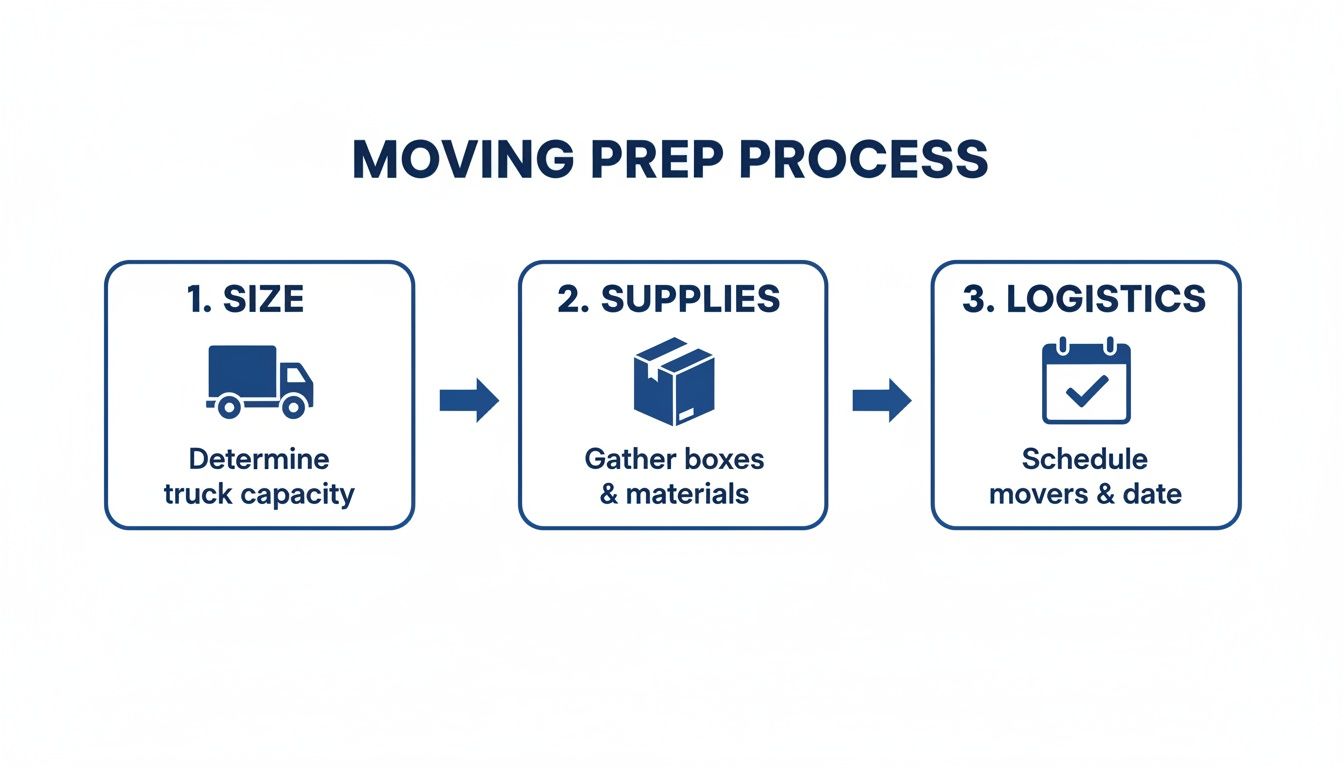
As you can see, choosing the right vehicle and gathering the correct materials are foundational steps. You can't load a truck properly without them.
Distributing Weight Evenly
Loading your heavy items first is only half the battle. You also have to distribute that weight evenly from left to right across the truck’s axle. An unbalanced truck is a nightmare to drive—it can sway on highways and feel unstable on winding roads, creating a serious safety hazard.
Think of it like a game of scales. If you put a heavy fridge on the left side, you need to place something of similar weight, like a washing machine or a solid chest of drawers, on the right to balance it out. Our experienced removalists have perfected this balancing act over thousands of relocations across the Central Coast. It’s this attention to detail that keeps every relocation safe.
Building Your First Tier
Once your heaviest items are locked in against the bulkhead, it's time to build your first "tier." This is where you use your long, flat items to create strong "walls" down the sides of the truck.
Look for items like:
- Mattress bases and ensembles
- Large tabletops (with the legs removed)
- Long mirrors and large picture frames (wrapped up tight, of course)
Stand these items upright and secure them against the truck walls. This not only locks your heavy base into place but also makes clever use of vertical space—a key trick to packing a truck efficiently. For a house relocation in Lake Macquarie, for example, building these walls is what stops smaller boxes from tumbling into gaps.
A Note on Safety: Throughout this process, safety comes first. Always lift with your legs, not your back, to avoid injury. If you're working with helpers, keep the communication clear and constant. Yell out when you’re lifting, turning, or putting something down.
By getting this foundation right, the rest of the packing process becomes much simpler and safer. If you’re feeling a bit overwhelmed by the thought of it, our guide on how to choose the right loading services can help you figure out if calling in the professionals is the better move.
Stacking the Middle and Top Tiers
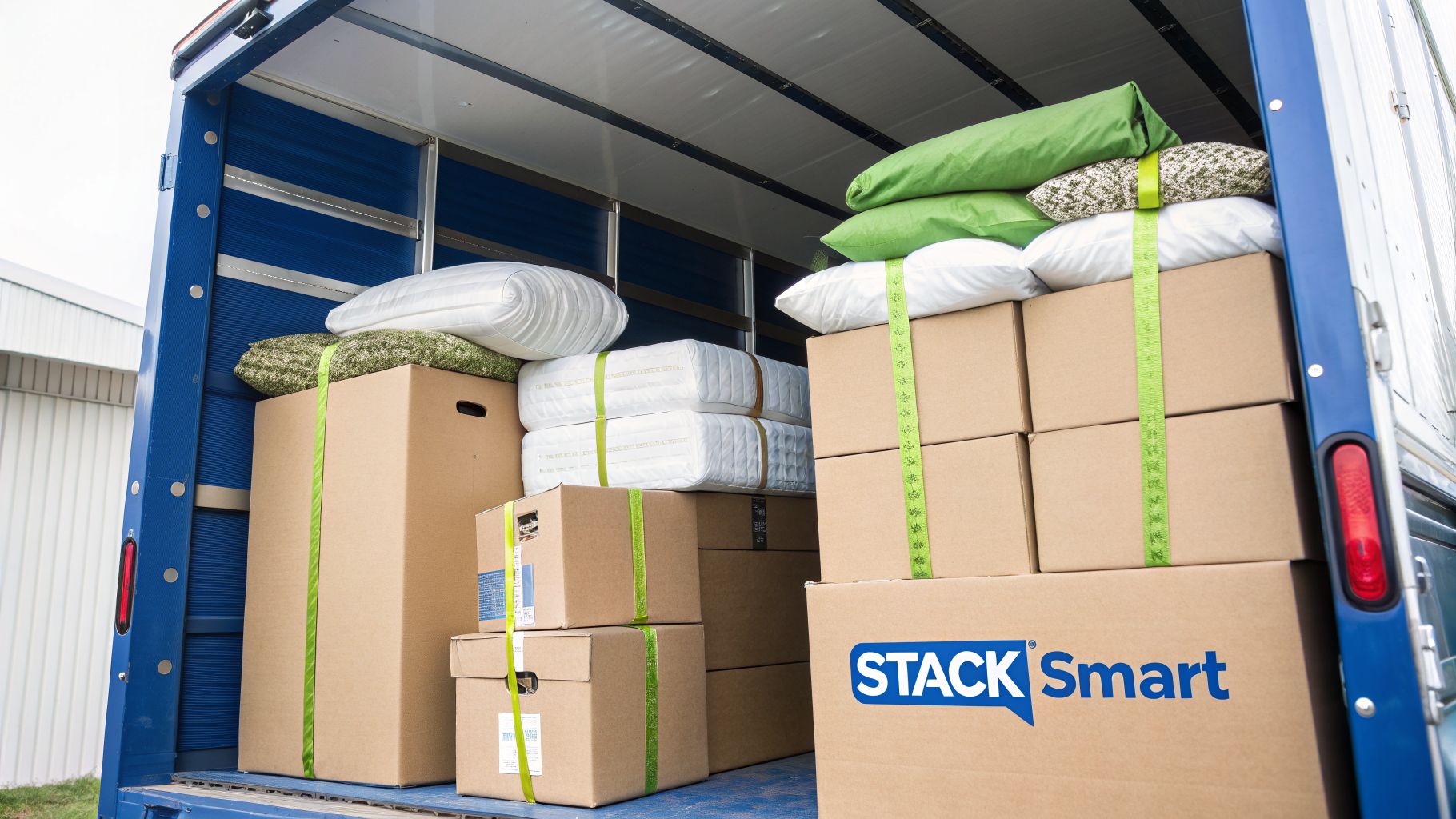
Once your heaviest furniture has created a solid base against the bulkhead, it's time to build upwards and outwards. This is where your medium-weight boxes come in, creating strong, interlocking walls that give the whole load structure and security.
Think of it as playing Tetris, but with your life's belongings. The aim is to pack everything tightly from floor to ceiling and wall to wall. You want to leave no gaps for items to shift, fall, or slide around on the roads around Sydney or the Central Coast. This creates a solid block that supports itself—exactly what you need for a safe journey.
Creating Your Walls of Boxes
This middle section is where most of your standard cardboard boxes will find their home. Filled with items from the kitchen, office, and bedrooms, these boxes are perfect for building on top of the heavy base you’ve already set.
Items for the middle tier typically include:
- Boxes of books and documents
- Kitchen appliances like toasters, blenders, and microwaves
- Packed dishes, pots, and pans
- Boxes of clothing, linen, and toys
A golden rule we always follow is to place heavier boxes at the bottom of a stack and the lighter ones on top. It’s a simple step that stops your box of precious dinner plates from being crushed by a box of encyclopaedias. As you work, imagine you’re building a brick wall—stagger the boxes to create a strong, interlocking structure.
Professional Technique: As you complete a section of the truck, usually about a metre or two deep, stop and secure it with tie-down straps. Don't wait until the entire truck is full. Creating smaller, secured compartments prevents a domino effect if you need to brake suddenly. This is a crucial safety step our team never skips.
Loading the Final Top Tier
Once you have solid tiers of medium-weight boxes reaching near the roof of the truck, it’s time for the final layer. This is where all your lightest and most awkwardly shaped belongings will go. These items are loaded last simply because they are the most vulnerable to being crushed.
Good candidates for the top tier are things that can be gently placed on top of your sturdy box walls or tucked into secure gaps. This includes items like:
- Cushions and pillows
- Duvets and bedding
- Lampshades
- Small, lightweight bags
These soft items also make fantastic padding. If you spot any small gaps between your stacked boxes or furniture, just stuff a cushion or a bag of linen in there. Every gap you fill makes the entire load more secure and less likely to move during transit. Getting your kitchen items packed securely is a big part of this; our detailed kitchenware packing tips offer specific guidance for those fragile items.
Your most delicate items, like mirrors or framed artwork that couldn't be placed along the side walls, should also go in last. Stand them upright in a protected spot where they can't fall, cushioned between soft items like mattresses or sofas. Never lay them flat where something could accidentally be placed on top of them. This systematic layering is a core part of how we ensure everything arrives in perfect condition.
Final Checks for a Safe Journey
The truck is almost full and the heavy lifting is nearly over, but don't shut that door just yet. These last few steps are absolutely crucial for protecting your belongings and ensuring a safe trip to your new home. This is where a professional touch can turn a good pack into a great one.
Before you do anything else, take a moment to do a quick visual sweep of the entire load. You’re looking for any obvious gaps or empty pockets between boxes and furniture. Even a small space is enough for items to shift and build up momentum during transit, which is a classic recipe for damage.
Your goal now is to fill those voids. It's the perfect job for your softest, most lightweight items.
- Grab any duvets, blankets, pillows, and even rolled-up rugs.
- Methodically stuff them into any empty spaces you can find.
- Pay close attention to the area near the rear door, as this is where things are most likely to move about.
This simple action adds an extra layer of cushioning and braces the whole load, locking everything firmly in place.
Securing The Final Tier
With all the gaps filled, it’s time to secure the very last section of your load. This final tier of boxes and items is the most vulnerable to toppling over against the door, so securing it properly is non-negotiable.
For this, you’ll want to use ratchet straps or tie-downs. Run at least one strap horizontally across the face of the final stack of boxes, connecting it to the anchor points on the truck's walls. For extra security, using two straps to create an "X" pattern offers even better stability, preventing any vertical or horizontal movement. Taking this sort of meticulous care is a core part of how we deliver on our 'On Time, Every Time' promise. Before you hit the road, you can ensure your belongings are tightly bound by referring to a stretch wrap hand guide to secure loads safely to prevent shifting.
Safety Warning: When you open the rear door at your destination, items can sometimes fall out if they have shifted against it. Always unlatch the door slowly and stand to the side, never directly behind it. This small precaution can prevent a serious injury.
Prepare Your 'First Night Box'
One of the best tips we can give you is to pack an "essentials" or "first-night" box. This box should be the very last thing you load onto the truck, making it the very first thing you can grab when you arrive.
Trust us, there's nothing worse than desperately hunting for the kettle or toilet paper after a long day of moving. A well-stocked essentials box makes that first hour in your new place far more comfortable.
Your first-night box should contain:
- Kettle, coffee, tea, and mugs
- Snacks and bottled water
- Toilet paper and hand soap
- A basic toolkit (screwdrivers, Allen keys)
- Phone chargers
- A change of clothes and basic toiletries
Knowing these crucial items are within easy reach makes a huge difference. You can find more advice on what helps a relocation run smoothly in our article on why professional loading services matter for Central Coast moves.
Finally, before you get behind the wheel, do one last physical check. Walk around the truck, make sure the loading ramp is securely stowed and latched, and double-check that the rear door is properly locked. With these final checks complete, you’re ready for a safe and successful journey.
Your Truck Packing Questions Answered
Even the most organised person has questions pop up on moving day. After 40 years in the business, we’ve heard them all.
Whether you're relocating from a small apartment on the Central Coast or planning a major interstate relocation from Sydney, our experienced team has the answers to get you through the final details.
How Long Does It Take to Pack a Truck?
This is the big one, and the honest answer is: it all comes down to your preparation and how many hands are on deck. For a well-organised relocation, though, you can plan on a fairly predictable timeframe.
- 1-2 Bedroom Apartment: Give yourself about 2 to 4 hours. This is a good baseline for straightforward relocations in places like Gosford or Newcastle where truck access is decent.
- 2-3 Bedroom House: Plan for around 4 to 6 hours. A family home naturally has more furniture, more boxes, and just more stuff to Tetris into the truck.
- Larger Homes (4+ Bedrooms): This can easily take 6 to 8 hours or even longer. Things like tricky accessibility, lots of stairs, or a long walk from the front door to the truck can add significant time.
Keep in mind, these are just estimates. If we’re navigating a narrow lift in a Sydney apartment building or dealing with a steep driveway, things will take a bit longer. The single best thing you can do to speed things up? Be completely packed and ready to go when the removalists arrive.
What Are the Most Common Packing Mistakes?
After four decades of moving people, trust us, we’ve seen it all. Most problems stem from a few common mistakes that are surprisingly easy to avoid with a bit of foresight.
The number one error is poor weight distribution. Loading too much heavy gear at the very back of the truck is a recipe for disaster, making it unstable and dangerous to drive. Always load your heaviest items first, placing them at the front of the truck against the bulkhead.
Another classic mistake is leaving gaps. Any empty space is an invitation for your belongings to shift, slide, and bash into each other during the journey. That’s how breakages happen. Use your soft items—think blankets, doonas, and cushions—to fill every single void and create one solid, tightly packed block.
A well-packed truck is a quiet truck. If you can hear items rattling or shifting around as you drive, it's a clear sign that things aren't secure enough. A solid, professional-grade load should be almost silent on the road.
DIY Pack or Hire a Professional?
Deciding whether to pack the truck yourself or bring in the pros really comes down to a trade-off between your time, budget, and stress levels.
Going the DIY route gives you total control and can feel cheaper at first glance. But it’s a massive physical job, and it carries real risks of injury or damage to your possessions if you don't have the right experience or equipment.
Hiring a professional team like ours brings expertise and sheer efficiency. We know exactly how to pack a moving truck to maximise space and safety—it’s what we do all day, every day. We also supply all the proper gear, like dollies and protective pads, and our full insurance gives you complete peace of mind. For many people, especially those with busy lives or valuable items, the cost is a worthwhile investment.
If you're weighing your options, have a look through our extensive removalist FAQ section. It covers many of the questions you might be asking yourself.
Ultimately, the goal is getting your belongings to your new home in one piece. Whether you tackle it yourself or call in the experts, applying these professional principles will make all the difference.
Ready to take the stress out of your next relocation? Let Gentle Giant Removals & Relocations handle the heavy lifting. Request a free in-home assessment today and let our experienced Central Coast team plan your perfect relocation. For urgent moves, call us on 02 4358 3796.