

You’re probably reading this with half-packed cupboards, a growing pile of tape, and that nagging thought that the move is bigger than it looked on paper. That’s normal. Most NSW moves feel manageable until you get to the kitchen, the linen press, the garage shelves, and the awkward bits like lift bookings, parking permits, and the narrow driveway that seemed fine until a truck got involved.
A good packing service for moving doesn’t just save time. It changes the whole pace of the relocation. Done properly, it protects your belongings, keeps access areas safer, helps loading run faster, and reduces the little mistakes that cause damage, delays, or arguments on moving day. If you’re moving around the Central Coast, Sydney, Newcastle, or Lake Macquarie, local conditions matter too. Coastal weather, apartment rules, traffic windows, and building access can all affect how packing should be handled.
If you’re comparing DIY against getting help, this guide will give you a practical view of what works, what usually doesn’t, and how to decide what’s worth paying for.
What Is a Professional Packing Service Anyway?
A professional packing service means trained removalists pack your belongings using proper packing materials, a clear room-by-room system, and handling methods designed for transport. It’s not just putting things into cartons. It includes wrapping, cushioning, labelling, grouping items sensibly, protecting fragile pieces, and preparing everything so it can be loaded safely and unloaded in the right order.
For a local example, say you’re moving a family home from Gosford to Lake Macquarie. The bedrooms are straightforward enough, but the kitchen has glassware, the office has cords and screens, the garage has odd-shaped gear, and there’s a steep front path. A packing crew looks at those risks early and packs for the move itself, not just for storage on the floor.
It’s a system, not a rush job
The difference between average packing and professional packing usually comes down to sequence and materials. Good crews don’t mix heavy books with fragile décor, don’t overfill cartons, and don’t leave loose items to rattle around in the truck. They also think about where the carton is going next, whether that’s a storage unit, a terrace in Newcastle, or a unit block in Sydney with booked lift times.
That’s why so many people choose the all-in option. In Australia, full-service relocation including packing held a 64.20% revenue share in 2025, which shows how strongly clients lean toward complete help when they move, especially for intrastate relocations in NSW, according to Mordor Intelligence’s moving services market report.
Practical rule: Packing should make loading simpler. If the packing method creates loose bundles, mystery cartons, or unstable stacks, it wasn’t done properly.
What you’re really paying for
You’re paying for judgment as much as labour. A trained packer knows when to use smaller cartons for weight, when to use extra wrap, when to keep parts together, and when an item needs to travel upright. That matters more than people think.
You’re also paying for consistency. Labels are readable. Fragile items are separated. Essentials can be identified quickly. The house stays workable during the pack. That’s especially helpful if you’ve got children at home, a tight settlement schedule, or access restrictions in a strata building.
If you’re still weighing up service levels, it’s worth reading practical buying advice on how to choose the right removalist. And if you’re comparing how different Australian operators describe these services, this overview of Packing services Perth is a useful reference point for what a packing-inclusive move generally involves.
Your Options DIY vs Professional Packing Services
There isn’t one right answer for everyone. The common approach falls somewhere between doing everything themselves and handing over the whole job. The better question is this: where are you likely to save money, and where are you likely to create extra risk, extra mess, or a long night before moving day?
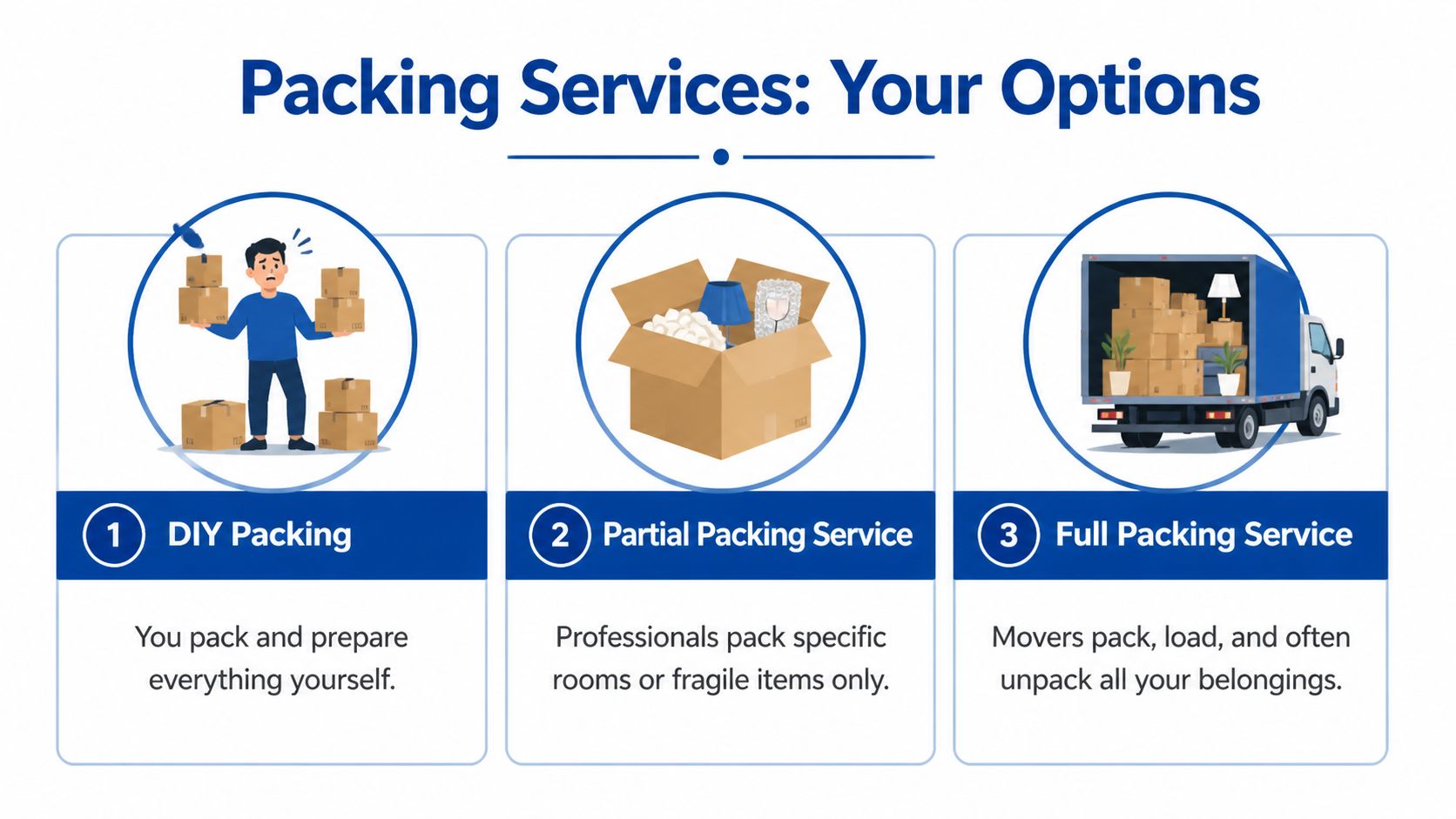
Full packing service
This suits people who are short on time, dealing with a complex property, or just don’t want the move to take over two weeks of their life. Think of a couple relocating from a Sydney apartment with loading dock rules, lift bookings, and weekday traffic constraints. In that situation, speed and order matter as much as care.
A full packing service usually works best when:
- Time is the main pressure: You’re working full-time, managing children, or settling a property sale.
- The home has a lot of breakables: Kitchens, art, mirrors, collectibles, and electronics take longer than commonly anticipated.
- Access is tricky: Apartments, terraces, busy streets, and multi-level homes all benefit from better planning.
The trade-off is simple. You spend more for labour and materials, but you save a great deal of effort and avoid the common last-minute rush where half the house is still loose on move morning.
Partial packing service
This is often the sweet spot. You pack the easy rooms at your own pace, and the removalists handle the fragile or fiddly parts. For many Central Coast households, that means clothes, toys, and books are done beforehand, while the kitchen, artwork, office equipment, and décor are left to the professionals.
This option makes sense if you want control over budget without taking on the highest-risk items yourself. It’s also useful for people moving from a house in Terrigal or Wamberal where access is decent, but the contents include glass, ceramics, framed pieces, or sentimental items that need more care than a quick DIY wrap.
A partial pack is often the most practical compromise. You keep control of the simple jobs and hand over the rooms most likely to slow the move down.
DIY packing
DIY can work well when the move is small and your schedule is flexible. A student leaving a Newcastle unit or a renter moving from one one-bedroom flat to another may do perfectly well packing themselves, provided they start early and use decent packing materials.
DIY tends to work best when:
- The volume is modest: Fewer rooms means less chance of a last-minute blowout.
- You’ve got time: Not one evening. Actual time over several days.
- You’re realistic about your limits: Heavy cartons, fragile pieces, and rushed packing usually end badly.
Where DIY commonly falls over is not effort. It’s decision fatigue. People leave the hardest rooms until last, buy the wrong cartons, under-label everything, and then loading takes longer because nothing is grouped properly.
A useful parallel sits outside moving. This guide for Portland homeowners on cleaning choices explains the same kind of trade-off people face with professional help versus doing it themselves. Different service, same decision pattern. Cost matters, but so do time, finish quality, and what happens when you run out of steam.
A quick comparison
| Option | Best for | Main advantage | Main drawback |
|---|---|---|---|
| DIY | Small, simple moves | Lowest upfront spend | More time, more physical effort, more risk of poor packing |
| Partial pack | Families and mixed-priority moves | Better control of budget and risk | Requires coordination between your packing and theirs |
| Full pack | Busy households, complex access, fragile contents | Fastest and most organised option | Highest total service cost |
If you’re leaning toward doing some of it yourself, this guide on how to pack for a move is worth a look before you buy materials or start taping cartons shut.
What a Packing Service Includes and What Affects the Cost
It's common to ask about cost first, but the better place to start is inclusions. If you don’t know what’s in the service, it’s impossible to compare one quote with another properly.
A proper packing service for moving usually includes trained labour, packing materials, carton assembly, wrapping of breakables, labelling, and staging items so they’re ready to load. Some providers also offer unpacking, wardrobe cartons or porta robes, and reusable or refundable box options. Others will only quote for labour and charge materials separately. That difference matters.
What’s usually included
A standard professional pack often covers the practical jobs people struggle to estimate on their own.
- Packing materials: Cartons in different sizes, butchers paper, tape, protective wrap, and specialist materials for fragile items.
- Room-by-room labelling: Cartons are marked for destination rooms so unloading is faster and less chaotic.
- Protection for breakables: Glassware, crockery, lamps, mirrors, artwork, and electronics get individual attention.
- Furniture preparation: Loose parts, shelves, and small fittings are grouped so they don’t vanish halfway through the move.
Some jobs also include unpacking support at the other end, particularly for older clients, families with young children, or office relocations where downtime matters. If you’re moving into a unit block in Sydney or Newcastle, ask whether common areas, lifts, and wall protection have been considered as part of the day plan. A cheap quote can become an expensive one if the crew loses time dealing with access they should have planned for earlier.
What affects the cost
There’s a reason packing quotes can vary a lot between jobs. The labour is only one part of it. The layout of the property, the type of contents, and access conditions all affect how long the work takes and how much material is required.
The biggest factors are usually:
- Volume of goods: More belongings means more cartons, more wrapping, and more handling. You may hear the term cubic metres, which means the space your belongings take up in the truck.
- Property access: Stairs, lifts, narrow hallways, steep driveways, long carries, and limited parking all slow the job down.
- Fragile or specialty items: Artwork, antiques, musical instruments, glass cabinets, and delicate electronics need more time and better protection.
- Building rules: Strata properties may require lift bookings, parking approvals, protection of shared areas, and strict move-in windows.
- Distance between parking and the door: Not glamorous, but very real. The farther the carry, the slower the process.
Worth checking early: If you’re in an apartment, ask your building manager about lift bookings, loading zones, insurance requirements, and approved moving hours before you lock in the date.
A Terrigal house with straightforward driveway access is a different job from a Newcastle heritage apartment with stairs and limited street parking. A modern townhouse in Sydney with a booked service lift can be efficient, but only if the booking window matches the packing and loading plan.
For a closer look at broader moving spend, this article on the cost of removalists in Sydney helps frame the moving side of the equation.
What clear value looks like
The most useful quote isn’t the cheapest one. It’s the one that tells you what’s being handled, what materials are included, what access assumptions have been made, and whether unpacking or specialty wrapping sits outside the base service.
This short video gives a practical sense of how the moving side ties in with planning and preparation.
When pricing is vague, problems follow. Clients are often left guessing about what’s covered, what counts as extra, and why timing changed on the day. That’s why it’s so important to ask direct questions about materials, specialty items, access issues, and whether the quote assumes you’ll do some of the packing yourself.
The Professional Packing and Moving Day Timeline
Packing day runs best when it follows a clean sequence. Not rushed. Not improvised. Just organised from the first call through to the last carton in the correct room.
Before the team arrives
It usually starts with a quote request and a conversation about the property, access, dates, and whether you need a full pack, partial pack, or packing for fragile items only. Some moves are simple enough to assess from a detailed call. Others are better with an in-home assessment, especially if there are stairs, oversized furniture, or a mix of house and storage items.
Once the booking is confirmed, the plan should be clear. That includes arrival time, service scope, access notes, any strata conditions, and whether packing and moving happen on the same day or across separate days.
On packing day
A good crew arrives on time, walks through the property with you, confirms what is and isn’t being packed, and identifies your essentials area first. That might be medications, chargers, keys, important documents, pet gear, school items, and the kettle.
Then the work becomes systematic. One room is packed properly before the next one starts. Fragile items are wrapped, cartons are labelled, and furniture parts are kept with the item they belong to. In a standard family home on the Central Coast, that organised approach often means the place can be packed efficiently without the house turning into a maze of half-finished piles.
The smoothest moving days usually start the day before, with clear labelling, an agreed scope of work, and one visible area set aside for items that must stay with you.
Loading and transport
When the house has been packed well, loading is faster and safer. Cartons stack properly. The truck can be loaded in a sensible order. Fragile items don’t need to be reworked at the tailgate because someone used the wrong carton or packed a shelf of glassware loose.
This matters a lot in NSW conditions. Sydney traffic windows, Newcastle street access, and Central Coast coastal weather all affect timing. If there’s limited parking or the truck can’t sit close to the entry, every delay compounds. Good packing reduces those delays before they start.
Arrival and optional unpacking
At the destination, labelled cartons make placement far easier. Bedrooms go to bedrooms. Kitchen cartons go straight to the kitchen. If unpacking is included, the crew can remove materials, place essentials first, and help get key areas working sooner.
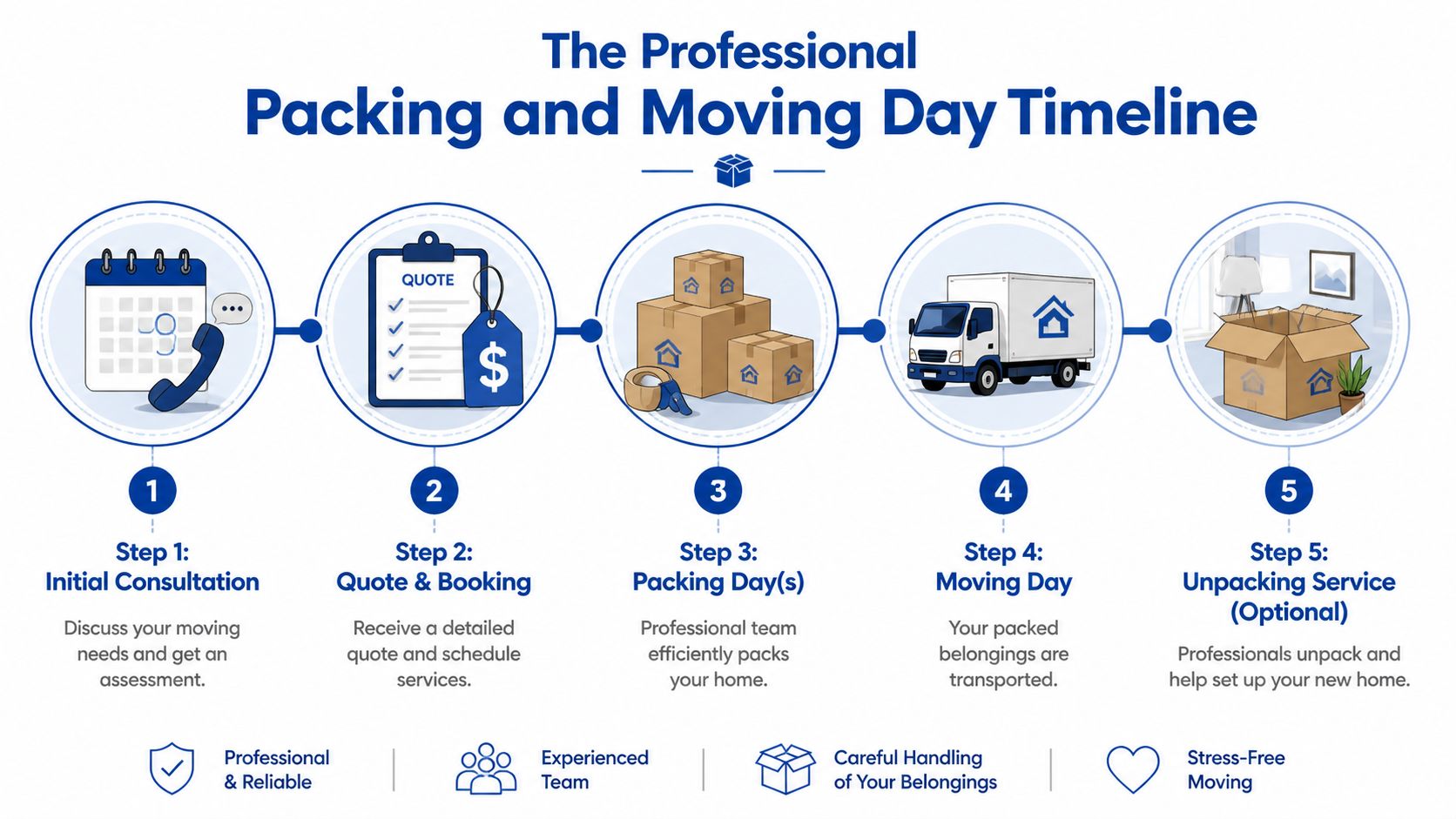
Here’s the timeline most clients find easiest to follow:
Initial consultation
You explain the move, the property, and any concerns about access, fragile items, or timing.Quote and booking
The job is scheduled with a clear scope, including whether packing, transport, and unpacking are all included.Packing day or days
The crew packs room by room, labels cartons, and prepares the house for efficient loading.Moving day
The packed goods are loaded, transported, and unloaded in the right rooms.Optional unpacking
Priority rooms are set up first, and packing materials are removed if that service is included.
How to Prepare Your Home for the Packers
The better prepared your home is, the better value you get from the packing crew. You don’t need to pre-pack everything. In fact, if you’re paying for a packing service, that defeats the purpose. But you do want the house ready so the team can work cleanly and efficiently.

Declutter before the assessment if you can
Don’t pay to pack and transport things you already know you don’t want. Clothes for donation, old pantry items, broken outdoor gear, and duplicate kitchen pieces are worth sorting early.
Even a modest declutter makes the quote more accurate and the packing day more efficient. It also helps you avoid that annoying moment at the new place where you realise you paid to move things you meant to throw out months ago.
Create a do-not-pack zone
This is one of the simplest habits that prevents confusion. Pick a bench, spare bathroom, or clearly marked corner and keep your essentials there. Tell the crew exactly what’s staying with you.
A good do-not-pack area usually includes:
- Daily essentials: Medications, chargers, wallets, keys, school items, and toiletries
- Important paperwork: Passports, contracts, medical information, and anything confidential
- First-night basics: Kettle, mugs, snacks, pet supplies, and a change of clothes
- Valuables: Jewellery, sentimental keepsakes, and small personal items you’d rather carry yourself
Make access safer and easier
Clear walkways inside and outside the home. Move pot plants, bikes, loose mats, and anything that narrows the path to the truck. If you’re in a unit block, confirm lift access and tell the team about loading dock rules, basement height limits, or body corporate instructions before the day.
Safety first: A packing crew works faster in a clear home, but the bigger benefit is lower risk to your belongings, your walls, and everyone carrying cartons through tight spaces.
Flag anything unusual early
Don’t wait until the truck is outside to mention the antique mirror, the steep rear stairs, or the cupboard full of fragile ceramics. The more the team knows in advance, the better they can prepare the right packing materials and the right plan.
If you’re sourcing cartons ahead of time, this guide on boxes for moving free can help you decide what’s worth reusing and what’s better bought new.
Tailored Packing for Special Relocations and Items
Not every move looks the same. Packing a suburban family home is one thing. Packing an office, an aged care relocation, or a piano heading interstate is another job entirely. The method changes because the risks change.
Office and commercial relocations
For offices, the main goal is keeping downtime low and keeping equipment, files, and workstations organised enough to restart quickly. That means labels need to be useful, not vague. “Office stuff” isn’t a system. Desk-by-desk packing, cable grouping, and room allocation are.
A Sydney office move might also involve loading dock bookings, after-hours access, shared lifts, and building manager sign-off. Those details affect packing because items need to leave in a sequence that matches the building window, not just the floor plan.
Seniors and aged care moves
These jobs need patience. The packing itself matters, but so does the pace and the way decisions are handled. Many older clients aren’t just changing address. They’re downsizing, parting with belongings, or moving under emotional strain.
Good support here means breaking the move into manageable parts. Essentials should be easy to find at the new place. Medical items should stay accessible. Sentimental pieces need clear identification. Unpacking can be just as important as packing, especially where mobility is limited or family members can’t be present for every step.
Fragile, valuable, and awkward items
Some belongings need specialist handling from the start. Pianos, antiques, artwork, mirrors, sculptures, and selected electronics shouldn’t be treated like standard household contents. In Australian removals, established providers use international-grade cartons and protective materials that meet the highest standards, along with layered protection such as purpose-designed cartons, plastic moving boxes, bubble wrap, and tape for different item types, as described by Palmers Relocations.
That matters because road transport isn’t gentle. Things vibrate, shift, and settle. The packing materials have to account for that.
If you’re moving a piano or another large instrument, it’s worth reading specialist advice from a dedicated piano mover. The packing and handling requirements are completely different from general furniture.
Interstate moves and documentation
Interstate work brings another layer of discipline. All interstate removals include careful compilation of detailed packing lists with numbered and listed items to ensure every object is accounted for, according to King & Wilson’s interstate removals information. That kind of itemisation helps with accountability, condition records, and insurance support if anything needs to be checked later.
For long-haul relocations out of NSW, that inventory also helps when goods move through multiple handling points. Carton numbering, descriptions, and room allocation become more than admin. They become part of risk management.
On interstate jobs, the inventory starts during packing, not after the truck doors close.
There are also practical lifestyle details people forget to plan for. If pets are part of the move, especially cats on a longer relocation, this guide on moving across country with cats is a sensible companion read while you organise the household side.
Frequently Asked Questions About Packing Services
Is my stuff insured while you pack it?
You should always ask this directly before booking. A professional removalist should explain what insurance cover applies during packing, loading, transport, and unloading, and what conditions sit around owner-packed cartons versus professionally packed ones. Full insurance coverage matters, especially for fragile items, high-value goods, and interstate work.
If anything in the answer sounds vague, keep asking. You want clarity before the first carton is taped shut.
Do I need to be home while you pack?
Not always, but it helps to be available at the start and finish. At the start, you can confirm priorities, point out special items, and identify what stays behind. At the end, you can check that essentials are still separate and that nothing in the do-not-pack zone has been swept up by mistake.
For some clients, especially seniors or people coordinating a move from another suburb, a family member can also manage that handover.
What about personal or sensitive items?
It's common practice to keep documents, jewellery, medications, and personal belongings with you. That’s usually the right call. Even with a trusted crew, some items are better self-managed because they’re private, irreplaceable, or needed on the day.
If you do want help packing sensitive rooms such as a home office, say so upfront. Clear instructions avoid awkward assumptions.
Can you unpack as well?
Many removalists offer unpacking, and it can be a very practical add-on. It’s especially useful for older clients, busy families, and anyone moving into an apartment where cartons can quickly block hallways or create trip hazards.
Unpacking support can also be adapted for accessibility. If someone has limited mobility, the useful question isn’t just “Can you unpack?” It’s “Can essentials be unpacked first and placed where they’re easiest to reach?” Medical equipment, daily-use kitchenware, bedroom setup, and safe walking paths should come before decorative items.
How should medical equipment be handled?
This comes up often and deserves a straight answer. Keep anything essential for daily care clearly identified, easy to access, and discussed before packing starts. If equipment is sensitive, detachable, or comes with cables, manuals, or accessories, keep those components together and labelled in plain language.
For special needs and aged care moves, the best approach is a slower, more deliberate one. Rushing those items creates problems later.
Let Our Team Take the Weight Off Your Shoulders
A proper packing service for moving isn’t about handing over control. It’s about making the job safer, more organised, and easier to manage from first quote to final unpack. If you’re moving on the Central Coast, to Sydney, Newcastle, Lake Macquarie, or further afield, the right packing plan can save a lot of wasted effort and prevent the usual trouble spots like breakages, access delays, and last-minute chaos.
The biggest difference is usually simple. Professional packing turns dozens of small moving problems into one coordinated job. That matters whether you’re relocating a family home, downsizing into aged care, managing a strata move, or sending selected items interstate.
If you want reliable help, ask for a clear quote, an honest assessment of what should be packed professionally, and a plan that reflects your property, your timing, and your access conditions. Good removalists won’t overcomplicate it. They’ll tell you what works.
If you’d like practical advice for your move, get a free quote from Gentle Giant Removals & Relocations. We help households and businesses across the Central Coast, Sydney, Newcastle and beyond with packing, moving, unpacking and specialty relocations. If your move is urgent or you’d rather talk it through with a real person, call our team for prompt help, or request a free in-home assessment online.