
So, you’re planning a relocation. Whether it’s a high-rise apartment in Sydney or a family home on the Central Coast, the whole process really kicks off with one fundamental task: getting your hands on the right packing materials.
You’ve got a few main paths to choose from: you can hire them from your removalist, buy them new from a retailer, or track them down for free. Each option has its own set of pros and cons, and as experienced removalists, we're here to give you the local knowledge you need.
Finding the Right Packing Materials in NSW
As removalists who have helped countless people relocate across Newcastle, the Central Coast, Sydney and beyond, we’ve seen it all when it comes to packing materials. We know what works, what doesn't, and what will save you a headache on moving day.
This guide is our way of sharing that hard-won experience with you. We’ll give you a straight-up look at your options so you can figure out what’s best for your budget, your timeline, and most importantly, the safety of your belongings.
Let's get you packing with confidence. Here’s a look at your options.
The Easiest Option: Using Your Removalist's Boxes
When you're staring down a big relocation, the last thing you want is to spend your weekends hunting for packing materials. This is where getting boxes directly from your removalist becomes the most straightforward choice. We take the guesswork out of the equation and save you precious time, ensuring you get high-quality, professional-grade materials delivered right to your door.
But this is about more than just convenience; it’s about protecting your belongings. Using uniform, sturdy boxes is the first step to making sure everything is packed securely. When all the cartons are the same size and strength, they stack perfectly in the truck. This dramatically cuts down the risk of items shifting, crushing, or breaking during transit—a crucial element for ensuring your move is covered by our full insurance.
How Our Box System Works
We’ve designed our packing material service to be as simple and cost-effective as possible. Instead of you buying boxes outright, we run a refundable-deposit system. You pay a small deposit for the cartons you need, and once your relocation is complete and you’re settled in, we come and collect the empty boxes and refund your deposit.
It’s a win-win for everyone. You get the benefit of professional materials without the full purchase price, and it’s a much more environmentally friendly approach than buying new.
In busy areas like the Central Coast, where families frequently move between suburbs like Doyalson, Newcastle, and Sydney, finding ways to manage moving expenses is always a priority. Our refundable-deposit model is designed to help with this and can save you a significant amount compared to buying new packing materials.
A Real-World Example: Imagine you’re a family planning a relocation from a three-bedroom house in Gosford to a new home in Lake Macquarie. During our free in-home assessment, we would calculate exactly what you need—perhaps 40 standard cartons, 25 book boxes for heavier items, and four porta-robes for your clothing. This precise count means no wasted money on excess boxes and no last-minute panic to find more.
Why Professional Materials Matter
Using the right materials from the start has a ripple effect on your entire relocation. It doesn't just make the truck pack safer and more efficient; it also simplifies your own packing process.
Having the correct number of book boxes stops you from making cartons too heavy to lift safely, while porta-robes mean your clothes arrive at your new wardrobe crease-free and ready to hang. This level of organisation is especially important when dealing with the logistics of moving out of an apartment with strict strata rules or navigating Sydney's busy traffic.
Ultimately, opting for your removalist’s boxes is about setting your relocation up for success. It’s an integral part of a well-planned move and ties directly into the overall cost and safety of the service. You can learn more about how packing materials influence the final price by checking out our guide on the cost of Sydney removalists.
Buying New Moving Boxes from Retailers
Heading out to buy brand-new moving boxes is a popular route for many people. There's a certain peace of mind that comes with knowing your cartons are clean, sturdy, and all yours. You can find a whole range of them at big hardware stores like Bunnings, local storage facilities, and plenty of online suppliers who will deliver right to your door in Sydney or Newcastle.
The main appeal is convenience—a one-stop shop for all your packing needs. But that convenience definitely comes with a price tag. While it’s handy to grab everything at once, the cost of buying new boxes for an entire house can add up surprisingly fast. For a standard three-bedroom home, you could easily find yourself spending several hundred dollars on just the boxes, before you even think about tape, bubble wrap, and paper.
What to Look for When Buying
When you’re buying your own boxes, picking the right type is crucial for keeping your belongings safe. You can't just grab any old box; you need to think like a professional removalist.
For heavy or fragile items like books, kitchenware, and electronics, you absolutely want double-walled cardboard boxes. They provide the extra strength needed to prevent collapses and protect what’s inside. For lighter goods like linen, clothes, and kids' toys, standard single-walled boxes will do the job just fine.
It’s also smart to get a mix of sizes. A common mistake we see is people packing heavy items into huge boxes. Instead, use smaller "book" boxes for things like books and pantry items. This keeps them at a manageable weight, which is a massive safety bonus for both you and our removalist team.

As you can see, working directly with your removalist often simplifies the whole process. It’s the most direct path to getting the right supplies delivered to you, without the guesswork of shopping around. We’ve put together a full guide to the different kinds of moving boxes and packing supplies available to help you figure out exactly what you need.
The biggest downside of buying brand-new boxes? Figuring out what to do with them once you’re all unpacked. You’re left with a mountain of cardboard to break down and recycle, which is the last thing you want to deal with, especially if you’ve just moved into a new apartment on the Central Coast with limited bin space and body corporate rules to follow.
Hunting for Free Boxes The Pros and Cons
Everyone loves saving a few dollars, and the thought of getting free moving boxes is definitely appealing when you're watching your relocation budget. You'll see plenty of suggestions to hit up local supermarkets, bottle shops, or online marketplaces like Gumtree and Facebook.
While you can get lucky, it’s worth thinking about this from a professional removalist’s point of view. From our "On Time, Every Time" service perspective, reliability starts with the packing materials.
From our experience on the road, the single biggest problem with free boxes is their inconsistency. When you gather them from all over town, you end up with a random mix of shapes, sizes, and strengths. This makes it incredibly hard for us to stack them securely in the removal truck. A properly packed truck relies on uniform, strong cartons that form stable tiers. Mismatched boxes just create gaps and wobbly stacks, which raises the risk of your items shifting and breaking in transit.
The Hidden Risks of Used Boxes
Beyond just being awkward to stack, used boxes come with other serious risks that can end up costing you a lot more than you saved.
- Structural Weakness: You have no way of knowing what the box was used for before or how many times it’s been moved. A box that once held heavy tins might have tiny tears and a weakened frame, making it likely to collapse under the weight of your own belongings.
- Moisture and Contamination: Cartons left in damp stockrooms can hide mould or mildew, which can easily transfer to your clothes and furniture. Even worse, old food or liquid spills can attract pests — the last thing you want to bring into your new home in a place like Lake Macquarie.
- Safety Hazards: An overloaded or weak box that splits open while being carried is a genuine safety risk for both you and our crew. Our team's safety is our top priority, and we have to be careful with unpredictable materials.
The Australian moving industry is massive, and we know from experience that finding good packing materials is a major headache for many people. In fact, some reports show that up to 30% of boxes found through recycling or second-hand sites are unusable because of damage. That’s a lot of wasted time and effort.
As professional removalists, we’ve seen the unfortunate results of poor-quality boxes time and time again. Just imagine the cost and frustration of replacing a smashed television or a shattered set of family dinner plates. When you weigh up that risk, the money saved on free boxes suddenly doesn’t seem so attractive.
This is particularly true for moves with tricky access, like navigating the narrow stairwells in Newcastle's heritage apartments or dealing with tight lift bookings in a busy Sydney high-rise. In those scenarios, having strong, reliable boxes is non-negotiable for keeping your valuables safe and ensuring the relocation stays on schedule.
For a deeper dive into this topic, you can read our complete guide on the pros and cons of free moving boxes.
How to Estimate the Number of Boxes You Need
It’s the classic moving question we get all the time: “How many boxes am I actually going to need?” Getting this wrong can mean frantic, last-minute trips to buy more supplies or being stuck with a mountain of unused cartons after the move.
As a starting point, we've developed a pretty reliable formula based on years of experience. A good ballpark figure is about 10-15 standard cartons per room, plus a few extras for hallways and any storage areas. Of course, this number can shift depending on how long you've lived in your home and your lifestyle. A minimalist in a one-bedroom Newcastle apartment might only need 20 boxes, while a family in a four-bedroom house on the Central Coast could easily be looking at 80 or more.
A General Guideline For Your Home
While every home is unique, this breakdown gives you a realistic starting point for planning your packing materials. We help you with this exact calculation during our free in-home assessment.
- 1-Bedroom Apartment: Approximately 20-30 boxes.
- 2-Bedroom Home: Approximately 30-50 boxes.
- 3-Bedroom Home: Approximately 50-70 boxes.
- 4+ Bedroom Home: Approximately 70-100+ boxes.
But remember, it’s not just about the total number. You absolutely need the right types of boxes to protect your belongings properly and make lifting safe for everyone involved.
Matching Box Types to Your Belongings
Getting the mix of cartons right is just as important as getting the count right. The golden rule is simple: small, sturdy boxes for heavy things, and large boxes for light, bulky things.
Safety Tip: One of the most common mistakes we see is people filling a large "tea chest" carton with books. This makes the box dangerously heavy and almost guarantees it will break. Always pack heavy items like books, pantry goods, and wine into smaller, double-walled book/wine boxes.
Save the larger tea chest cartons for lighter items like linen, pillows, lampshades, and small kitchen appliances. And for clothing, nothing beats a porta-robe. They're basically portable wardrobes that let you move clothes while they're still on their hangers—a massive time-saver when you're unpacking.
The Central Coast continues to be a hugely popular moving destination, which means demand for quality packing materials is always high. We know box costs can add up, which is why we've worked to ease that pressure with our refundable box system. You can get a better handle on all the potential moving costs with this in-depth moving rates calculator.
Honestly, the only way to get a perfectly accurate box count is with a professional eye. When we visit your home for a free quote, we’re not just looking at the big furniture. We're mentally calculating the precise number and types of cartons you’ll need for everything else, taking all that guesswork and stress completely off your plate.
Tips for Packing and Managing Your Boxes
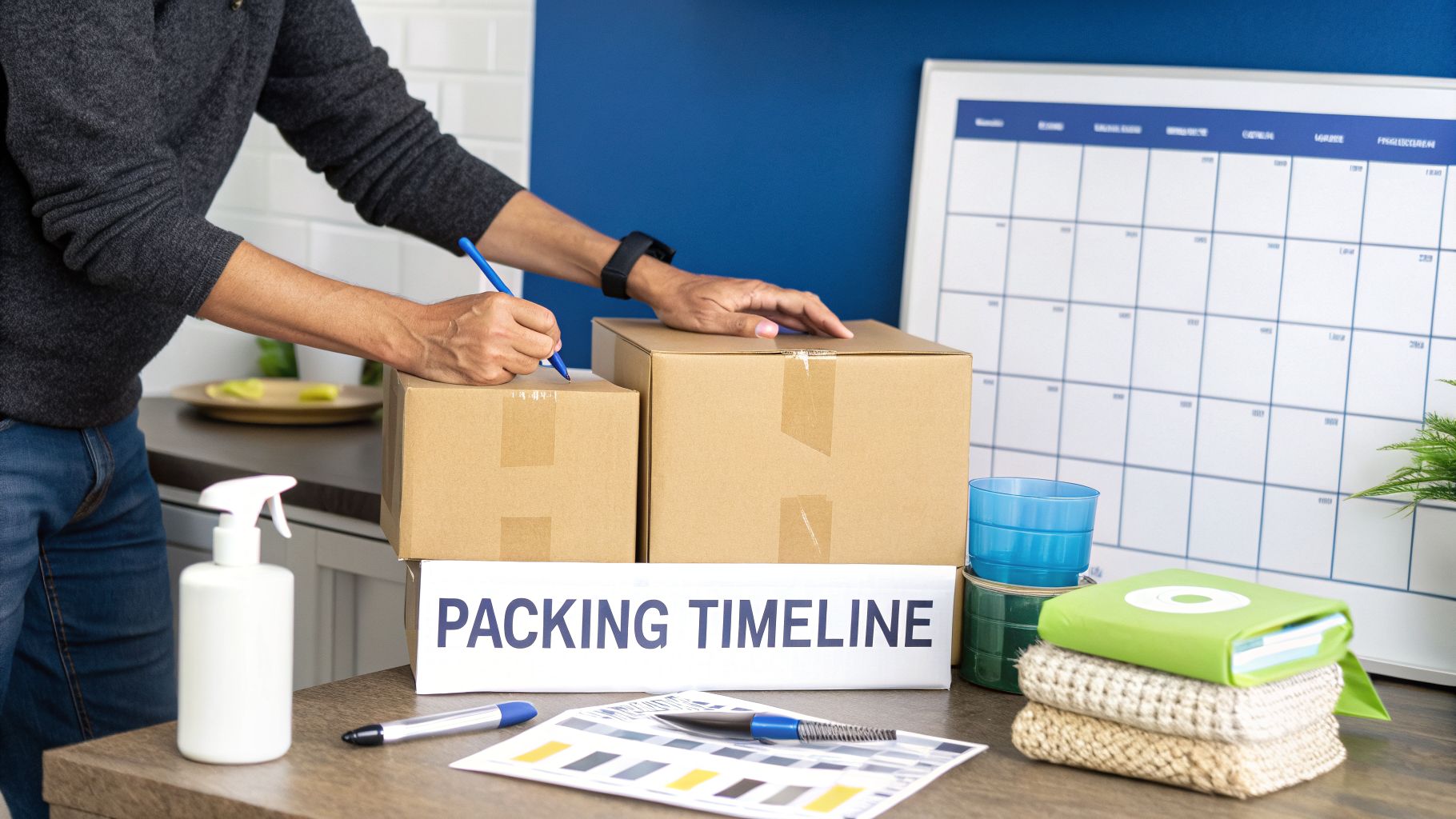
Once you’ve sourced your moving boxes, the real work begins. We’ve seen it all, and a solid packing strategy is every bit as crucial as having the right supplies. Our advice? Give yourself a decent runway—start the packing process at least two to four weeks before moving day.
This timeframe lets you work through your home methodically without that last-minute panic. A great way to begin is by tackling the rooms you use the least, like the spare bedroom, garage, or any out-of-the-way storage spaces. Clearing these areas out first creates a sense of progress and makes the rest of the house feel far more manageable.
Creating a Simple Labelling System
Trust us on this one: a good labelling system will be your best friend when you’re tired and surrounded by boxes in your new home. On the top and at least one side of every box, write down three key things:
- The destination room: Main Bedroom, Kitchen, Living Room, etc.
- A quick summary of what’s inside: "Towels & Linen" or "Pots & Pans."
- A bold "FRAGILE" warning: If it contains anything delicate, make sure it’s impossible to miss.
This simple habit helps our crew place everything in the right room, saving you from lugging heavy kitchen boxes up from the garage. More importantly, it helps you find the kettle for that all-important first cup of tea without opening a dozen cartons.
Coordinating with Buildings and Strata
Moving into or out of an apartment building in Sydney or Newcastle adds another layer of planning. Most strata-managed buildings have specific rules for relocations, which can include booking the lift, arranging parking permits, and protecting common areas like hallways and lobbies.
Getting your packing materials and starting early means you can identify any potential access challenges ahead of time. It allows you to coordinate with strata management, book lifts, and secure any necessary parking permits well before moving day. This is a standard part of the planning process we can help you with.
For seniors navigating a move, the process can feel particularly complex. Thankfully, there are dedicated resources that offer specific packing help for seniors to make it all a bit smoother.
If the sheer thought of packing everything yourself is overwhelming, remember you don’t have to do it alone. Our professional packing services are a lifesaver for busy families, anyone facing a large interstate move from the Central Coast, or simply those who want it done right. We can handle it all, ensuring your belongings are packed safely and efficiently under our full insurance coverage.
For more expert advice, check out our guide on the 7 essential packing materials for a damage-free move.
Common Questions About Moving Boxes
Over our decades helping people move across the Central Coast, Sydney, and Newcastle, we’ve heard just about every question there is when it comes to packing. When you're staring at an entire house worth of belongings, knowing where to start with boxes can feel overwhelming.
Here are our honest answers to the questions we get asked the most, based on real-world moving experience.
Is It Cheaper to Buy My Own Boxes or Hire Them?
This is the big one, and it's a classic case of cost versus value. While sourcing your own free or cheap boxes from a supermarket might seem like a saving at first, it often creates bigger problems down the track.
Our hire boxes, offered on a refundable-deposit system, are professional-grade and uniform in size. This means they stack securely in the truck, drastically lowering the risk of anything getting crushed or damaged. In the long run, avoiding a broken TV or smashed dinner set saves you far more than the few dollars you might save on flimsy boxes. Plus, we deliver them right to you, saving you time and petrol.
What Do I Do with Boxes After the Move?
Here’s where hiring really shines. If you get your boxes from us, you just unpack and give us a call. We’ll schedule a convenient time to collect the empty boxes from your new home, whether you're in Sydney, Newcastle, or on the Central Coast.
Once we pick them up, you get your deposit back. No hassle, no mess. If you buy your own, you’re left with the job of breaking them all down for recycling or trying to offload them on community websites, which can be a real pain if your local council has specific rules.
Can I Use Plastic Tubs Instead of Cardboard Boxes?
Absolutely. Plastic tubs are a fantastic option, and we happily offer them for hire too. They’re incredibly durable, stack perfectly, and are brilliant for protecting items from moisture in a garage or shed.
The main trade-off is that they can be a bit more expensive to buy outright compared to cardboard. During a free in-home assessment, our team can chat with you about what you're packing and help you decide if our quality cardboard cartons or sturdy plastic tubs are the right fit for your gear and budget.
Key Takeaway: The right choice often depends on what you're packing. Tubs are excellent for long-term storage or sensitive items, while quality cardboard is the versatile workhorse for most household goods.
How Far in Advance Should I Get My Boxes?
Our golden rule is to have your packing materials delivered at least two to three weeks before your relocation date. It might sound early, but it’s the secret to a low-stress pack.
This gives you plenty of time to work at a steady pace without that frantic, last-minute rush. Start with the non-essential rooms first—like the spare room or garage—and you’ll find the whole process feels much more organised and manageable. And if you book our professional packing service, we coordinate all of this for you.
Planning your relocation and need expert advice on packing materials? The team at Gentle Giant Removals can help you get exactly what you need, with a service that is reliable and fully insured.