
You’re probably reading this with half a lounge room still assembled and one big question in your head. What’s the best way to move furniture interstate without damaging your good pieces, blowing the budget, or getting caught by a problem you didn’t know existed.
That question comes up a lot on the Central Coast. A family in Terrigal is heading to Brisbane. A couple in Gosford is leaving a unit for a house in regional Victoria. An office in Lake Macquarie needs desks, shelving and IT furniture moved with as little downtime as possible. On paper, the options look simple. In practice, each one comes with trade-offs around labour, timing, access, insurance, packing standards and, in Australia, quarantine rules that many people miss entirely.
The right choice depends on what you’re moving, where you’re starting, where you’re going, and how much risk you’re willing to carry yourself. A solid interstate move is planned well before the truck arrives.
Planning Your Big Move Across State Lines
A typical example is a three-bedroom family home on the Central Coast heading north. You’ve got a sofa that barely made it through the current front door, a dining setting you want to keep, a few fragile pieces from the grandparents, bikes in the garage, and a settlement date that won’t move. At that point, you’re not just comparing price. You’re weighing time, effort, damage risk, access, and whether you can realistically manage the job yourself.
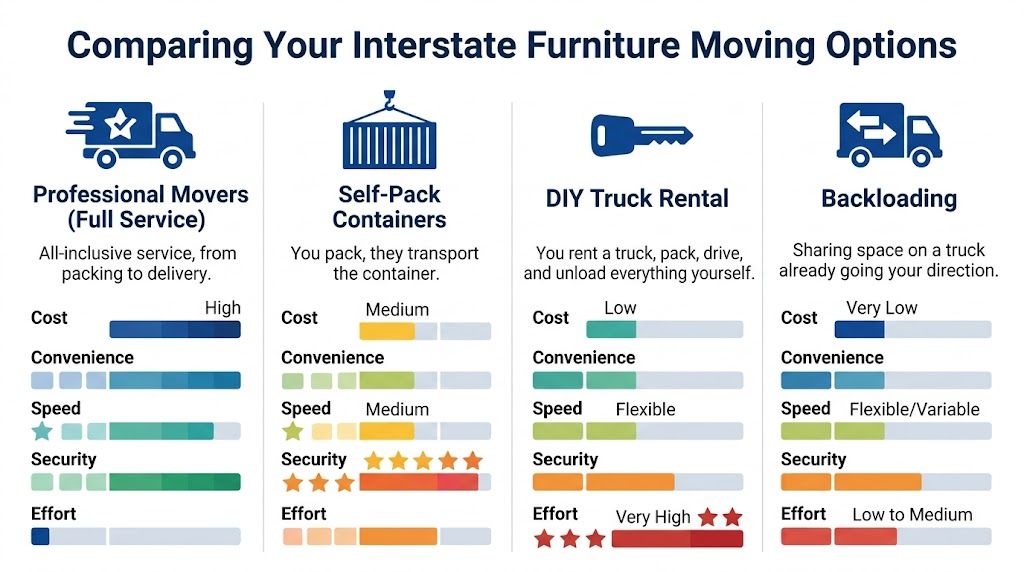
You'll typically evaluate four main options. You can hire a full-service removalist, rent a truck and do it yourself, book a container and pack it on your own schedule, or use a freight or backloading arrangement for selected items. Each can work. Each can also go badly if it doesn’t match the move.
Early planning makes the rest easier. A written moving calendar, a proper furniture inventory, and a realistic packing plan will save you from the usual last-week scramble. If you want a broad planning resource alongside local advice, these essential cross country moving tips are a useful starting point. For an Australia-focused timeline, a practical relocation checklist for Australia helps keep the admin, utilities and booking dates in one place.
What matters first
Before you compare providers, answer three questions.
- How fixed is your timing: If you must vacate on one day and take possession on another, that affects whether shared loads, storage, or a dedicated truck make sense.
- How difficult is the access: Stairs, steep driveways, narrow streets, waterfront properties, lift bookings and loading bay rules all shape the move.
- How protective do you need the service to be: Flat-pack furniture, antiques, pianos and oversized lounges all need very different handling.
Practical rule: If the furniture would be expensive, hard, or impossible to replace, choose the method that gives you the most control over handling, not just the lowest upfront cost.
Understanding the Language of Interstate Relocations
Interstate quotes can sound confusing if you don’t deal with removals every day. A lot of the decision-making gets easier once you know the basic terms and why they matter.
Cubic metres and why they affect your quote
Cubic metres are the amount of space your furniture and packed items take up in a truck or container. Think of it as volume, not weight. A light but bulky couch can take up a lot of cubic space, while books are heavy but pack tightly.
That matters because interstate pricing is often shaped by how much truck space your load uses, how awkward the pieces are, and how much handling is involved. If your inventory is vague, the quote can be vague too. A proper in-home or video assessment is usually better than guessing from a short list.
If you’re trying to understand how volume, distance and service level affect cost, a moving cost calculator guide can help you frame the quote properly.
Backloading, dedicated loads and delivery windows
Backloading means your furniture shares truck space with another load already heading in the same direction. It can be a sensible choice if you’re flexible on delivery timing and your inventory is straightforward. The trade-off is less control over exact dates and, in some cases, more handling along the way.
A dedicated load means one household or one business gets the truck space. That’s usually the cleaner option for households with fragile pieces, strict timeframes, or premium furniture.
A delivery window is the period in which your goods are expected to arrive. Local moves are usually same-day jobs. Interstate relocations are different. Travel time, weather, loading sequences and access at the destination all affect delivery.
If a quote promises the world but asks very few questions about access, inventory or timing, it usually means the hard parts haven’t been planned yet.
Inventory, packing scope and what a quote really covers
An interstate inventory should be more detailed than a local one. It needs to note large items, dismantling requirements, special handling pieces, and anything that won’t travel well unless packed properly. A hallway table and a marble hall table are not the same job.
It also helps to understand what’s included in the service:
| Term | Plain English meaning | Why it matters |
|---|---|---|
| Packing service | The crew packs some or all items for you | Saves time and usually improves protection |
| Owner-pack | You do the packing | Can save money, but poor packing often causes claims |
| Transit insurance | Cover for loss or damage during transport | Essential to clarify before move day |
| Access fees or added labour | Extra work caused by stairs, long carries or difficult access | Common in apartments, tight streets and walk-ups |
A clear quote should also spell out who is responsible for lift bookings, parking permits, body corporate approvals, and whether the crew is expected to dismantle and reassemble furniture. Those details often decide whether moving day runs smoothly or runs late.
Comparing Your Interstate Furniture Moving Options
Choosing the best way to move furniture interstate means looking beyond the headline price. Labour, protection, transit control and the risk of extra handling all matter.
In Australia, interstate furniture moves have increased, with AFRA reporting a 15% increase in interstate relocation jobs from 2020 to 2025, and professional services reduced damage claims by 67% compared with DIY methods. For Central Coast-based moves, interstate truck rentals average $1,800 to $3,500 for a three-bedroom household, while professionals using quilted pads cut transit vibration damage by 75% according to Gentle Giant Removals & Relocations.
| Option | Best for | Main advantage | Main drawback | Effort from you |
|---|---|---|---|---|
| Full-service removalist | Family homes, valuable furniture, complex access | Strong protection and less lifting for you | Higher upfront spend | Low |
| Self-pack container | Flexible schedules, moderate household loads | Pack in your own time | You still do the packing and loading logic | Medium |
| DIY truck rental | Small budgets, confident drivers, simple furniture | Control over schedule | Heavy labour and higher risk | Very high |
| Backloading or freight | Flexible dates, smaller loads, selected items | Can reduce transport cost | Timing and handling can vary | Low to medium |
Full-service removalists
This is usually the strongest option when the move involves a full household, awkward access, or furniture you care about. The crew handles loading plans, wraps furniture properly, secures the load, and deals with the practical issues that catch people out, like stair carries, low awnings, shared driveways, or booking a service lift.
It’s also the easiest option to manage if you’re moving from a Sydney apartment to a house in Queensland, or from a coastal Central Coast property where truck placement needs to be thought through in advance. You’re paying for labour, equipment, loading skill and accountability, not just transport.
A full-service move isn’t always the cheapest line item, but it often becomes the cheapest overall once you factor in time off work, truck hire, fuel, the risk of damage, and the physical toll. If you’re comparing budget-led services, this guide to cheap interstate removalists in Sydney is helpful because it explains what to compare beyond the quote total.
Self-pack containers
Containers sit in the middle. They suit households that want more time to pack and don’t mind doing the labour themselves. They can work well if your property has enough space for container placement and the access is straightforward.
They’re less convenient in dense suburbs, steep driveways, or apartment settings where a container can’t sit outside for days. They also shift the packing risk back onto you. If fragile furniture is packed too tightly, too loosely, or without the right edge protection, the transport stage exposes every shortcut.
For office relocations, containers can be useful for disassembled desks, shelving and archived materials if the timing is flexible and there’s room to stage the load. For a household full of mixed furniture, they’re often more work than people expect.
DIY truck rental
DIY truck hire appeals because it feels cheaper and more direct. For very small, simple moves, it can be workable. For full homes, the true difficulty is rarely the driving alone. It’s the loading sequence, securing the load correctly, lifting safely, and managing the destination when you’re already tired from the road.
A three-bedroom load from the Central Coast to another state is not a casual weekend task. You’ll need enough people to lift heavy items safely, proper tie-downs, quilted protection, and a realistic plan for unloading after a long drive. Access is another issue. A truck that fits outside a house in Doyalson may not fit neatly outside a unit block in inner Sydney or a narrow street in Newcastle.
DIY also assumes nothing goes wrong. If settlement is delayed, parking isn’t available, or the weather turns, the pressure lands on you.
The cheapest-looking option often becomes expensive when you add fuel, accommodation, time off work, equipment hire, repair costs and the chance that you’ll need help halfway through.
Backloading and freight
Backloading can be excellent for the right load. If you’re not moving on a fixed date and you’ve got a modest volume, sharing truck space can lower transport costs. Freight can also suit palletised office furniture or selected bulky items that don’t need a full household service.
The issue is suitability. If the load includes fragile furniture, inconsistent packing, or strict move-in conditions at the destination, a shared arrangement can be harder to line up cleanly. You need to ask good questions about timing, handling points, insurance, and whether your goods stay on one vehicle or move through depots.
Backloading isn’t “good” or “bad”. It’s just specific. It works best when your dates are flexible and your load isn’t highly sensitive.
Which option usually works best
For a single mattress, a bike and a few flat-pack items, DIY or freight may be perfectly sensible. For a proper family home with lounges, dining furniture, bedroom suites and breakables, full-service removals are usually the most reliable answer.
That’s especially true when the move starts or ends in an apartment, a strata complex, a heritage building, or a property with poor access. Interstate relocations punish weak planning. The option that reduces handling, reduces guesswork and puts responsibility with an insured professional is often the one that protects both your furniture and your sanity.
Handling Special Items Pianos Antiques and Art
Some furniture can survive a rough move. Special items usually can’t. A piano, antique sideboard, original artwork or stone-top console has weak points that aren’t obvious until something shifts, twists, or absorbs vibration over a long run.

Why ordinary handling fails
Pianos are the obvious example. They’re heavy, but balance is the problem. The weight isn’t distributed evenly, the exterior marks easily, and the internal mechanism doesn’t like jolts. According to the 2025 Transport Workers Union data cited by Gentle Giant’s piano moving information, piano relocations make up 5% of specialist moving jobs and require specific equipment to prevent 90% of common post-move tuning issues.
Antiques and artwork fail in different ways. Timber joints can loosen. Veneers can lift. Glass can flex inside frames. A tall carved cabinet might look sturdy, but after hours on the road, repeated vibration can work on every old fixing in the piece.
What proper preparation looks like
The safest approach is to treat each item as its own project. That usually means:
- Pianos need specialist gear: Skids, straps, blankets, controlled lifting and a route check from room to truck.
- Antiques need surface protection first: Wrapping should protect the finish before heavier outer padding goes on.
- Art needs rigid support: Corners, face protection and stable vertical positioning matter more than extra tape.
- Stone and glass need movement control: These pieces often break because they flex, not because they’re dropped.
If you’re moving a piano from a Newcastle weatherboard home into a Sydney terrace, the route matters as much as the truck. Front steps, side access, floor protection and truck position all need to be planned before anyone starts lifting.
A special item should never be the piece you “work out on the day”. It needs a handling plan before move day starts.
Insurance and accountability matter more with valuables
Proper documentation and cover are essential. Australian Consumer Law mandates transit insurance, and that change reduced disputes by 60% by setting clearer liability standards for professional removalists, as cited by the same Gentle Giant source used above.
That doesn’t mean every policy covers every scenario in the same way. Owner-packed cartons, pre-existing damage, and items with hidden weaknesses can all affect a claim. Ask what cover applies, how high-value items should be declared, and whether the condition of the item will be noted before loading.
If you own pieces that would be difficult to replace, the best way to move furniture interstate becomes much narrower. For these items, the professional option isn’t a luxury. It’s the practical choice.
Navigating the Central Coast Sydney and Newcastle Corridor
A move on this corridor can be short in kilometres and still difficult in execution. The challenge isn’t only distance. It’s access, timing, traffic, and building rules that vary from suburb to suburb.
Central Coast access is often trickier than it looks
Coastal homes in places like Terrigal, Avoca Beach and Copacabana often have steep drives, split levels, exposed steps or limited turning space. Waterfront properties can also have long carries from the truck to the front door. A quote that doesn’t ask about these details is missing part of the job.
Older homes around the Coast can be generous inside but tight at the front entry. Newer estates may have easier access but stricter parking layouts. If you’re heading toward Sydney from the Coast, departure timing also matters because one delayed start can throw the whole day into heavier traffic.
Sydney adds strata and timing pressure
Apartment moves into or out of Sydney are usually governed by strata rules. You may need a booked lift, proof of insurance, loading bay access, floor protection in common areas, and a narrow time slot approved by building management. Some buildings won’t allow moves at certain hours or on certain days.
That changes the planning completely. If the lift is booked for a set window, the truck needs to arrive on time, the inventory has to be realistic, and the crew can’t spend an hour sorting a poorly packed storage cage. Anyone relocating between the Coast and Sydney should understand the extra planning involved in a Central Coast to Sydney removalist service.
Newcastle and Lake Macquarie have their own issues
Newcastle has a mix of modern apartments, tight urban streets and older heritage buildings. Parking a truck can be the main challenge, not loading the furniture. Some streets don’t give you much room to work, and some entries involve stairs, small landings or awkward turns that need more labour and more patience.
Lake Macquarie can present a different version of the same issue. Sloped blocks, long driveways and detached garages mean more carrying distance. For offices, loading dock access and tenancy rules often need to be coordinated with building managers well before move day.
The local details that save trouble
A clean move on this corridor usually comes down to practical preparation:
| Local issue | What to confirm early |
|---|---|
| Strata apartment | Lift booking, move hours, certificates of insurance, loading bay rules |
| Heritage or terrace property | Stair widths, door clearance, truck parking, wall protection |
| Coastal or steep site | Truck access, weather exposure, carry distance, safe footing |
| Busy urban street | Council permit needs, nearest legal truck position, neighbour access |
The difference between a smooth day and a messy one is often whether these details were checked a week earlier instead of discovered on arrival.
The Hidden Traps of Interstate Moves You Must Avoid
The biggest interstate moving mistakes are usually the quiet ones. Not the obvious problems like forgetting to label a carton. The dangerous ones are the assumptions people make because a local move once went fine.

Quarantine rules catch DIY moves off guard
Australia’s interstate biosecurity rules are one of the most overlooked parts of furniture relocation. Under the Biosecurity Act 2015, used household goods can be stopped if they carry soil, seeds, plant matter or pests. Data from the Department of Agriculture in 2025 showed a 22% rise in violations involving household items moved between states, and non-compliance can lead to fines over $10,000 or destruction of goods, according to the earlier-cited Gentle Giant source.
This matters more than people think. An outdoor setting with dirt in the feet, a mower stored near furniture, pot plant residue on shelving, or mud trapped in a caster wheel can all create trouble at the border. DIY operators often focus on truck hire and forget that the load itself may need cleaning and inspection.
Clean outdoor furniture, vacuum storage cavities, and check the underside of items before loading. Quarantine problems are far easier to prevent than fix on the road.
Insurance is often misunderstood
A lot of people hear “insured” and assume every item is covered in every situation. That’s not how moving cover works. The important questions are what sort of transit insurance applies, whether owner-packed items are treated differently, and what documentation is needed if you need to make a claim.
The cheap quote can become expensive if there’s no clear paper trail and no practical accountability after delivery. Ask for the details in writing. If the explanation is vague, keep asking.
Peak periods punish late bookings
School holidays, holiday periods and high-demand moving months can squeeze availability hard. That affects price, but it also affects truck choice, timing options, and whether you get the right crew for the job. If you leave booking too late, you may end up choosing from what’s left rather than what suits your move.
That’s especially risky if you need a dedicated date because of settlement, lease expiry or strata booking windows. Interstate moves need more lead time than local jobs because there are more moving parts to line up.
Backyard operators create expensive messes
The last trap is the operator who sounds cheap and available but doesn’t ask serious questions. No discussion about access. No clear inventory. No proper explanation of cover. No interest in strata paperwork or quarantine cleaning. That’s usually a warning sign.
A reliable removalist should care about the details because the details affect the outcome. If they don’t, the risk lands on you.
Making Your Final Decision A Step-by-Step Guide
By this point, the answer is usually clearer. The best way to move furniture interstate depends on matching the method to the move, not choosing the lowest quote on the page.
Start with the furniture, not the truck
Look at what you own. If most of the load is flat-pack furniture, basic beds and general household goods, you’ve got more flexibility. If you own solid timber pieces, a piano, antiques, artwork or expensive lounges, the handling method matters more than the transport method.
Write down the items you’d be upset to lose or damage. That list should drive the decision.
Measure your tolerance for effort and risk
Some people are happy to pack, lift, drive and troubleshoot. Others don’t have the time or physical capacity. Be honest about that. Interstate DIY is hard work before the driving even starts.
Ask yourself:
- Can you safely lift and load the heaviest items you own?
- Do you have enough help at both ends?
- Can you cope if access, weather or settlement timing changes?
- Will you still think DIY was worth it if one valuable item is damaged?
Match the service to the property
The same furniture load can be easy from one property and difficult from another. A ground-floor house in Lake Macquarie is one thing. A Sydney unit with a booked lift and loading bay is another. If your move involves strata, narrow access, steep sites or long carries, lean towards a service with stronger planning and loading control.
Choose the provider the same way you’d choose a tradesperson
A solid interstate provider should inspect or assess the load properly, ask about access, explain the quote clearly, and tell you what they need from you before move day. They should also explain insurance, packing scope and timing without dancing around the details.
The practical test is simple. If the company sounds organised before you book, the move is more likely to be organised on the day. If they sound rushed and vague early, that usually gets worse later.
How Gentle Giant Makes Your Interstate Move Simpler
For households and businesses moving out of the Central Coast, Sydney, Newcastle or Lake Macquarie, the hard part isn’t finding someone with a truck. It’s finding a team that understands practical complications and plans for them before they become your problem.
Gentle Giant Removals & Relocations brings 40 years of experience, a fleet of 12 trucks, full packing and unpacking support, secure loading with quilted pads, storage coordination, vacate cleaning options, and piano relocation capability. The business is based in Doyalson and works regular routes across the Central Coast, Sydney, Newcastle and beyond, which matters when timing, access and local knowledge all affect the success of an interstate job.
The service is built around practical reliability. That means turning up prepared, protecting both the belongings and the property, understanding apartment and body corporate requirements, and carrying full insurance coverage so there’s proper accountability if something goes wrong. It also means offering the right level of help, whether you want an end-to-end household relocation, selected packing for fragile items, or a commercial move planned to keep downtime low.
If you need straightforward advice on the best way to move furniture interstate, Gentle Giant keeps the process clear. You can get a quote, arrange a free in-home assessment, or talk through access issues, packing needs and timing before locking anything in.
If you're planning an interstate relocation from the Central Coast, Sydney, Newcastle or Lake Macquarie, Gentle Giant Removals & Relocations can help you work through the practical details before move day. Request a free moving quote or a free in-home assessment, and if your timeline is tight, call the team for urgent move planning and availability.