

In Australia, a piano move is rarely a single fixed price. Most jobs are built from a base removal fee plus access add-ons, and in NSW a realistic local range is roughly $200 to $2,000 depending on the piano's size, weight, stairs, and parking access.
A family in Woy Woy moving an upright into a Newcastle terrace won't get the same quote as someone relocating a grand piano into a Sydney apartment, because the job is priced around the obstacle load as much as the instrument itself. If you're comparing quotes, it helps to think about the piano as a specialist item that needs planning, much like a roof inspection where access and safety determine the method, not just the task. For a broader moving budget, our Sydney removalists cost guide is a useful starting point.
What a Piano Move Actually Costs in NSW
A piano quote in NSW usually starts with the removalist's base fee, then climbs or settles depending on the route through the property. That's why a small upright on a ground-floor job can sit near the lower end, while a grand piano, a steep driveway, or limited parking can push the number up fast. The big mistake is asking for a single “best price” before the access details are known.
A simple NSW example
Take a household in Woy Woy moving an upright piano into a renovated terrace in Newcastle. The piano type is only part of the story, because the terrace stairs, street parking, and narrow entry may take more time and more crew than a straightforward house-to-house job on level ground. That's exactly why cost guides for local piano moving talk about flat rates, hourly pricing, and access complexity rather than one universal price tag, with Gentle Giant's published local range running from about $200 to $2,000 and hourly pricing often around $40 to $80 per hour when that model is used. The same guide also notes that local piano moves sit well above standard furniture moves because pianos are heavy, fragile, and need specialist handling. Gentle Giant's local piano moving guide sets out that market range clearly.
Practical rule: if the quote doesn't account for stairs, parking, and crew size, it's probably not a real quote yet.
Why NSW jobs vary so much
NSW properties are full of cost triggers, especially in Central Coast coastal homes, Newcastle heritage apartments, and Sydney's busy traffic zones. Slopes, stairs, tight hallways, lift bookings, and difficult truck access all add time and risk. If a removalist has to work around building rules or delayed access, the clock starts running even when the piano isn't moving.
That's why the best starting point is a proper assessment, not a guess. For jobs where access is unusual, even non-moving specialists such as a guide to drone roof inspections show the same principle, access changes the method, and the method changes the cost. A piano move is no different.
The Core Factors That Drive the Price
The price of a piano move comes down to four things, piano type, weight, crew size, and access. If you know those details before you call, the quote is far more likely to reflect the actual job rather than a broad estimate. An upright piano might look manageable in the lounge room, but once you factor in stairs or a tight turn, the work changes completely.
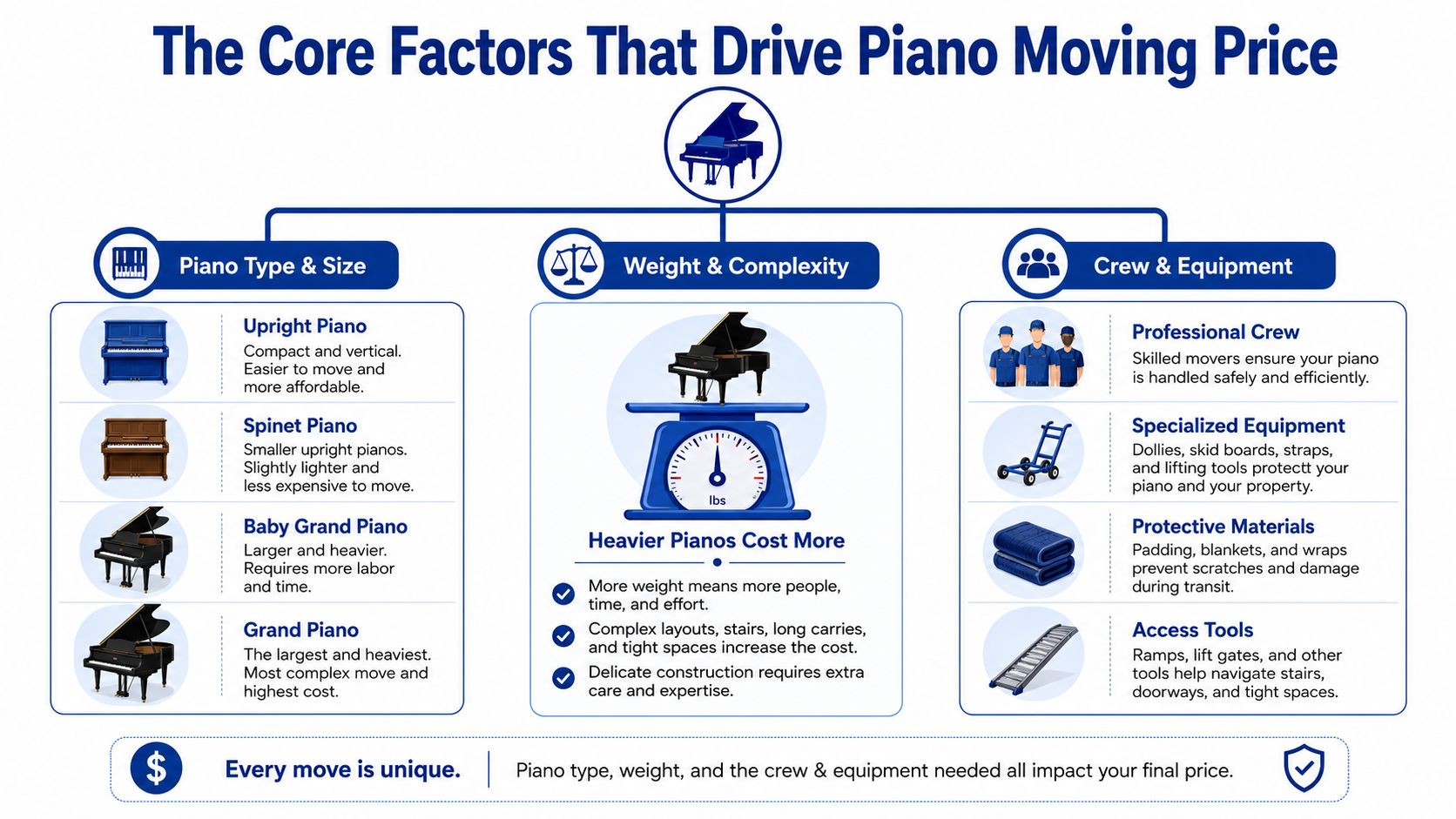
Piano type and size
A spinet or small upright is easier to manoeuvre than a baby grand or full grand, and that size difference affects how many people and what equipment are needed. Gentle Giant's local guide notes that market pricing can run from about $200 to $2,000 depending on size and weight, while broader consumer guides show local upright and grand moves in much lower or mid-range bands in other markets. That's useful as a benchmark, but in NSW the practical issue is always the same, bigger instrument, more handling, more risk, more cost.
Weight and crew size
A piano isn't just heavy, it's awkwardly weighted. A safe local move often needs three to four trained removalists, and a baby grand can require four. That matters because labour is not an invisible line item, it's the core of the job.
A cheap quote that quietly assumes too few crew members usually becomes an expensive problem on the driveway.
Distance and equipment
Same-suburb moves are priced differently from longer NSW relocations because travel time, fuel, and vehicle allocation all increase. If the job goes from Gosford to Sydney, or from the Central Coast to Newcastle, the removalist has to factor in route length and the type of truck that fits the access. For interstate work, the transport leg becomes a major part of the price because the crew may need extra travel time, and the move has to be staged around the property on both ends.
What to tell the removalist
Before you ring, have these details ready.
- Piano type: upright, spinet, baby grand, or grand.
- Access: stairs, lift, narrow doorway, steep driveway, or tight hallway.
- Parking: whether a truck can stop close to the entry.
- Property type: house, terrace, apartment, or strata building.
That short list usually tells a removalist more than a vague “it's a small move” ever will.
Local Intrastate and Interstate Price Ranges
Distance changes the way a piano job is priced, but not in the simple way many expect. A short move across the Central Coast may still be more difficult than a longer trip with easy access, while an interstate relocation brings in travel, timing, and crew logistics. The piano itself stays the same, the travel burden doesn't.
| Move Type | Typical Distance | Indicative Price Band | Main Cost Drivers |
|---|---|---|---|
| Same suburb on the Central Coast | Short local trip | Lower end of the local range | Base removal fee, access, crew size |
| Central Coast to Newcastle | Intrastate, moderate drive | Mid-range local to intrastate pricing | Travel time, stairs, parking, truck access |
| Central Coast to Sydney | Intrastate, longer drive | Higher intrastate pricing | Traffic, route length, access at both ends |
| NSW to another state | Interstate | Highest pricing tier | Distance, fuel, crew scheduling, possible overnight travel |
The point of a table like this is not to pin down an exact number, because no reputable removalist should promise one without seeing the job. It's to help you understand the tier your move falls into. A piano moved from Terrigal to Newcastle with a straight driveway will sit in a very different pricing world from the same instrument carried through a Sydney terrace staircase.
International benchmarks help frame the NSW picture. HomeAdvisor reports an average piano-moving cost of $426, with most homeowners paying between $259 and $593, while local upright moves often run $150 to $300 and local grand moves can reach $350 to $650. Thumbtack's 2025 data shows a national average of $294 and a typical range of $194 to $448, and Airtasker's 2026 guide lists a US average of $425. Those figures aren't NSW-localised, but they do show the broader pattern, simple moves stay in the low hundreds, and harder jobs move up quickly. HomeAdvisor's piano moving cost guide is the clearest published benchmark in that set.
For longer hauls, the same HomeAdvisor guide puts long-distance upright moves at $500 to $800 and long-distance grand piano moves at $1,000 to $2,000. That's why our local and interstate removals guide is worth reading if your piano is travelling beyond the local area. The route matters, but so does the loading point.
Access Add-ons That Quietly Add Up
The quote often looks fine until the access notes are added. That's where piano prices climb, because the crew isn't just carrying weight, they're managing risk through stairs, corridors, lifts, and street access. Two houses can have the same piano and produce very different invoices.
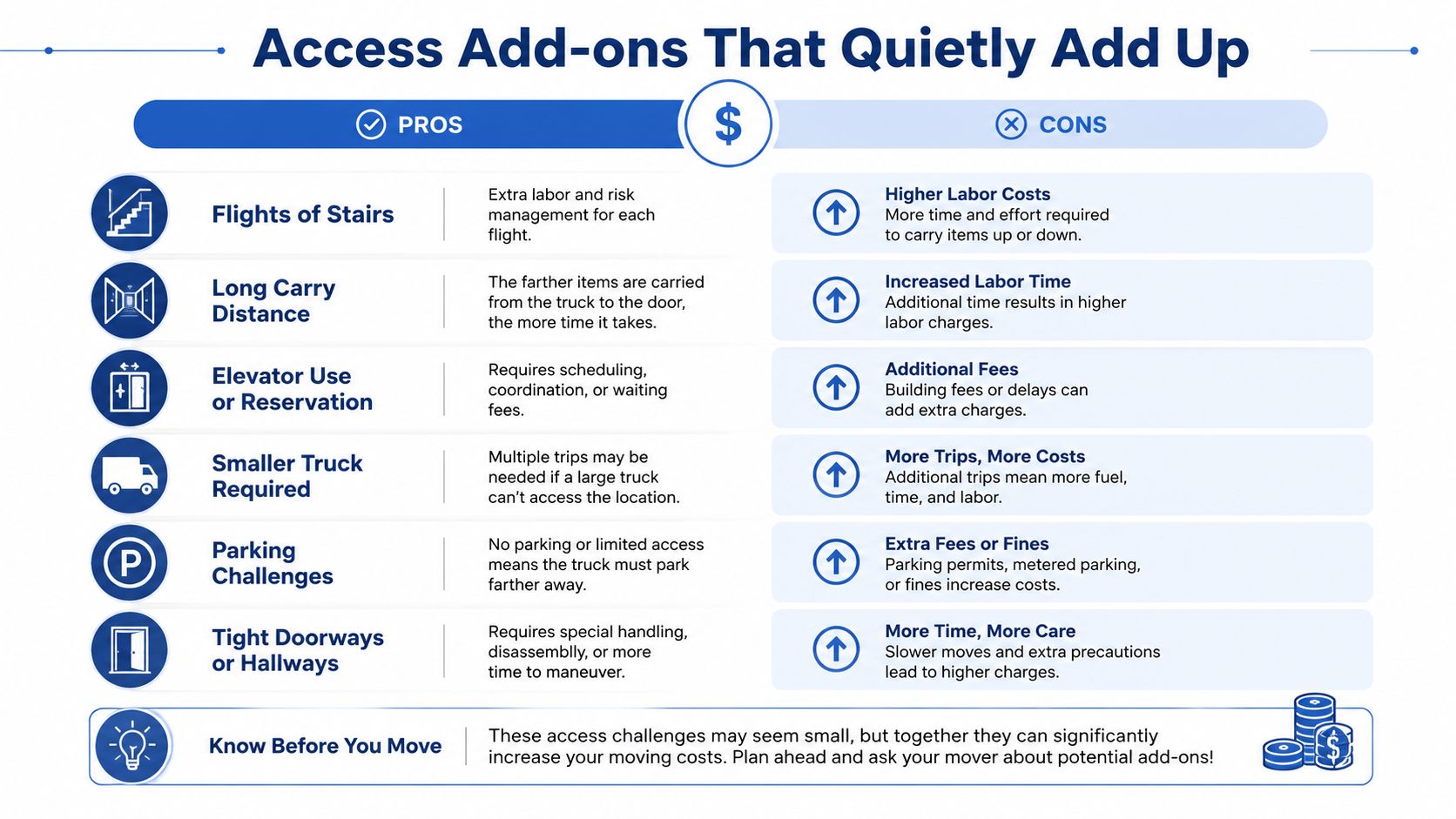
Where the extras usually appear
A Central Coast coastal cottage with a steep driveway can take more care than a flat suburban home. A Sydney apartment with a heritage staircase can slow a crew down even if the piano is only moving one block. Add a lift booking, a body corporate window, or a narrow street that forces a smaller truck, and the access costs start stacking up.
Industry pricing models commonly add per-step or per-obstacle surcharges, and one cost guide cites staircase charges of about AU$5 to AU$10 per step or AU$40 to AU$100 per staircase, with long-distance pricing then increasing further through per-kilometre fees. The important point isn't the exact figure, it's that obstacles are priced as real work, not as an inconvenience. Bernard Movers' piano moving price guide shows how stair and obstacle charges are commonly structured.
Common add-ons to ask about
- Flights of stairs: Each flight adds labour, control, and time.
- Tight hallways or doorways: Extra manoeuvring means more protection and slower progress.
- Lift bookings: Apartment lifts often need to be reserved in advance, and missed bookings can delay the job.
- Parking permits: In Sydney and Newcastle, a legal loading spot can save time and avoid fines.
- Body corporate rules: Shared areas, move-in windows, and noise restrictions all affect scheduling.
If the truck can't park close to the door, the whole move gets more expensive, even before the piano is lifted.
The best way to reduce these extras is simple. Measure the route, clear furniture, and tell the removalist about any steps, turns, or restrictions before the day arrives. That lets the crew choose the right truck and the right loading plan instead of discovering problems at the door.
Insurance Crew Size and Hidden Risk Costs
The cheapest quote isn't always the cheapest job. Once you price in breakage risk, property damage, and the possibility of a crew working unsafely, a slightly higher quote from an insured removalist can be the better deal. That matters with pianos because the instrument, the walls, and the crew are all at stake.
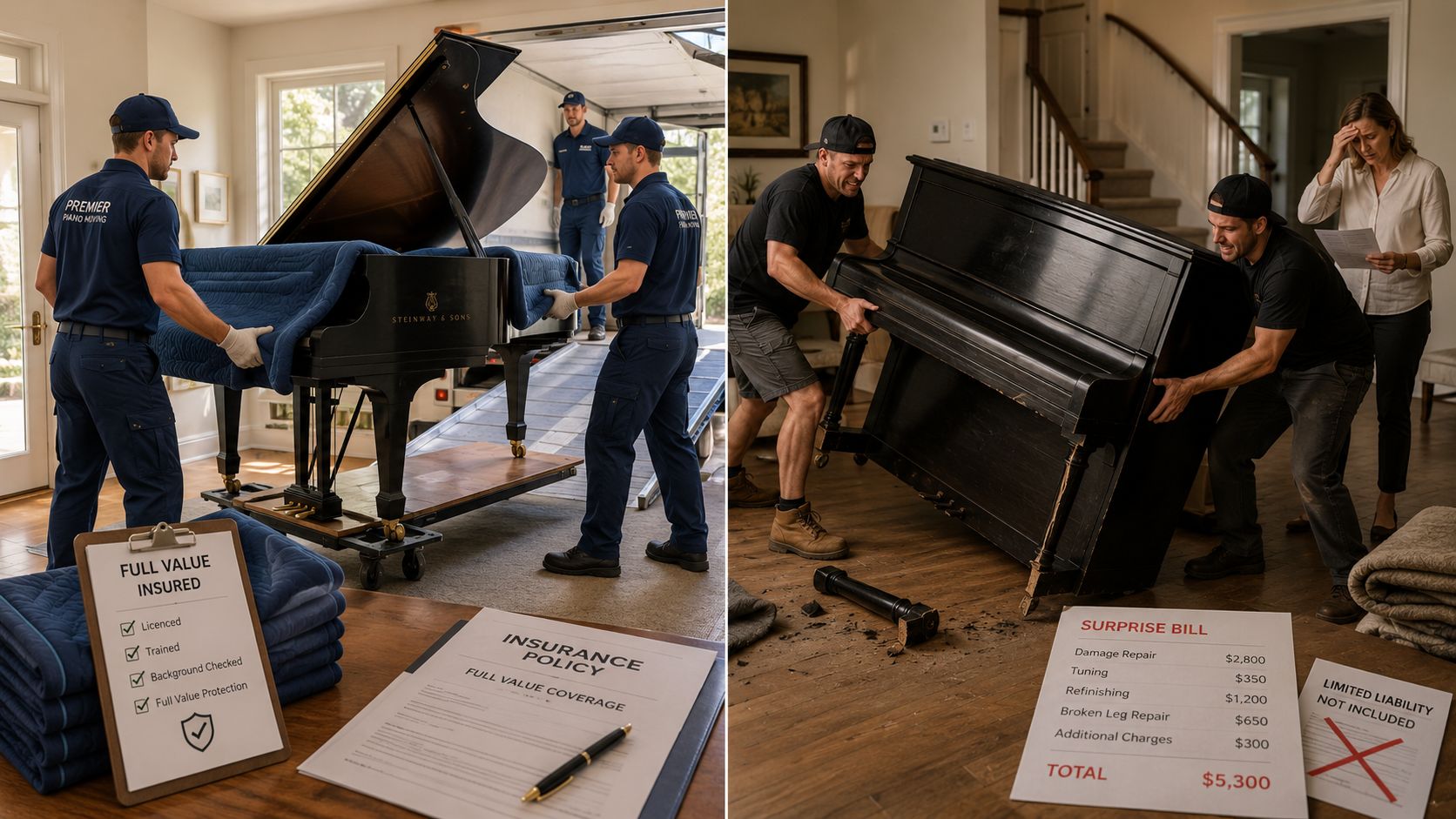
What full insurance should cover
A proper piano move should be covered for the instrument and the property, not just one side of the risk. If a crew scrapes a staircase, cracks a leg, or damages a wall, you need to know the policy is built for that kind of work. That's why moving insurance shouldn't be treated as a tick-box extra.
If you want a deeper read on policy gaps, Duncan & Associates Insurance Brokers explain why companies need to avoid costly gaps for moving firms. The useful lesson for customers is straightforward, ask what's covered, and ask it before the truck arrives.
Why crew size changes the risk
A grand piano down a steep Central Coast driveway is not a two-person job. If the crew is too small, the load gets harder to control, the risk of injury rises, and the piano becomes more vulnerable at every turn. That's where the savings disappear, because a bargain quote can turn into a damage claim or a worksite incident.
Gentle Giant's value sits in the practical side of that equation, 40 years of experience, 140-plus five-star Google reviews, and the ability to match the job to a proper crew. Their insurance for removals guide is a good reminder that insurance and experience belong in the quote conversation from the start. A price without those protections is not really a complete price.
A well-resourced crew protects the piano, the property, and the people carrying it.
The question to ask is simple. How many removalists will be there, what insurance is included, and what happens if access is harder than expected? If the answers are vague, the quote probably is too.
Practical Ways to Keep the Bill Down
You can lower the cost without cutting corners, but only if the preparation is good. A removalist can work faster, safer, and with fewer surprises when the path is clear and the booking details are settled early. That's the place to save money.
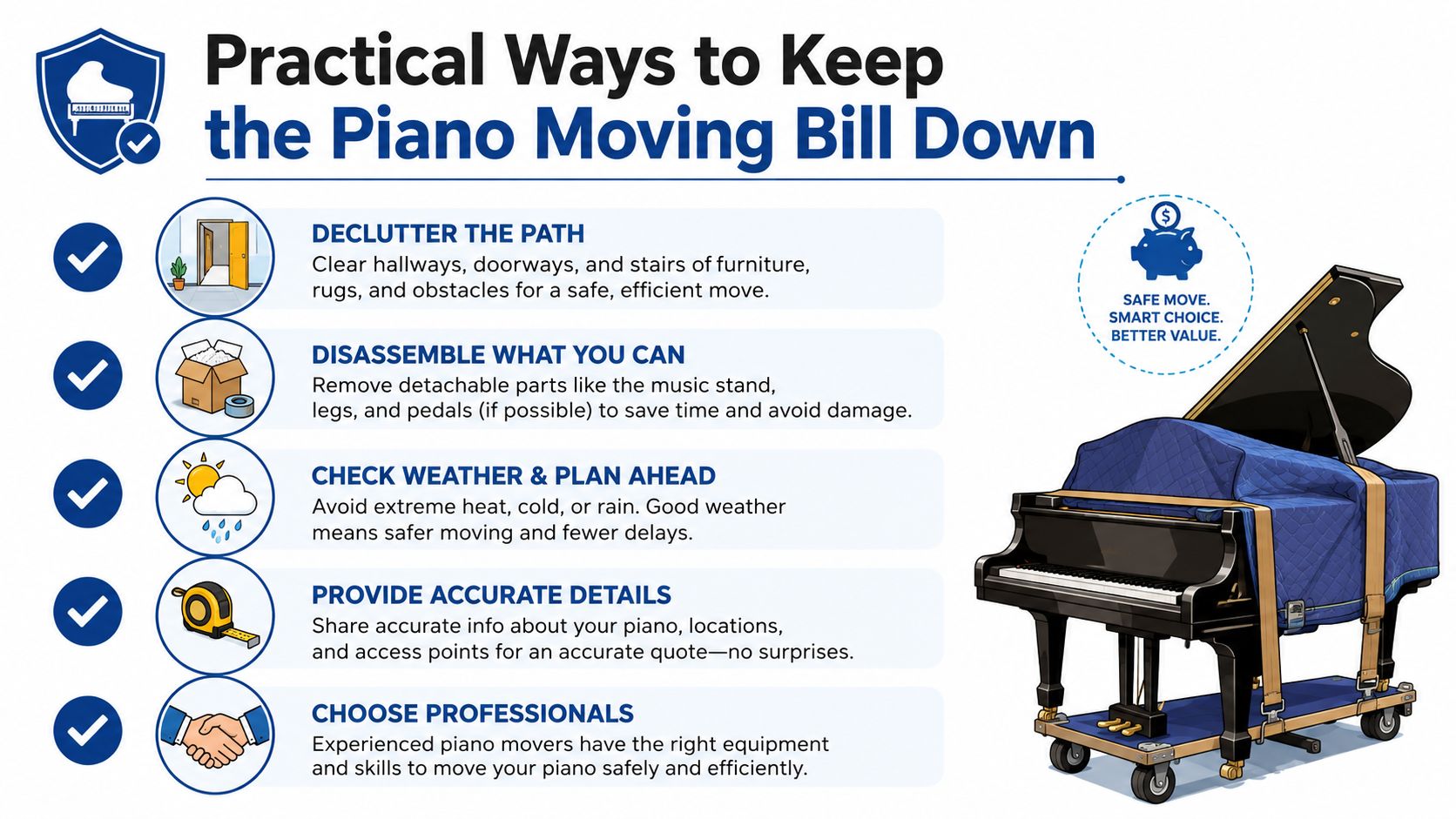
What to do before the crew arrives
- Declutter the path: Move rugs, plants, chairs, and side tables out of the route.
- Remove internal doors if needed: If a tight doorway is the problem, giving the crew extra width can save time.
- Book the lift early: Apartment buildings in Sydney and Newcastle often require lift reservations.
- Sort parking in advance: A permit or legal loading zone can stop the job from stalling.
- Be ready at the start time: Idle minutes still cost money if the crew is waiting on access or keys.
Timing matters too. Mid-week and mid-month bookings usually give you more flexibility than peak periods, especially around school holidays and public holiday weekends. If your move date is flexible, ask about the quieter windows.
Packing and protection also matter. A piano doesn't need the same packing materials as a dining setting, but it does need the right blankets, straps, and clear access. If the instrument has a delicate finish, tell the removalist before the day so they can plan the protection properly.
The more accurately you describe the job, the less likely you are to pay for guesswork.
Be honest about tuning as well. If the piano only needs a basic re-level after the move, say so. If it needs post-move tuning, that should be discussed separately so the quote reflects the full job rather than an assumption.
Getting an Accurate Quote from Gentle Giant
The fastest way to get a useful quote is to send the details that change the job on the day. That means the piano type, access photos, stairs, driveway slope, parking limits, and any body corporate rules or move-in windows. A quick phone estimate works for straightforward jobs, but an in-home assessment or virtual walkthrough is better when the access is tight or the building rules are strict.
Gentle Giant offers free, no-obligation quotes, and their removalist cost calculator is a sensible place to start if you want a rough budget before speaking to the team. The company also notes hourly rates from $110, a fleet of 12 trucks, and services that include piano relocations, end-to-end packing, storage coordination, and vacate cleaning. That combination matters because the right truck size and the right crew can change the final cost without changing the move itself.
What to send with your enquiry
- Photos of the piano: Include the front, sides, and any surrounding obstacles.
- Access shots: Show stairs, driveways, tight turns, and entry doors.
- Building details: Mention lifts, strata rules, and booking windows.
- Timing needs: Tell them if the move has to fit around work, children, or building restrictions.
A written quote is only as good as the information behind it. If you want the number to be budgetable, give the removalist enough detail to see the actual job. One of the simplest options is to ask for a phone estimate first, then a virtual walkthrough or in-home assessment if anything looks tight.
A Simple Pre-Move Checklist for Piano Owners
The price comes down to piano type, distance, access, and crew size. Ask about stairs, parking, lifts, and body corporate rules before you book. Make sure the team has full insurance and the experience to handle a piano safely, especially on NSW properties with slopes, terraces, or narrow streets.
If you want a clear number you can plan around, ask for a free quote from an experienced removalist who understands Central Coast, Newcastle, Lake Macquarie and Sydney access. Gentle Giant Removals & Relocations has the trucks, crew, and planning experience to handle piano relocations with care, and owner Michael Byrne's 40 years in the trade still show up in the way the job is scoped. For a more direct look at the service, see the piano mover page.
If you're planning a piano move on the Central Coast, in Newcastle, Lake Macquarie, or Sydney, visit Gentle Giant Removals & Relocations to request a free quote or a free in-home assessment. If the move is urgent, call the team and give them the piano type, access details, and preferred date so they can match the right crew to the job.