

When you're planning a relocation, one of the first questions that pops into your head is probably, "Are my belongings protected?". It’s a big deal. Professional removalists like us offer specific insurance for removals to cover your goods while they're in our care, from the moment we pick them up until they’re placed in your new home. Think of it as a dedicated safety net just for your move.
What Is Removalist Insurance and Why Do You Need It?
It's easy to assume your standard home and contents policy has you covered, but that’s rarely the case. Most policies simply don't cover your belongings once they leave your property and are in transit. This creates a risky gap right when your possessions are most vulnerable.
Imagine you're moving your family home from Gosford on the Central Coast up to a new place in Newcastle. This is where specialised removalist insurance, often called Goods in Transit insurance, becomes essential. It’s designed specifically to fill that gap, protecting your belongings from the second we start loading the truck until the last box is safely inside your new home. It’s the genuine peace of mind you need when all your worldly possessions are on the road.
Common Types of Cover
To make it clearer, let’s quickly run through the common types of insurance you’ll come across. Each one has a different job to do when it comes to protecting your relocation.
Types of Removalist Insurance at a Glance
Here's a quick summary of the common insurance options available when you move, clarifying what each one typically covers.
| Insurance Type | What It Covers | Best For |
|---|---|---|
| Goods in Transit | Your personal belongings against damage or loss while being moved. | Every residential and commercial relocation. |
| Public Liability | Accidental damage to property (e.g., walls, floors, lifts) at either location. | Moves in apartments, strata buildings, and any property. |
| Full Replacement | Covers the cost to replace an item with a new one if it's damaged beyond repair. | Protecting high-value or essential items. |
Choosing a fully insured removalist isn't just a good idea—it's a non-negotiable for a successful relocation. The Australian removals industry has plenty of operators, but not all offer the same level of protection.
With the increasing frequency of extreme weather events in NSW, like the 2024 storms that led to 21,200 claims costing $332 million, proper insurance is more critical than ever. You can see more data on insurance trends from the Insurance Council of Australia to understand why this protection matters so much. Ultimately, it ensures that no matter what happens on the road, you’re not left out of pocket.
Why Your Home Insurance Is Not Enough
"Won't my home and contents insurance cover my move?" It’s a question we hear all the time, and it’s a perfectly logical one. But relying on it is one of the riskiest gambles you can take during a relocation.
The simple truth is that standard home policies are designed to protect your belongings while they're safely inside your house—not while they're on the back of a truck cruising down the M1 between Sydney and the Central Coast.
The Transit Exclusion Clause
Most home insurance policies have a sneaky little clause in the fine print called a "goods in transit" exclusion. This basically means that once your items leave your property and are in the hands of a third party (that’s us, your removalist!), your coverage often stops dead.
This leaves a huge gap where your most prized possessions are at their most vulnerable.
Imagine you're moving from a high-rise apartment in Sydney to a new home on the Central Coast. During the move, a box holding your brand-new TV is accidentally dropped in the building's carpark. If you try to claim on your home and contents policy, the insurer will almost certainly point to that transit exclusion clause and deny the claim.
The damage happened outside your insured address and while the item was in our care. That fine print can leave you footing the entire bill for a replacement. To see how these policies work on your property, it's worth checking out a good guide to home insurance claims to understand what they're designed for.
Professional Removalist Insurance Fills the Gap
This is exactly why professional removalists like us have specialised Goods in Transit insurance. Our policy is built specifically to cover that gap your home insurance creates.
It protects your belongings from the moment we start handling them right up until they are placed safely inside your new home. This specialised cover is your financial safety net against the unexpected—an accident, theft, or damage during the relocation. It’s the critical difference between a fully protected move and a risky one.
Key Takeaway: Your home insurance protects your belongings at your home. A removalist’s Goods in Transit insurance protects them between homes. Never assume one does the job of the other.
This distinction becomes even more important if your relocation involves a stint in storage. Many home policies also won't cover items in an external storage unit, creating yet another potential gap in protection. If you think you might need this service, have a read of our guide on preparing items for short term storage solutions to make sure they stay protected.
Always have a chat with your removalist to be crystal clear on how their insurance works if storage is part of your moving plan.
What Your Removalist’s Insurance Actually Covers
Figuring out removalist insurance can feel a bit daunting. But once you know that your standard home and contents policy won’t cover your gear while it's on the road, it gets much simpler.
Think of it like car insurance. You have basic options that offer limited protection and more comprehensive choices for complete peace of mind. Knowing what's what helps you make sure your valuables are properly protected from door to door.
Goods in Transit Insurance
This is the big one. Goods in Transit insurance is the specific policy that protects your personal belongings against damage or loss while they are in our care. It kicks in the moment we start loading the truck and ends when we deliver everything safely to your new home.
Let’s say we’re moving your furniture from Terrigal to a new apartment in Newcastle. If a box is accidentally dropped or a piece of furniture gets damaged on the journey, our Goods in Transit policy is what covers the repair or replacement. It’s the fundamental safety net for your possessions while they're on the move.
Public Liability Insurance
While Goods in Transit covers your stuff, Public Liability insurance covers the property we’re working in and around. This policy is designed to pay for any accidental damage to third-party property—that means your old home, your new place, or common areas like lifts and hallways in an apartment complex.
For example, if a wall gets scuffed while we navigate a tight corner in a Sydney terrace house, our Public Liability cover handles the repair costs. This protects you from being held responsible for property damage, which is a huge relief, especially in strata buildings with strict body corporate rules about shared areas.
This chart shows exactly how a removalist’s insurance provides specific cover that your home insurance doesn’t.
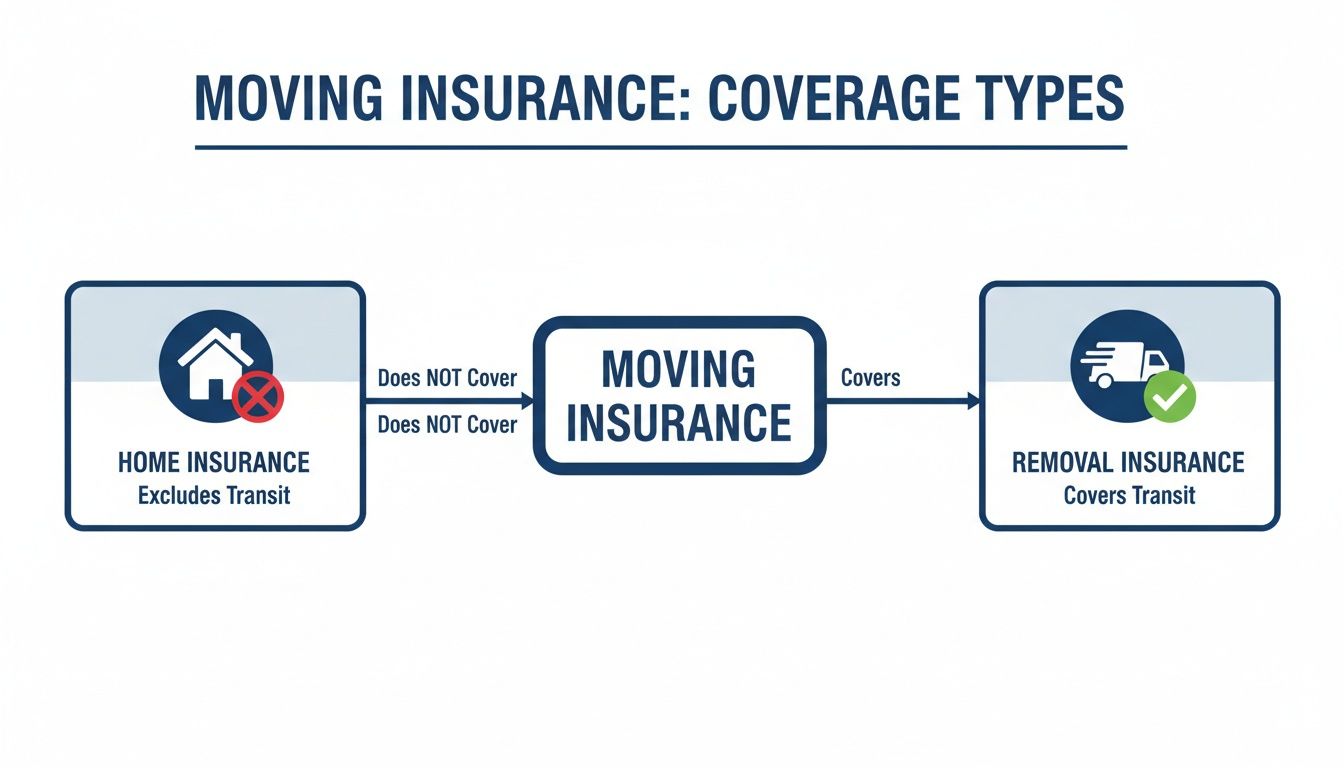
As you can see, home insurance is for when your home is static. The moment things start moving, you need a policy built for transit.
Key Difference: Goods in Transit covers your belongings. Public Liability covers the building. Any professional removalist worth their salt must have both.
Full Replacement Cover
If you have items that are especially valuable, you can also talk to us about Full Replacement Cover. This is a higher tier of protection that ensures if an item is damaged beyond repair, the policy will pay out the cost of a brand new equivalent, not just its secondhand value.
This is a great option for high-end electronics, artwork, antiques, or anything with significant sentimental and financial worth. It gives you the highest level of financial security for your most treasured possessions. For very delicate or heavy items, it's always smart to explore your options. You can learn more about the care required in our guide on what to look for in a professional piano mover.
Knowing about these policies helps you ask the right questions to make sure you're properly covered. A trustworthy removalist will always carry these policies as standard and be completely transparent about what they include. To get a deeper understanding, it’s useful to read up on policies like Motor Truck Cargo Insurance, which is the specific cover transport companies hold for goods in transit. This level of professional cover is what separates a reliable removalist from a risky gamble.
How Removalist Insurance Costs Are Calculated
We get asked about insurance costs a lot, and while we can’t give you an exact price on the spot, we can walk you through what goes into it. Understanding how your premium is calculated isn't just about budgeting; it’s about seeing insurance for what it is—a smart investment in protecting your belongings.
There’s no secret formula. Let’s pull back the curtain and show you exactly what shapes the cost.
The biggest piece of the puzzle is the total value of your goods. We call this the ‘declared value’. It’s pretty straightforward, really. The more your things are worth, the more it costs to insure them.
It just makes sense when you think about it. Insuring a modest one-bedroom unit in Terrigal is naturally going to cost less than covering a large five-bedroom family home in Wahroonga filled with antiques and high-end electronics.
Declared Value: The Starting Point
So, what is the declared value? It's simply your own assessment of what it would cost to replace everything you’re moving. To make this easier, we give you a form to help you inventory your items and put a value on each one.
This figure is the foundation for your insurance premium, so getting it right is crucial. Underestimating the value might save you a few dollars upfront, but it could leave you seriously short-changed if you ever need to make a claim.
Other Key Cost Factors
Beyond the total value of your gear, a few other things play a big role in figuring out the final cost of your removalist insurance.
Type of Cover: It’s a bit like car insurance—a basic policy costs less than a comprehensive one. Full Replacement Cover, which replaces damaged items with brand-new equivalents, will have a higher premium than a policy that only covers the current, depreciated value.
Distance of the Relocation: The length and complexity of the journey directly impact the risk. A local relocation within the Central Coast carries less risk than a big interstate relocation from Sydney to Queensland, which means more time on the road and more handling.
High-Value Items: If you own special high-value pieces like artwork, a piano, or jewellery, they often need to be listed separately. Insuring these items might add to the premium, but it’s the only way to ensure they are covered for their full worth.
Knowing how these factors work together helps put the cost into perspective. For instance, industry data shows that fully insured intrastate relocations in Australia can range from $300 to $3,500, while interstate moves might cost between $2,000 and $6,000. These figures reflect the genuine value of proper protection, which is a core part of what any reputable removalist provides. You can dig deeper into current trends in the Australian removals industry to see why professional, insured services are worth it.
When you’re putting your budget together, it’s useful to see how all the costs fit. To get a clearer idea of the moving costs themselves, you might want to read our guide on the cost of removalists in Sydney. It’s a great companion piece to understanding your insurance expenses. Our team is always here to walk you through the options and help you find the right level of cover for your needs and budget.
What to Do If Something Goes Wrong: Navigating the Claims Process

Even with the most careful planning and a professional team, life can be unpredictable. At Gentle Giant, our top priority is getting your belongings to their new home safely, but we also believe in being ready for anything. Knowing exactly what to do in the rare event of an accident gives you enormous peace of mind.
Think of it like this: you hope you'll never need it, but you're glad the process is there. A clear claims procedure is a core part of any good insurance for removals policy. We want you to feel supported from the first box we pack right through to a successful resolution if an issue ever comes up. It’s all about accountability.
What to Do Immediately If You Spot Damage
If you notice an item has been damaged when we unload, the most important thing is to act quickly. Don't worry or panic; just follow a couple of simple steps to get the process started on the right foot.
The very first thing you should do is let our team leader know right away, before they leave your property. Point out the issue so we can see it firsthand. Next, grab your phone and take clear photos of the damage from a few different angles. This documentation is vital for the claim.
These initial steps are crucial. They create an immediate and clear record of the incident, which makes the entire claims process much smoother for everyone involved.
The Role of Your Inventory List
Remember that inventory list or 'condition report' you signed before we started loading the truck? This document becomes incredibly important if a claim is necessary. It serves as our shared record of the condition of your items before the relocation began.
When we deliver your belongings, we’ll ask you to check them and sign off again. This is your chance to note any problems or discrepancies. By comparing the 'before' and 'after' states, we have a clear, undisputed basis for the insurance claim, preventing any "he said, she said" confusion.
Our Promise: If you need to make a claim, you won't be navigating a maze of paperwork alone. We will personally guide you through every step, liaising with our insurer on your behalf to ensure a fair and timely resolution.
The Australian general insurance sector is well-equipped to manage claims efficiently. Events like the Newcastle Hailstorm, which resulted in $377 million paid out from 27,500 claims, show the system's capacity to respond. This robustness is reassuring, as it means insurers are prepared to handle claims properly. You can learn more about recent general insurance industry insights to see how the industry operates.
Demystifying the Paperwork and Timelines
Once you've notified us and documented the damage, we'll give you a straightforward claim form. We’ll help you fill it out correctly, attaching your photos and referencing the inventory list. Our administrative team then lodges it directly with our insurer.
While every case is different, most claims are reviewed within a few weeks. The insurer will assess the damage, review the policy, and determine the settlement, which could be for repair or replacement depending on your cover. We’ll keep you in the loop the whole time, so you're never left wondering what's happening. Our commitment doesn't end when the truck drives away; we’re here until the job is well and truly done.
Key Questions to Ask Your Removalist About Insurance
When you're comparing removalists, it’s easy to get bogged down in quotes and reviews. But there’s a crucial step many people miss: asking some direct questions about their insurance for removals.
This isn't about being difficult; it's about being smart. A few pointed questions will quickly separate the true professionals from the rest. Any reliable removalist will be ready and willing to give you clear answers, proving your relocation across the Central Coast, Sydney, or interstate is in safe hands.
What to Ask Before You Book
Think of this as your first line of defence. The answers you get here will tell you almost everything you need to know about a company's professionalism and accountability.
"Can I please see a copy of your Certificates of Currency?"
This is non-negotiable and the most important question of all. A Certificate of Currency is the official proof from an insurer that a business has an active policy. It lists what they're covered for (like Goods in Transit and Public Liability), the policy limits, and the expiry date. A professional will have these on hand. If a company hesitates or refuses to show you, that’s a massive red flag."What is your claims process if something is damaged?"
The answer should be straightforward. A good removalist can walk you through their exact process, which should sound organised: you notify the team on the spot, document everything, and they guide you through the paperwork. If their explanation is vague or confusing, it’s a good sign their process is too.
Understanding the Finer Details
Once you've confirmed they have active insurance policies, it’s time to dig into the nitty-gritty. These questions will clarify exactly what happens if an accident occurs, so you're not hit with any nasty surprises.
"Who is responsible for paying the insurance excess?"
Just like car insurance, most business policies come with an excess that's paid when a claim is lodged. You need to know who foots that bill. Reputable companies almost always absorb this cost as part of their service. Be very cautious of any removalist who expects you to pay the excess on their insurance policy."Does your insurance cover damage to the building?"
This is a great way to test their knowledge of Public Liability insurance. A confident removalist will immediately tell you that their policy covers damage to property—including walls, floors, lifts, and common areas in strata buildings. This protects you from being on the hook for a scuffed hallway in Newcastle or a dented lift door in a Sydney high-rise.
By asking these pointed questions, you empower yourself to identify a truly professional and fully insured operator. It’s not about being difficult; it’s about being a savvy consumer protecting your valuable assets.
Asking the right questions is a critical step in planning any relocation. For more ideas on what to discuss with potential removalists, check out our guide on other questions you should be asking moving companies.
Frequently Asked Questions About Removalist Insurance
We get asked about removalist insurance all the time. It’s a topic that can feel a bit confusing, so we’ve put together answers to the most common questions we hear from clients moving across the Central Coast, Sydney, and Newcastle to give you clarity and confidence.
Does Insurance Cover Boxes I Pack Myself?
This is a great question, and it’s one we hear a lot. The short answer is: it depends.
When we professionally pack your boxes with our packing materials, everything inside is fully covered. If you choose to pack your own boxes, our insurance will still cover them for major events like being dropped or damaged in transit. However, if an item breaks because it wasn't packed securely inside the box, the insurance may not apply.
It’s always best to have a chat with us about this beforehand. We can talk you through the specifics so you know exactly what your cover looks like.
What If My Apartment Building Gets Damaged?
This is what Public Liability insurance is for, and it’s something every legitimate removalist must have. This policy is designed to cover accidental damage to third-party property – which includes the building you’re moving out of or into.
Think about a scuffed wall in a tight Sydney corridor or an accidental dent in a lift in a Newcastle apartment complex. Our Public Liability insurance is there to handle the repair costs. This is one of the biggest reasons to steer clear of uninsured operators. If they cause damage, you could be left personally responsible for the bill, especially in strata buildings with strict body corporate rules.
Are My Belongings Covered While in Storage?
This all comes down to the type of cover you have. Standard transit insurance typically only protects your belongings while they're on the move from point A to point B.
If you need to put your items into storage, even for a short time, you’ll usually need a separate storage insurance policy to keep them protected. We can help you arrange both storage and the right insurance to go with it, making sure there are no gaps in your cover. Just let us know your storage plans upfront.
For more answers to common moving questions, feel free to check out our main FAQ page.