
You’re probably standing in front of a cupboard or display shelf right now, looking at the things you’d least like to see broken. Glassware from your wedding, the mirror that barely made it into your current place, a TV that cost more than you care to remember. That worry is normal. It’s also manageable.
Fragile items don’t survive a move by luck. They survive because someone used the right packing materials, packed each item for the trip it’s taking, and loaded everything with care. That matters whether you’re moving from a unit in Gosford to a family home in Newcastle, or heading from the Central Coast into a tight-access Sydney apartment building.
If you’re organising protection beyond standard transit arrangements, it’s also worth understanding options like shipping insurance so you know exactly where responsibility sits before moving day. Good packing lowers the risk. Clear cover lowers the stress.
Your Guide to a Damage-Free Move
The first mistake often made is treating all fragile items the same. A dinner plate, a lamp base, a framed print and a television might all be breakable, but they fail in different ways. Plates crack under pressure, glassware chips when it knocks together, artwork gets corner damage, and electronics suffer from impact and poor support.
We handle these jobs across the Central Coast, Sydney, Newcastle and Lake Macquarie, and the pattern is always the same. Damage usually starts long before the truck leaves. It starts with weak cartons, rushed wrapping, half-filled boxes, or labels that don’t tell anyone the essential details.
The good news is that how to pack fragile items for moving isn’t complicated once you understand the method. Use the right carton. Wrap each piece properly. Stop movement inside the box. Seal it well. Label it so the removalist crew can load it in the safest position.
Fragile packing works best when you think in layers. Item protection, box strength, then safe loading.
Gathering Your Essential Packing Materials
Buy your packing materials before you pack the first item. If you start with whatever’s in the garage, you’ll make compromises all the way through the job.
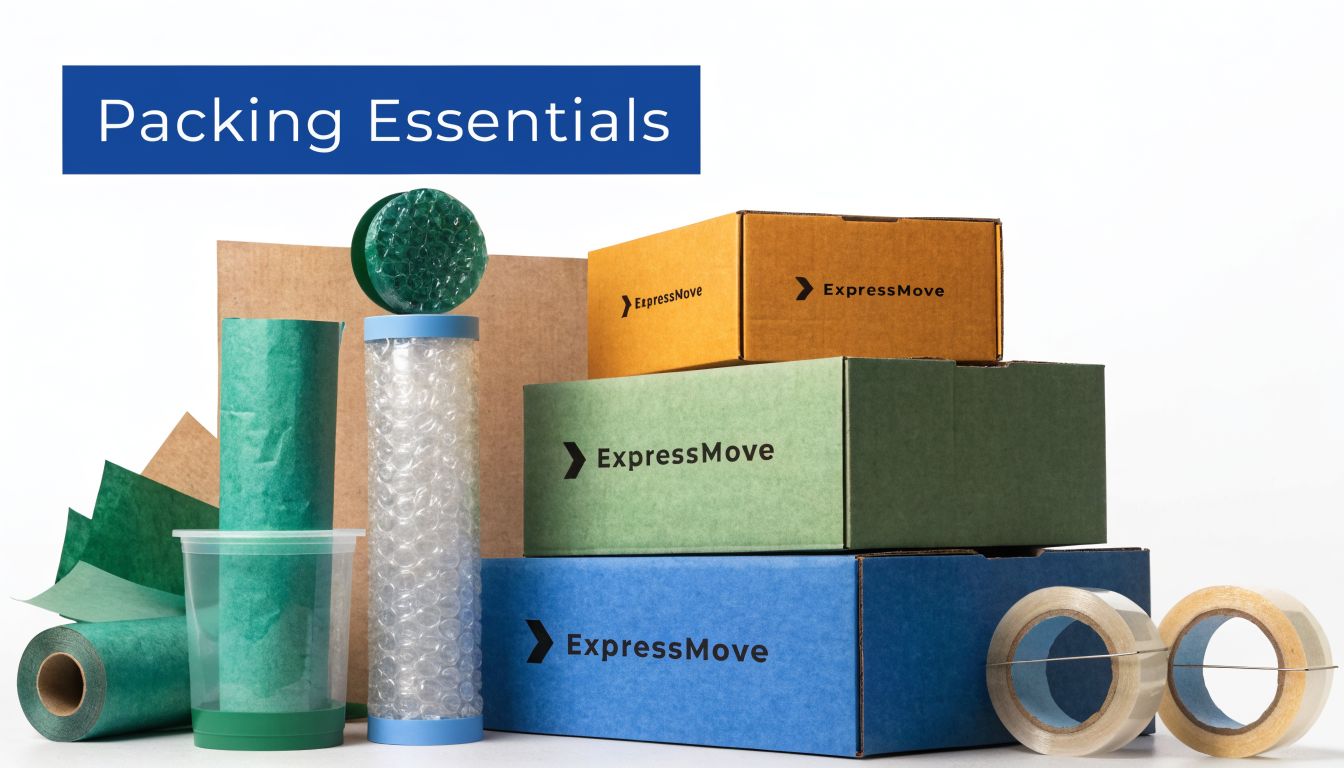
The foundation is the carton itself. For fragile items, use small-to-medium double-walled heavy-duty boxes no larger than 18x18x16 inches. The reason is simple. Large cartons invite overpacking, and overpacked cartons fail. The Australian Furniture Removers Association reports that boxes overpacked by more than 20kg increase their risk of collapsing during transit by 35%, which is a major cause of fragile item damage (AFRA guidance cited here).
Start with the cartons that suit the job
A standard supermarket box might be fine for linen. It isn’t good enough for crystal, ceramics or framed décor. Double-walled cartons resist crush pressure better, stack more safely in the truck, and hold their shape if conditions are a bit damp.
That last point matters on the Central Coast. Coastal air and damp mornings can soften poor-quality cardboard fast, especially if cartons are left in a garage overnight or staged outside while access is being sorted.
Three cartons usually cover most fragile packing needs:
- Dish pack boxes for crockery, serving pieces and heavier kitchen breakables
- Cell boxes for stemware, tumblers and smaller decorative glass items
- Small heavy-duty cartons for mixed fragile items that need cushioning but not much stacking weight
If you want a fuller rundown of what to buy and why, this guide to essential packing materials for a damage-free move is a practical place to start.
Use wrapping materials for different jobs
People often grab one material and use it for everything. That usually means too much bubble wrap in the wrong places and not enough structural fill inside the carton.
Packing paper is your first wrap. It protects surfaces, stops rubbing and lets you wrap tightly around awkward shapes. Bubble wrap is your cushioning layer. It absorbs bumps and vibration. Cardboard dividers create separation between fragile pieces that should never touch.
Avoid newspaper on anything delicate or light-coloured. Ink transfer is real, and cleaning it off after the move is frustrating.
A practical setup looks like this:
| Material | Best use | What it prevents |
|---|---|---|
| Packing paper | First wrap on plates, glassware, ceramics | Surface scratches and rubbing |
| Bubble wrap | Outer cushioning layer | Shock from knocks and bumps |
| Cardboard dividers | Glasses and stemware | Items hitting each other |
| Quilted pads | TVs, mirrors, framed items | Surface impact and edge damage |
| Packing tape | Sealing and reinforcement | Carton failure at seams |
Don’t forget the tools
A good tape gun saves time and gives cleaner seals. Permanent markers matter because “Fragile” on its own isn’t enough. You also want room names, orientation arrows and a short content note.
If you’re short on time, reusable packing materials can make life easier. Refundable-deposit boxes and porta robes are handy for organised packing, especially if your move has a fixed building window or lift booking. They reduce waste and they stack neatly, which helps on moving day.
Practical rule: If the carton bends when you lift it empty, don’t trust it with anything breakable.
Mastering the Art of Packing Common Household Fragiles
Most household breakage comes from ordinary items packed the wrong way. The fix isn’t more tape. It’s better technique.
A useful rhythm is wrap, cushion, place, fill. Wrap the item so surfaces are protected. Cushion the base of the carton. Place each piece in a stable position. Fill every gap so nothing moves when the box is carried, stacked or loaded.
Plates and bowls
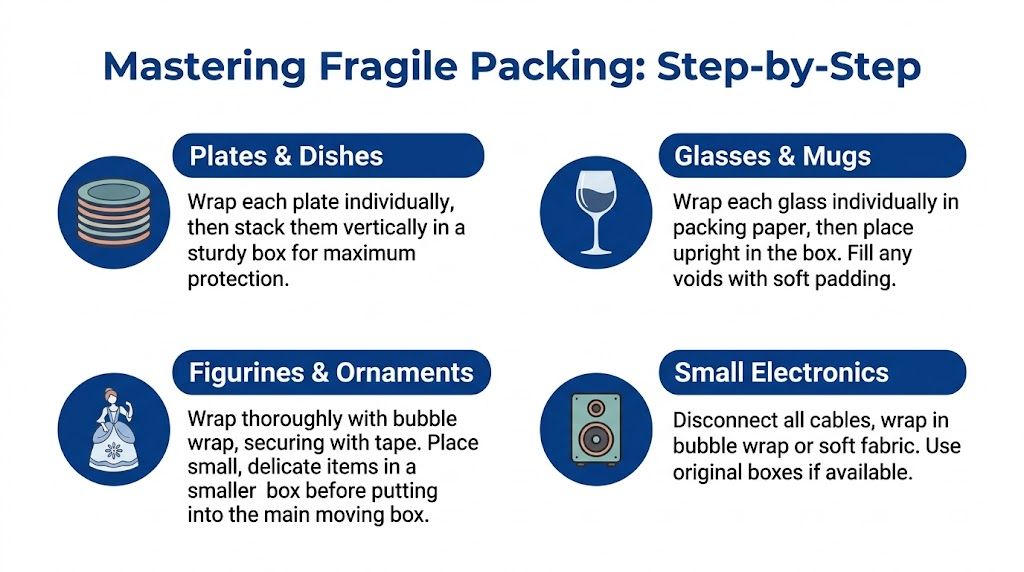
Plates should never be laid flat in a stack at the bottom of a carton. That feels tidy, but it exposes the broad face of each plate to downward pressure.
A 2022 Choice Australia survey of 5,000 NSW households found that vertically stacking plates reduces damage by 45% compared to flat packing (details here). Think of records on a shelf rather than pancakes in a pile.
Here’s the method that works:
- Lay out packing paper on a flat surface.
- Wrap each plate individually.
- Add cushioning around the bundle if the plate is delicate or valuable.
- Build a soft paper base in the carton.
- Stand plates on edge in the box.
- Add paper between rows if needed.
- Fill side gaps and top gaps so the contents can’t sway.
Bowls and serving dishes can be packed in layers, but they still need separation. The heavier pieces go lower in the carton, with lighter pieces above them. Don’t wedge them so tightly that unpacking becomes a wrestling match.
If you’re packing out a full kitchen, these dedicated kitchenware packing tips will help you sort fragile cookware, crockery and pantry items room by room.
Glassware and stemware
Glasses break for two reasons. They knock together, or pressure lands in the wrong place. Stemware is especially vulnerable because the bowl, stem and base all react differently when the box shifts.
The benchmark method is to wrap each item individually in 2 to 3 sheets of paper and use dedicated cell boxes. AFRA benchmarks cited in the same source note that this technique withstands impacts up to 50kg in 90% of tests.
That sounds technical, but the practical takeaway is straightforward. Separation matters.
Use this sequence:
- Stuff the hollow lightly: A little paper inside the bowl or cup helps support the shape.
- Wrap from the weakest point outward: For stemware, protect the stem and base before finishing around the bowl.
- Place upright in the cell: Don’t force oversized glasses into undersized slots.
- Fill unused cells or gaps: Empty spaces invite movement.
Mugs are simpler, but handles still need protection. Wrap the handle area with extra paper so it doesn’t take the full hit if the carton is set down firmly.
Figurines, ceramics and decorative pieces
Decorative items are awkward because they’re rarely uniform. One figurine might have a narrow neck, another has protruding arms, another is all sharp corners.
Overconfidence often causes damage. If it looks delicate, pack it as an individual item, not as part of a “miscellaneous décor” box.
A good approach is to create a small inner bundle first. Wrap the piece in paper, then add bubble wrap, then place it inside a smaller carton or a tightly padded section of a larger carton. Fragile ornaments should never rattle if you gently move the sealed box.
If you hear movement, the box isn’t packed yet.
For sets of ornaments, don’t let the pieces touch. Shared boxes are fine. Shared surfaces are not.
Lamps and shades
Lamps are two jobs, not one. The base is usually heavy and breakable. The shade is light but crush-prone.
Remove the bulb. Remove the harp if there is one. Tape cords neatly so they don’t swing around and scratch the base. Wrap the base with paper first, then padding. Pack it upright if shape allows, or brace it tightly inside a carton.
Shades should be packed separately where possible. Don’t cram other items inside a fabric shade to “save space”. It often warps the frame, marks the lining, or leaves you unpacking a bent shade at the other end.
Small electronics
Electronics aren’t just fragile on the outside. Internal components don’t like impact, loose cables or pressure on the wrong side.
Original packaging is usually best because it was made for that item’s shape. If you still have it, use it. If not, choose a sturdy carton with enough space for wrap and side padding.
Before packing:
- Photograph the cable setup: Handy for routers, speakers and home office gear.
- Bag and label accessories: Remotes, chargers and leads disappear fast during a move.
- Protect screens and glossy surfaces: Use soft wrap first so rough materials don’t mark them.
For a short relocation from Terrigal to Newcastle, poor packing might still show up as a cracked screen or loose internal component because the issue isn’t distance alone. It’s lifting, loading, braking, cornering and rehandling.
What doesn’t work
Some methods look efficient but fail in transit. A few to avoid:
- Loose fill only: Peanuts or crumpled paper without proper individual wrapping won’t protect sharp edges or thin glass.
- One giant fragile box: It becomes too heavy, hard to carry, and risky to stack.
- Taping directly to delicate surfaces: Adhesive can mark finishes or leave residue.
- Mixing heavy and delicate without separation: A vase beside a cast-iron trivet is asking for trouble.
The safest cartons are boring when you lift them. No shifting, no clinking, no surprises.
Safely Preparing Large and Awkward Fragile Items
Large fragile items create a different problem. They usually can’t be tucked safely into a standard carton, and they’re often the first things people try to “just wrap in a blanket” and hope for the best.
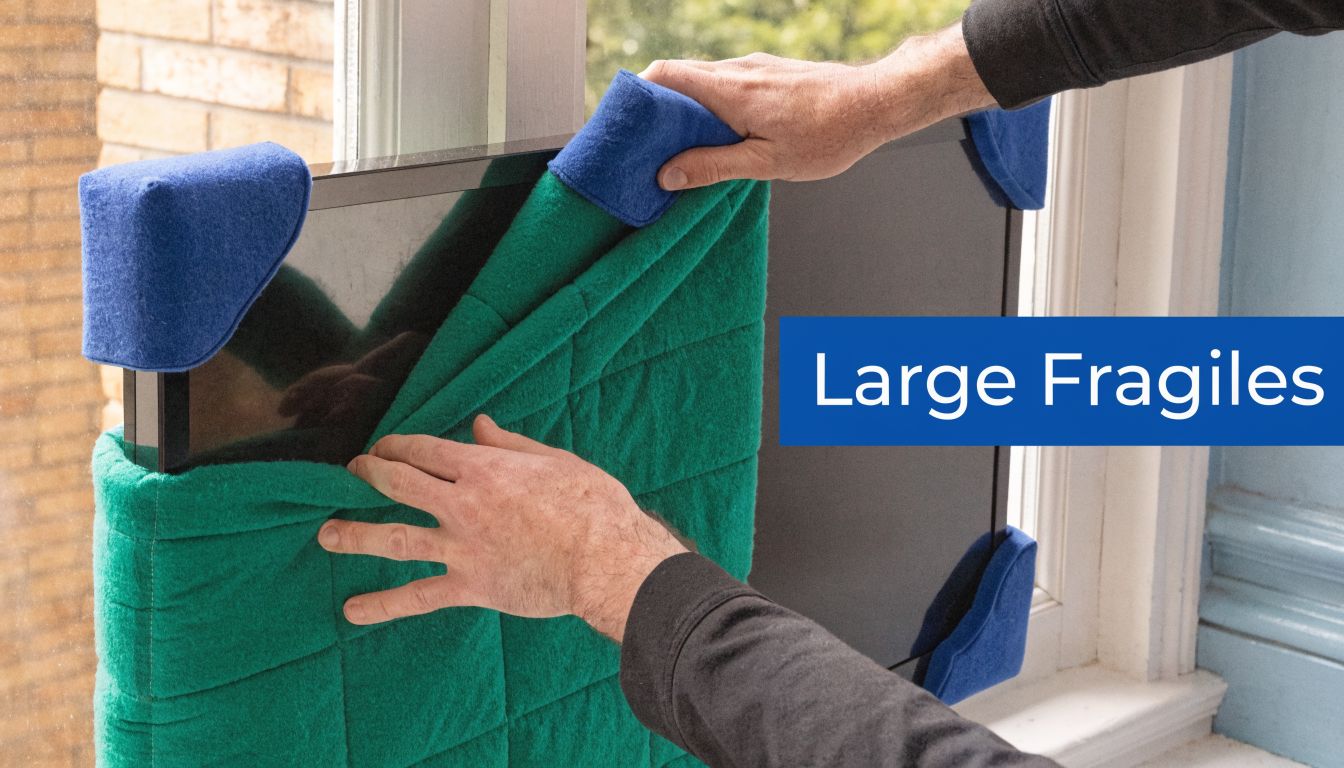
That approach is risky. Mirrors, artwork and televisions need edge protection, face protection and secure handling space around them.
Artwork and mirrors
The corners are the danger points. Once a corner takes a hit, the force transfers across the frame or glass.
Start with corner protectors if you have them. Then wrap the item in clean paper or another non-marking layer. After that, build a cardboard sandwich around the front and back. For framed items, a purpose-made picture carton is better than trying to patch together random cardboard offcuts.
For more valuable pieces, use quilted pads outside the cardboard layer. If the item is unusually large, antique, sentimental or irreplaceable, custom crating is the safer decision. That’s one of the cases where professional packing isn’t a luxury. It’s the right tool for the risk.
Televisions
Flat-screen TVs hate twisting pressure. The screen may look fine until it’s loaded badly, then one awkward lift or one tight strap creates damage.
If you’ve kept the original TV carton with its shaped inserts, use it. If not, use a dedicated TV moving box sized to the screen. Protect the face with a soft, non-abrasive layer first, then build cushioning around the edges and corners.
Don’t lay a TV loose in the back of a vehicle under doonas and jackets. It needs structure, not hope.
A careful visual walkthrough can help if you’re packing one yourself:
Stone, glass and specialty pieces
Glass table tops, marble lamp bases and similar specialty pieces need planning before moving day. Measure access first. A piece might be manageable in the lounge room but impossible through a stairwell turn, a lift opening or a narrow terrace hallway in Sydney.
For these items, ask practical questions early:
| Item type | Main risk | Better approach |
|---|---|---|
| Mirror | Corner strike | Corner protectors and picture carton |
| Framed art | Face puncture and edge crush | Cardboard sandwich and quilted pads |
| TV | Screen flex | Original carton or dedicated TV box |
| Glass top | Edge chip and slip | Upright carry with padded wrap |
| Antique item | Finish damage and instability | Custom protection and limited handling |
Large appliances can create a similar issue at the other end of the move. If you’re reconnecting whitegoods after transit, practical setup matters too. For example, this guide on installing a washing machine is useful if you’re handling post-move connections and want to avoid leaks or setup mistakes.
If your relocation includes exceptionally heavy specialty items, piano access is its own category of planning. A dedicated piano mover guide is worth reading before you try to combine that job with general household packing.
Large fragile items don’t usually break because they weren’t wrapped. They break because no one planned how they’d be carried, turned and loaded.
The Final Steps Boxing Sealing and Labelling
Once the item is wrapped, the carton still has to do its job. A well-packed plate in a poorly sealed box can still end up broken.
Build the box like a protective capsule
Start with a cushioned base. Crumpled packing paper works well because it creates a soft nest and helps absorb impact when the carton is put down.
Place heavier fragile items lower, lighter ones above. Keep weight balanced. If one side of the box is noticeably heavier, carrying gets awkward and the carton is more likely to tilt.
Then do the most important final check. Fill every gap. Side gaps, corner gaps, top gaps. If the contents can move, they eventually will.
A quick test works well. Gently rock the open carton before sealing it. If you hear knocking or feel a shift, add more fill.
Seal it properly
Use the H-taping method on both the bottom and top. That means one strip along the centre seam and additional strips across the side seams so the tape forms an H shape.
Cheap tape often lifts at the edges, especially in warm weather or on dusty cardboard. Use a quality packing tape and enough of it. This isn’t the stage to be stingy.
Label for the people handling it
“Fragile” helps, but it doesn’t tell a removalist where the carton goes or how it should sit. Better labels make the whole move smoother.
Include:
- Room destination: Kitchen, study, main bedroom
- General contents: Plates and bowls, lamp base, framed prints
- Handling note: Fragile
- Orientation: This way up arrows where relevant
This matters even more in apartment moves where cartons may be staged in lobbies, loaded through lifts, or moved under body corporate timing rules. Clear labels reduce unnecessary handling and stop cartons being opened early just to work out where they belong.
If you’re still sourcing cartons, this guide on free moving boxes can help, but always check that anything second-hand is still structurally sound before trusting it with breakables.
Special Considerations for Your Move in NSW
A fragile packing plan that works in a suburban driveway can come unstuck fast in a Sydney tower, a Newcastle heritage building or a coastal Central Coast street with awkward access.
Local conditions change how you prepare.

Apartments, strata and access restrictions
In Sydney and parts of Newcastle, the fragile packing isn’t the only issue. Building rules often shape the whole moving plan.
A well-packed mirror can still be at risk if it’s waiting in a shared corridor because the lift wasn’t booked. The same goes for cartons of glassware stacked in a loading zone while someone sorts parking. Strata buildings may require lift protection, booked move windows, insurance paperwork, or rules around shared area access.
That’s why timing matters as much as wrapping. If you’re moving into an apartment, check these points early:
- Lift bookings: Some buildings allow only narrow moving windows
- Shared area protection: Hallways and lifts may need coverings
- Parking access: Busy Sydney streets and some Newcastle areas need planning
- Loading distance: The longer the carry, the more secure your cartons need to be
On the Central Coast, access issues can look different. Sloped driveways, coastal properties, holiday traffic and tight residential streets can slow loading if the day hasn’t been planned properly.
Coastal conditions and storage overlap
Humidity changes cardboard. It also affects electronics, books and some finishes if items sit packed too long.
If you’re in Terrigal, The Entrance, Wamberal or another coastal pocket, keep fragile cartons off concrete floors and out of damp garages where possible. Pack closer to moving day rather than weeks in advance for moisture-sensitive items. If you need a gap between properties, temporary short-term furniture storage can be the safer option than leaving packed items in a shed or carport.
Seniors and special-needs relocations
Fragile packing for seniors needs a different mindset. It isn’t only about preventing breakage. It’s also about reducing confusion, physical strain and avoidable risk.
According to the ABS, 25% of Australians over 65 have mobility impairments (supporting reference). That changes how cartons should be packed and labelled. A technically well-protected carton that’s too heavy or awkward to lift isn’t a success.
Use lighter cartons, clear writing and priority packing for everyday essentials. Medical items, sentimental pieces and daily-use kitchenware should be easy to identify and easy to access first.
Large-print labels help. So does keeping related items together rather than scattering them across multiple boxes. For clients dealing with memory issues or general relocation fatigue, simple labelling such as “BEDROOM DAILY ITEMS” or “KITCHEN FIRST TO OPEN” is far more useful than a coded inventory sheet.
Gentle packing isn’t about wrapping everything thicker. It’s about making each box safer to carry, easier to understand and easier to unpack.
DIY Packing vs Using Professional Removalists
DIY packing can work well if you’re organised, you’ve got enough time, and the fragile load is manageable. If you’re moving a smaller household from Lake Macquarie to the Central Coast and you can pack over a couple of weekends, doing it yourself may suit your budget.
The trade-off is that DIY packing pushes the risk back onto you. You have to source the right packing materials, judge carton strength, control box weight, and work around access issues like stairs, narrow entries or limited parking. You also lose a lot of time. Packing a kitchen properly takes longer than generally expected.
Professional packing makes more sense when the move includes any of these:
- High-value breakables: Artwork, collectibles, premium electronics
- Time pressure: Tight settlement dates, lease deadlines or weekday relocations
- Access complexity: Apartments, lifts, loading docks, narrow streets
- Physical limitations: Injury, mobility concerns, or senior relocations
The biggest practical difference is consistency. Trained removalists repeat the same protective methods all the time, so they spot weak cartons, bad weight distribution and problem items before those issues turn into breakage.
Insurance matters too. When protection is part of the service, there’s a clearer chain of responsibility. That’s especially important for delicate household contents and office equipment. Full insurance coverage is worth discussing upfront so you understand what’s protected during packing, transit and unloading.
If you do want to save money, a hybrid approach often works well. Pack books, linen and everyday non-breakables yourself. Hand over the kitchen, glassware, artwork and electronics.
Ready for a Smooth and Secure Relocation
Fragile items arrive safely when every stage is handled properly. The right carton, the right wrap, the right fill, the right seal, and the right loading order. That’s what stops small packing mistakes from turning into moving-day damage.
If you’re doing it yourself, keep the process simple and disciplined. Don’t rush. Don’t overpack. Don’t assume a blanket or a big box will sort itself out. If your move involves strata rules, tight access, coastal conditions or a lot of delicate items, plan earlier than you think you need to.
A safe relocation across the Central Coast, Sydney, Newcastle or Lake Macquarie starts with good preparation. If you’d like a second opinion on access, packing scope or timing, getting advice before moving day can save a lot of trouble later.
If you’d like help with packing, access planning or a full home or office move, Gentle Giant Removals & Relocations can arrange a free moving quote or a no-obligation in-home assessment. For urgent moves across the Central Coast, Sydney, Newcastle and beyond, give the team a call and get practical advice from local removalists who know the route, the buildings and the common pitfalls.