
Picture this: you’ve just sold your home in Terrigal, but the keys to your new place in Newcastle won’t be ready for another month. It’s a classic scenario we see all the time, and it’s exactly where short-term furniture storage becomes a lifesaver. Think of it as a flexible solution for those in-between moments, whether you're renovating, downsizing, or just bridging two different settlement dates. Our job is to make this gap in your relocation timeline smooth and simple.
When Do You Need Short-Term Furniture Storage?
Life rarely moves in a perfectly straight line, and that's especially true when you're relocating. One of the most common reasons people need a temporary home for their belongings is a gap between moving out of one property and into another. Using storage gives you that much-needed breathing room, turning what could be a frantic, stressful situation into something far more manageable.
A well-planned move is always a smoother one, and figuring out your storage options early on is a big part of that. To make sure you've got all your bases covered, you can check out our comprehensive moving in checklist. It helps you stay organised from start to finish.
Common Scenarios for Temporary Storage
All sorts of situations call for a short-term storage solution. Maybe you’re a student on the Central Coast who needs a spot to keep your things over the summer break. Or perhaps you're a business relocating a Sydney office and need to store furniture while the new premises are being fitted out.
Other common reasons we see include:
- Renovating your home: Keeping your furniture safe from dust and damage during renovations is vital. Storing it off-site not only protects it but also gives your tradespeople clear, easy access to get the job done efficiently.
- Downsizing your property: If you're moving to a smaller home in Lake Macquarie, you’ll probably need some time to figure out what to keep, sell, or give away. Storage lets you do that without cluttering up your new space from day one.
- Staging your home for sale: Real estate agents will often tell you that decluttering helps a home sell faster. Short-term storage is perfect for temporarily tucking away excess furniture to make your property look its best for potential buyers.
Think of it as a temporary home for your belongings. This approach gives you the flexibility to manage your relocation timeline without pressure, making the entire process much smoother.
Basically, whenever you find yourself facing a temporary gap or a space crunch, a dedicated storage service ensures your valuables are secure. It helps you get ready for the next chapter, knowing everything is protected. In the next sections, we’ll dive into the different types of storage available.
Comparing Your Storage Options in NSW
So you know why you need short-term storage, but what about the how? Across the Central Coast, Sydney, and Newcastle, you've got a couple of solid options, and the right choice really boils down to your situation. The two biggest factors are how often you’ll need to get to your belongings and who’s going to do the heavy lifting.
Your two main paths are traditional self-storage facilities and the more modern mobile modular storage. Each is built for a different purpose, so let's break down the differences to make sure your move is a smooth one.
This quick decision tree helps visualise how common moving scenarios often lead to needing temporary storage.
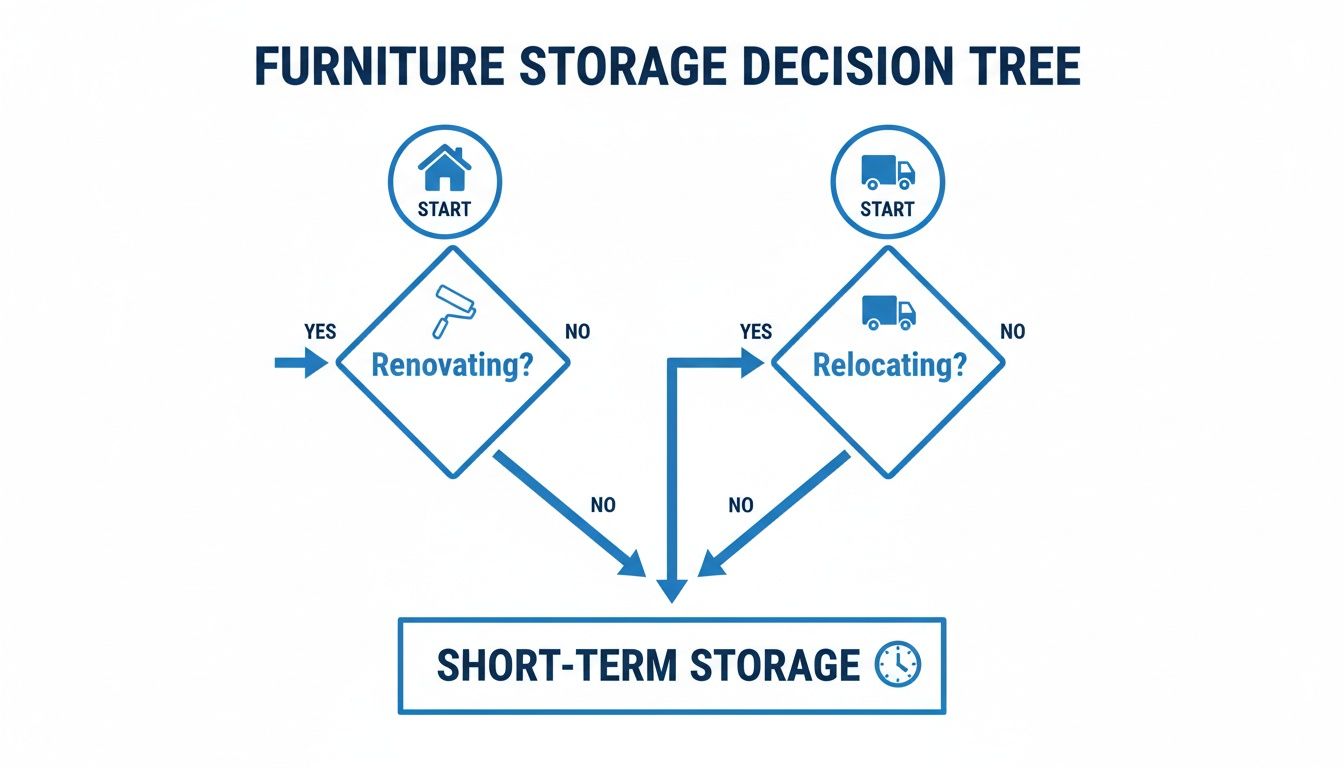
As you can see, whether you're renovating or relocating, temporary storage is often the most practical solution.
Traditional Self-Storage Facilities
When you think of storage, a traditional self-storage facility is probably what comes to mind. You rent a private, locked unit inside a large, secure complex that you can visit whenever you need to. This is a fantastic choice if you know you’ll need to pop in and grab things regularly.
Imagine you’re renovating your home in Gosford and need to get to your tools, or maybe pull out some seasonal clothes halfway through the project. Self-storage gives you that freedom. The main thing to keep in mind here is the logistics. You are responsible for packing, transporting, and unloading everything into the unit. This means either hiring a truck and roping in some friends, or getting a professional removalist to move everything for you.
If this sounds like the right fit, you can find out more about what's involved in our guide to self-storage in Gosford.
Mobile Modular Storage
Mobile modular storage flips the script, prioritising convenience and minimising how much your furniture gets handled. With this service, a sturdy storage container—or module—is delivered right to your door. You can pack it at your own pace, or our team can do all the professional loading for you.
Once it's packed, the module is collected and taken to a secure, climate-controlled warehouse. The beauty of this method is that your belongings are only loaded and unloaded once, which significantly reduces the risk of damage.
This is the perfect solution for times when you won't need regular access, like when you're bridging a settlement gap on a new property in Lake Macquarie. It bundles transport and storage into one seamless job, all handled by one team.
It's also a great help for tricky moves. Think about shifting office furniture out of a busy Sydney CBD building where body corporate rules might restrict leaving a container on-site. We manage all that coordination, so you aren't left juggling multiple companies.
To make the choice even clearer, here's a simple breakdown of how the two options stack up against each other.
Self-Storage vs Mobile Modular Storage At a Glance
| Feature | Self-Storage Facility | Mobile Modular Storage |
|---|---|---|
| Access | Frequent access, usually during set business hours. Ideal if you need to retrieve items regularly. | Limited access. Best for when you won't need to get to your items until final delivery. |
| Transport | DIY. You are responsible for hiring a truck or removalist to move items to and from the facility. | Handled for you. A container is delivered, packed, collected, and stored by the company. |
| Handling | Multiple handling. Items are loaded at home, unloaded at storage, reloaded, and unloaded again at the new place. | Minimal handling. Items are loaded once at your home and unloaded once at your destination. |
| Best For | Renovations, decluttering, or any situation where you need regular access to your belongings. | Bridging property settlements, long-distance moves, or when you want a convenient, hands-off solution. |
Ultimately, mobile modular storage is about making your life easier by combining services, while self-storage offers flexibility and control.
How To Properly Prepare Furniture For Storage
Just shoving your furniture into a storage unit and hoping for the best isn’t a strategy. To make sure everything comes out in the same condition it went in, proper preparation is non-negotiable. Taking that little bit of extra time beforehand is your best defence against common problems like mould, scratches, and warping.
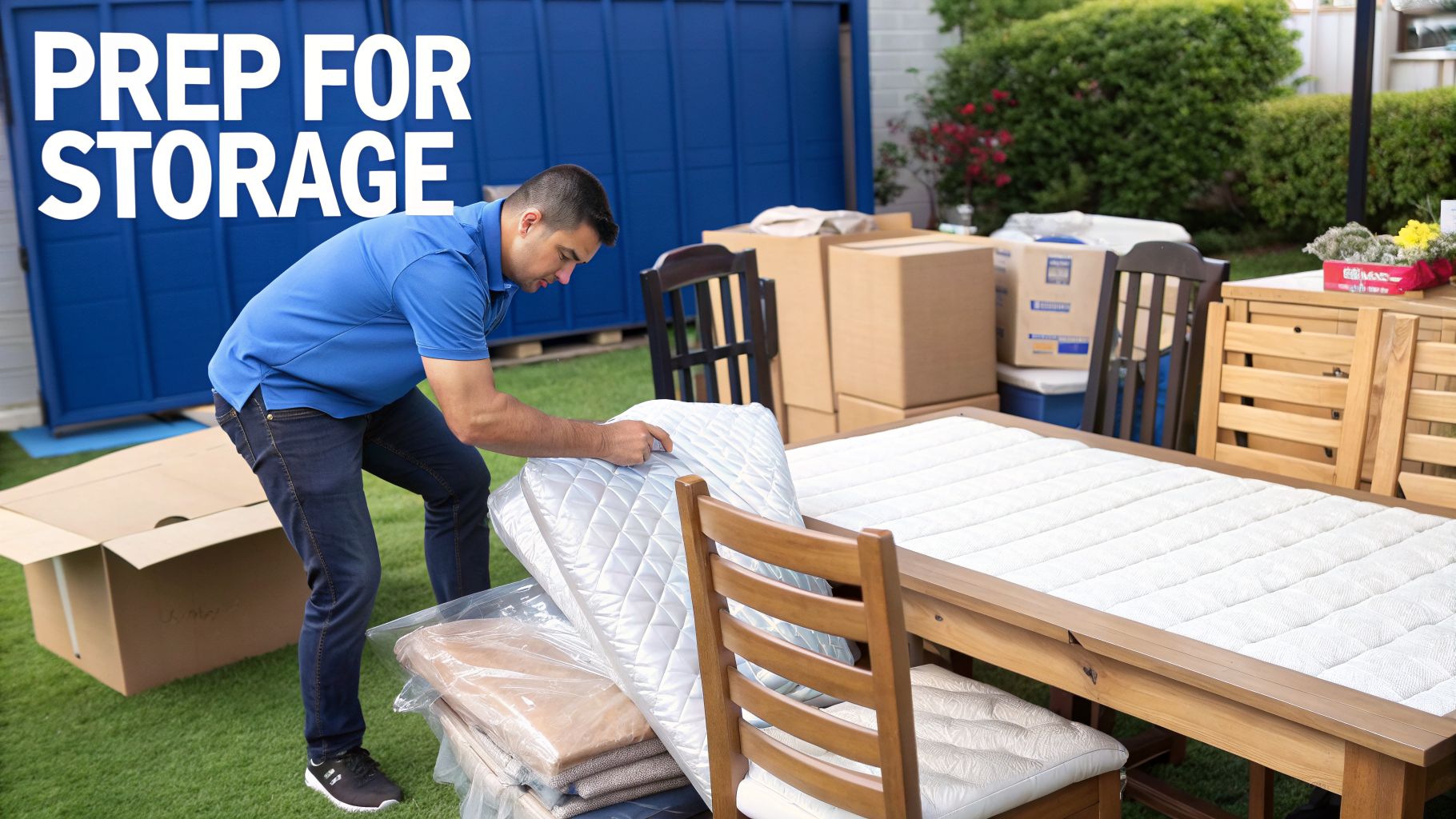
It all starts with a really good clean. Every single piece, especially anything made of timber or fabric, needs to be wiped down and left to dry completely before it gets packed. This is especially true in the Central Coast's coastal areas, where the higher humidity can kickstart mould growth if even a tiny bit of moisture is trapped.
Cleaning and Disassembly
Before you even think about wrapping or moving, get rid of all the dust, food crumbs, and any hint of moisture. For your timber pieces, a gentle wood cleaner is perfect. For anything upholstered like sofas and chairs, give them a thorough vacuum to suck up any hidden debris that could attract pests.
Once everything's clean, it’s time to break things down. Big items like bed frames, dining tables, and modular lounges should always be disassembled. This isn't just about making them easier for our removalists to navigate through tight hallways or down apartment stairs—it’s also essential for maximising your storage space.
A pro tip: keep all the screws, bolts, and other small parts together in a zip-lock bag. Label it clearly, then tape it securely to the largest piece of the furniture it belongs to. You’ll thank yourself later when it's time to reassemble.
Professional Packing Techniques For Protection
How you wrap your furniture makes all the difference. It might be tempting to just wrap everything in plastic, but this is a classic mistake. Plastic can trap moisture against surfaces and cause serious damage to timber finishes, a problem we in the industry call "sweating".
As professional removalists, we’ll always reach for quilted pads or thick moving blankets instead.
These breathable materials provide excellent cushioning against bumps and scrapes during the move and allow air to circulate. That airflow is absolutely essential for preventing moisture build-up while your items are in short-term furniture storage.
When you’re packing soft items or textiles, using products like vacuum storage bags can be a massive space-saver while offering top-notch protection from dust and dampness.
Don’t forget to give vulnerable spots like table corners and furniture legs some extra padding. Our teams come equipped with all the right packing materials to protect your belongings. If you’re doing it yourself and aren't sure what you need, our guide on 7 essential packing materials is a great place to start. A little effort here creates a protective barrier that keeps everything safe and sound until you need it again.
Understanding Insurance and Security for Your Belongings
When you place your furniture into storage, you’re entrusting a company with more than just timber and fabric; you’re storing valuable investments and cherished memories. That's why understanding exactly how your belongings are protected is so important. It’s all about combining solid physical security with the right insurance coverage to give you complete peace of mind.
While any reputable facility will have security measures like CCTV cameras and perimeter fencing, it's a common misunderstanding that this automatically insures your goods against every possibility. These features are designed to deter theft and monitor the premises, but they are not a substitute for a proper insurance policy.
As professional removalists, we operate with full insurance coverage for your belongings while they are in our care during transit. This protects them on the journey from your old home on the Central Coast to the storage facility, and again when we deliver them to your new place in Sydney or Newcastle. For the time they are actually sitting in storage, however, the responsibility for insurance often shifts.
Checking Your Existing Insurance Policy
Before you arrange any short-term furniture storage, your first port of call should be your current home and contents insurance provider. Many policies include a provision for "goods in storage" or "items temporarily removed," but the level of cover and the specific conditions can vary wildly.
It's vital to ask them directly:
- Does my policy cover belongings held in an off-site storage facility?
- Are there limits on the value of goods covered or the duration of the storage period?
- Are there specific security requirements the storage facility must meet for my policy to be valid?
Getting clear answers to these questions ensures you don't end up paying for duplicate cover or, worse, discovering you're not covered at all when you need it most.
Key Security Features to Look For
Beyond insurance, the physical security of the storage facility itself is crucial. Feeling confident about the safety of your furniture starts with knowing the security measures in place. Many top-tier facilities even offer or recommend a professional alarm system installation for an added layer of protection.
When you choose a storage solution, you should feel confident that it's a secure environment. Look for facilities with good lighting, comprehensive fire safety systems, and regular pest control programs—especially important in our coastal and regional climates.
A secure facility is a non-negotiable part of any short-term storage plan. This combination of robust physical security and appropriate insurance coverage is the best way to ensure your belongings are financially and physically protected until you're ready for them.
What Factors Influence Storage Costs in NSW?
Trying to budget for a move means you need to get your head around all the moving parts, and short-term furniture storage is often a key piece of that puzzle. While it’s impossible to give exact figures here, we can walk you through the main things that determine the cost. This will give you a much clearer picture of what to expect.
The biggest factor by a long shot is volume. We measure this in cubic metres—that's the space your belongings take up. A one-bedroom apartment in Terrigal might only need 10 cubic metres, while a big four-bedroom family home in Newcastle could easily need 40 cubic metres or more. The more belongings you need to store, the bigger the space you'll need to pay for.
Location and Duration
Where the storage facility is located plays a huge role. It probably won't surprise you to learn that a storage unit right in the middle of Sydney will have a higher price tag than one on the outskirts of Lake Macquarie. It all comes down to land value and local demand.
The length of your stay also matters. Even though it's "short-term," facilities will often have slightly different rates depending on whether you need the space for two weeks or two months. This is why getting a tailored quote is so important.
The storage market itself is another thing to consider. Recent data for Sydney shows how much pricing can shift, with average fees and occupancy rates changing based on what's happening in the wider economy. For anyone planning a move between the Central Coast and Sydney, these market details can influence your overall costs.
Unpacking the So-Called Hidden Costs
It’s the extra fees that can really catch people off guard. When you're comparing your options, it's absolutely crucial to ask about any potential 'hidden' costs that go beyond the basic weekly or monthly rate. We always tell our clients to get this stuff clarified right at the start to avoid any nasty surprises down the track.
Be on the lookout for things like:
- Administration or setup fees: This is often a one-time charge just for opening your account.
- Insurance premiums: As we've covered, making sure your goods are financially protected is non-negotiable.
- Charges for locks or access: Some places will insist you buy their specific high-security lock, or they might charge you extra if you need to get to your things after hours.
Understanding these variables helps you compare quotes properly and find a solution that offers real value. For a different perspective, you might find our guide on long-term storage useful, as a lot of these cost factors apply there, too. A transparent provider will always be happy to break down every single potential charge for you.
Why Using a Removalist for Storage Simplifies Your Move
Let's be honest, juggling a removalist and a separate storage company is a headache you don't need during a move. The real advantage of an integrated service is that it rolls two massive logistical jobs into one smooth operation. This saves you time and, more importantly, reduces how often your precious belongings are handled.

When you partner with a removalist like Gentle Giant that also coordinates your short-term furniture storage, the whole process just gets easier. We take care of everything from start to finish. Our team handles the professional packing at your old home, secure transport to a trusted facility, and careful delivery to your new place whenever you’re ready.
A Single Point of Contact
Think about it. If you're managing an office relocation in Newcastle, every hour of downtime costs money. Instead of trying to sync up two different suppliers, you have one expert team on the job. This end-to-end approach gets rid of the communication gaps and scheduling nightmares that often pop up when you use separate companies.
This also drastically cuts down the physical handling of your items. Your furniture is loaded once at your original property and only unloaded again when it reaches its final destination.
This streamlined process significantly lowers the chance of scratches, dents, or other transit damage. It’s the safest way to move and store your belongings, all protected under our comprehensive insurance.
Ultimately, letting one trusted team manage both the move and the storage takes a huge layer of stress off your shoulders. Our 'On Time, Every Time' promise means you can count on us to nail the logistics. Whether you need a top-tier furniture removalist on the Central Coast or a crew to handle a complex Sydney move, we'll ensure a smooth transition so you can focus on what matters most—settling in.
Your Short-Term Storage Questions Answered
To help you get your head around the planning, we’ve put together answers to some of the most common questions our clients from Sydney to Newcastle ask us about short-term furniture storage. Getting these details sorted upfront makes the whole process a lot less stressful.
How Much Storage Space Will I Need?
This is easily the question we hear the most! Storage space is measured in cubic metres, which is just the total volume all your belongings take up. As a rough guide, everything from a one-bedroom apartment usually fits into about 10 cubic metres, while a typical three-bedroom home might need anywhere from 30 to 40 cubic metres.
But just guessing can be a costly mistake. The most reliable way to figure it out is to have a professional removalist, like our team, pop over for a free in-home assessment. We’ll calculate the exact volume you need, making sure you only pay for the space you actually use.
Can I Store Appliances Like My Fridge?
Absolutely, but they need a bit of prep work to avoid any nasty surprises down the track. Fridges and freezers have to be completely emptied, defrosted, and then thoroughly cleaned and dried to stop mould or bad odours from developing. It’s crucial to prop the doors slightly ajar so air can circulate inside.
It’s a similar story for washing machines – they need to be fully drained and have their drum secured, ideally with the original transit bolts if you’ve still got them. As part of our service, we can walk you through preparing these items correctly so they’re ready to plug in and use as soon as you get them back.
What Items Are Prohibited From Storage?
For everyone's safety and for insurance reasons, there are some items that just can't go into a storage unit. This is standard practice right across the industry to protect your belongings, the facility itself, and of course, our removalist crews.
Prohibited items always include anything flammable or hazardous. Think petrol, gas bottles, paints, cleaning chemicals, and aerosols. Perishable foods are also a no-go, as they can attract pests and create a real mess.
Naturally, any illegal items, firearms, or living things like plants are also on the restricted list. Any reputable storage facility will give you a complete list of what’s not allowed, and we'll make sure you're fully aware of all the rules when we coordinate your short-term furniture storage solution.
Planning your move and need some expert advice on storage? The team at Gentle Giant Removals & Relocations is here to help. Get a free, no-obligation moving and storage quote today.