

Trying to budget a relocation in the Central Coast, Sydney or Newcastle corridor often starts the same way. You open a few tabs, type your suburbs into a moving company cost calculator, and hope the number on screen gives you something solid to plan around.
That first estimate can help, but it rarely tells the whole story. A two-bedroom apartment in Gosford heading to Sydney’s inner west is not the same job as a two-bedroom villa moving from Warners Bay to Newcastle, even if the bedroom count looks similar on paper. Access, parking, lift bookings, packing level, fragile items, traffic timing and building rules all change the true scope.
Good quoting is not about making a number look low. It is about matching the crew, truck, timing and protection to the move you are doing, so your belongings, property and budget are protected from the start. If you are still at planning stage, a practical relocation checklist for Australia helps you gather the details a proper quote will need.
Planning Your Move and Wondering About the Cost
A lot of people start with the same question. “How much should I allow for the move?”
That is a fair question, especially if you are lining up lease dates, settlement dates, utility changes and time off work all at once. The pressure is even higher in this part of NSW, where one relocation might mean a straightforward run from The Entrance to Lake Haven, and the next means loading in a tight Newcastle street or dealing with apartment access in Parramatta.
Online calculators are useful because they give you a starting point. They help you see whether the move is likely to sit in a smaller local range or whether it has the hallmarks of a bigger job with more labour, travel time or specialised handling.
Where they fall short is context.
A calculator cannot see that your unit block only allows moves between certain hours. It cannot tell that your street in Sydney is busier than it looks on a map, or that the driveway at a coastal property in Terrigal gets tricky for larger trucks. It also cannot judge whether your “few fragile items” really means a standard dining set, or framed artwork, a glass cabinet and a piano that all need careful protection and the right equipment.
That is why the best way to use a moving company cost calculator is as a guide, not a promise. It helps with early budgeting. The accurate figure comes from understanding the move properly.
What Exactly Is a Moving Cost Calculator
A moving company cost calculator is a digital estimating tool. You enter details such as where you are moving from, where you are going, the size of the property, and sometimes an item list. It then gives you a rough estimate based on those inputs.
It is similar to an online property estimate. It can tell you the ballpark, but it is not a formal valuation.
What the calculator is designed to do
Its main job is to help with early planning. If you are deciding between moving this month or next month, comparing a DIY approach with a professional removalist, or trying to understand whether packing services fit your budget, the calculator can give you a useful first read.
These tools became common in Australia after 2010 as people wanted clearer budgeting before booking. By 2015, digital calculators had become common for Australian movers, and they now help set broad expectations, with average local moves in NSW ranging from AUD 800 to AUD 2,500 for a 2-3 bedroom home according to Allied’s moving calculator guidance.
If you want to compare how these estimates are built, a dedicated moving rates calculator guide can help you read the numbers more critically.
What the calculator cannot know
A form can only work with what you type into it. That creates blind spots.
It usually cannot assess:
- Access conditions such as stairs, small lifts, narrow hallways, steep driveways or long carrying distances
- Building rules including strata move windows, body corporate approvals, loading dock bookings and lift protection requirements
- Handling needs for antiques, pianos, artwork, office equipment or aged care relocations
- Property protection such as whether floors, walls and entry points need extra care during loading and unloading
- Packing reality because “packed by owner” can mean anything from well-labelled cartons to loosely filled bags and open tubs
A key term that matters
You will often hear cubic metres, or m³. In plain language, that means the amount of space your belongings take up in the truck.
Why it matters is simple. Two three-bedroom homes can look similar on paper, but one might have minimal furniture while the other has a full garage, outdoor setting, gym gear and packed storage cupboards. Bedroom count gives a rough clue. Volume gives a working measure.
A calculator is most useful when your inputs are realistic. The closer your inventory and access details are to the true job, the closer the estimate will be to the final quote.
The Key Ingredients of Your Moving Quote
A proper removalist quote is built from a handful of variables that affect labour, vehicle choice, travel and risk. Once you understand those variables, the numbers stop feeling mysterious.
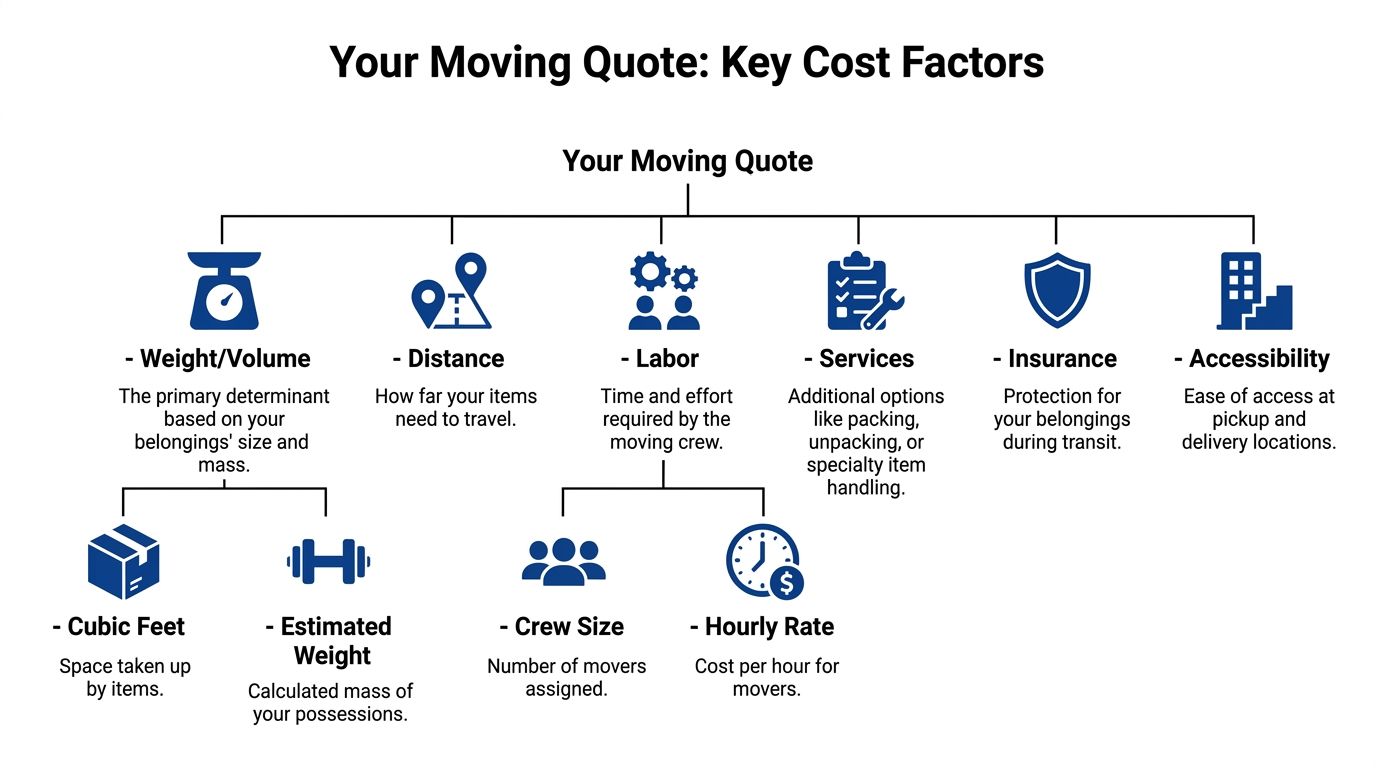
Distance changes the pricing model
Not every relocation is priced the same way.
For intrastate moves within NSW under 200km, such as a Central Coast to Sydney run, pricing is typically based on hourly rates of $110 to $200 per hour. Once the move becomes interstate, the model usually changes to weight, distance and volume, and the base cost can rise sharply. For a route like Newcastle to Brisbane, the base can increase by up to 5 times according to MoveBuddha’s moving cost calculator benchmarks.
Why this matters for you is practical. A shorter corridor move often hinges on how long the crew is working. A longer one hinges on how much truck space you need and how far the load has to travel.
If you are comparing city routes and service levels, this breakdown of the cost of removalists in Sydney gives useful context.
Volume matters more than bedroom count
People naturally describe a move as “a two-bedroom apartment” or “a three-bedroom house”. That is a starting point, not a final measure.
A better measure is volume. Cubic metres tell a removalist how much truck space your belongings will occupy. That affects truck selection, loading plan and whether the move can be completed in one run or needs a different setup.
A home with modest furniture, built-ins and limited outdoor gear can take far less room than another home with the same number of bedrooms but more freestanding storage, whitegoods and bulky items.
Labour is about time, safety and complexity
Labour is not just a headcount. It is the amount of hands-on work required to complete the job safely and efficiently.
A quote will be shaped by things like:
- Crew size based on the property type, item mix and timeline
- Handling time for wrapping furniture, protecting fragile items and securing loads
- Walking distance from front door to truck
- Disassembly and reassembly for beds, tables and larger furniture
- Traffic timing on routes through Sydney, Newcastle and the M1 corridor
The right crew size is a trade-off. Too few removalists and the move drags out. Too many, and you can end up paying for capacity you did not need. Good quoting aims for the middle ground where the job is completed safely, on time and without wasted labour.
Access can change a straightforward move
This is one of the biggest areas where online calculators miss the mark.
A ground-floor house in Tuggerah with easy driveway access is very different from a third-floor walk-up in Cooks Hill or an apartment in Sydney with lift bookings and loading dock rules. The more difficult the access, the more time and planning are needed.
Here is where access usually changes the quote:
| Access issue | Why it affects cost |
|---|---|
| Stairs | More manual handling and slower transit between truck and property |
| Lifts | Lift bookings, shared access windows and waiting time |
| Narrow streets | Truck positioning can be limited, increasing carry distance |
| Restricted parking | Council permits or alternative loading plans may be needed |
| Strata rules | Specific move times, floor protection and common area requirements |
If your building has strata, ask for the move rules early. Lift bookings, loading bay reservations and common area protection often decide how smoothly the day runs.
Extra services can save time or reduce risk
People sometimes treat extra services as optional add-ons that only increase cost. In practice, they can reduce time pressure, lower damage risk and make the job easier to control.
The common ones are:
Professional packing
Best when your schedule is tight, your home has many fragile items, or you do not want the final week consumed by packing.Unpacking and setup
Useful when you need a quicker return to normal at the new property, especially for families or office relocations.Specialty handling
Needed for pianos, antiques, artwork, large mirrors and other items that require different protection methods and equipment.Storage coordination
Helpful when settlement dates or lease dates do not line up cleanly.Packing materials supply
Worth considering if you are doing your own packing but still want the right cartons, paper, tape and porta robes.
Insurance is part of a proper quote, not an afterthought
When belongings are being lifted, wheeled, stacked and transported, protection matters. A reliable quote should address insurance clearly, not bury it.
Full insurance coverage is worth discussing early, especially if you have high-value items, fragile pieces or a move involving more than one property type. It is also part of good planning because the level of cover should match the actual contents being moved.
A Tale of Three Local Moves
The easiest way to understand a moving company cost calculator is to look at real-world situations. The calculator gives the outline. The details decide the final shape.

Gosford to Sydney inner west
A young couple in Gosford enters “two-bedroom apartment to two-bedroom apartment” into an online calculator. On screen, it looks fairly simple.
The move is not difficult, but it is not basic either.
Their Gosford pickup has underground parking with vehicle height limits, so truck choice matters. Their destination in Sydney’s inner west is a strata building with fixed lift booking times, shared corridors and body corporate rules around protecting common areas. Suddenly, timing becomes central to the quote.
The M1 route also needs to be treated realistically. If the crew hits the wrong traffic window into Sydney, the move can slow down before unloading even starts. That is not poor performance. That is route planning.
For this kind of job, the calculator’s first estimate is only a rough guide. The proper quote depends on access, building restrictions and whether the clients are self-packing or using a professional packing service.
Terrigal to Newcastle
A family moving from a house in Terrigal to a larger home in Newcastle often assumes the challenge is just “more stuff”. Volume is a big part of it, but not the whole picture.
Coastal homes can bring their own access issues. Steep driveways, uneven paths, outdoor furniture, surf gear, garage storage and balconies all add handling time. At the Newcastle end, the property might be easier to access, or it might be a heritage-style home with tight entries and less forgiving stair geometry.
Cubic metres become useful here. For a typical three-bedroom home, a benchmark volume is often applied, and volume is one of the key inputs in longer-distance calculations. On longer routes such as Brisbane, pricing can start around $160 per m³ base rate, with totals able to exceed $8,000 once all factors are included, according to North Removals’ interstate moving cost calculator. The local lesson is not the interstate price. It is that accurate volume estimation matters because it drives truck planning and quote accuracy.
A family that underestimates its contents might book for a standard household move, then realise the garage, shed and outdoor setting turn it into a larger-volume job. That can affect crew planning, truck size and the time needed to complete the relocation safely.
If you are moving from a house, do not forget the spaces you stop seeing. Garages, under-stair storage, linen cupboards and outdoor areas often change the volume more than the main bedrooms do.
For homes like these, packing style matters too. Professionally wrapped furniture, labelled cartons and properly prepared fragile items load faster and travel better. DIY packing can still work well, but only if the packing materials are strong enough and the cartons are packed to stack safely.
A practical example helps. A dining suite wrapped correctly with padded protection, chairs bundled securely and a glass top prepared separately is a predictable item to move. The same suite packed casually with loose parts and no protective layering takes longer and carries more risk.
This short video shows the sort of care and process that make a difference on moving day.
Office relocation in Lake Macquarie
A small office relocation works to a different rhythm.
A business moving within Lake Macquarie is not usually focused on whether the move takes a little longer to unpack decorative items. The primary concern is downtime. Phones, workstations, files, printers and internet setup all affect how quickly staff can get back to work.
That changes what “good value” looks like.
Instead of asking only for the cheapest quote, the business needs to ask:
- Can the relocation be staged around operating hours
- Will equipment be labelled by workstation or department
- Is there safe handling for monitors, servers and sensitive records
- Can truck access and parking be secured ahead of time
- Will the crew work to a relocation plan rather than just load and unload
In these jobs, a calculator often misses the operational side. It may ask about desks and filing cabinets, but not whether the building has loading dock rules, whether lift access is shared with other tenants, or whether the office needs to be up and running by the next morning.
That is why office quoting usually improves when there is a site discussion. The quote is not just about labour and truck space. It is about sequencing the move so business interruption stays low.
The Hidden Details Most Calculators Miss
The internet estimate often looks neat because it strips out the awkward parts. Actual relocations do not work that way.

Local logistics that change the day
Many online tools are built around overseas assumptions and broad averages. That is part of the reason they miss what matters in NSW. Most online calculators are US-centric and fail to account for Australia-specific costs, including M1 tolls and local permit issues. NSW Fair Trading data also shows 25% of complaints stem from customers being overcharged by firms that did not factor in local logistics, as noted in Move.org’s discussion of moving costs.
In this corridor, the common oversights are practical:
- Council parking permits for truck access on busy streets
- Loading zone restrictions around apartments and commercial buildings
- Body corporate requirements for lift bookings and protective coverings
- Shared driveway limits in tighter suburban streets
- Move-in time windows set by strata or building managers
A good online estimate rarely asks these questions in enough detail.
Seasonal pressure is real
Timing affects quoting, even when the inventory stays the same.
Holiday periods, school transitions, end-of-lease dates and wet weather all change demand and scheduling pressure. In the Central Coast and Sydney corridor, December and January can be harder to book cleanly because roads are busier, access windows are tighter and many clients want the same dates.
That does not always mean your move becomes unsuitable for that period. It means your planning window needs to be longer, and your access details need to be locked in early.
Insurance and protection need plain-English answers
A lot of people ask about “insurance” and get a vague answer back. That is not good enough.
You want to know what cover applies to your belongings, what protection is in place for handling and transit, and whether your more fragile or high-value pieces need any extra notation before the move. You also want to know how the crew protects property itself, especially walls, floors, stair rails, lifts and shared building areas.
Protection is not just paperwork. It is quilted pads, correct wrapping, secure tie-off in transit, sensible loading order and a crew that does not rush awkward lifts.
If a quote seems low but says little about access, protection or insurance, ask more questions before you book. A missing detail on paper often becomes a problem on moving day.
Special items often sit outside generic estimates
Many calculators assume a standard household load. The moment you add one or two non-standard items, the estimate loses value.
Pianos are the obvious example, because they need different handling, equipment and sometimes a different approach to access. If that applies to your move, this guide to choosing a piano mover is worth reading before you compare quotes.
The same applies to artwork, gym equipment, oversized fridges, safes, awkward outdoor pieces and aged care relocations where extra patience and setup support matter. These are not edge cases in real work. They are common reasons an online estimate ends up being revised.
Get Your Free Quote from a Local Expert
The easiest way to use a moving company cost calculator properly is to treat it as the first step, then turn that estimate into a proper assessment.
Start with the essential details. Enter your pickup and delivery suburbs, property types, likely moving date and a realistic sense of how much you are taking. If you know about stairs, lifts, narrow access, difficult parking or strata rules, include that straight away.
Then add the services you may want. That could be packing, unpacking, packing materials, storage coordination or help with a delicate item that needs extra care.
A more detailed request form is useful because it captures the details generic calculators skip. You can request one through the detailed quote page.
What happens after you submit
A proper quote process should not leave you guessing.
Usually, the next step is that an experienced team member reviews the information and checks for any points that could affect labour, truck selection, access or timing. If the move needs more clarity, a video call or in-home assessment may be suggested so the quote reflects the actual job rather than a rough assumption.
For urgent relocations, calling is often the fastest option. For planned relocations, an online quote request gives the team enough detail to start building a practical plan.
What to prepare before asking for a quote
It helps to have these details ready:
- Your addresses including suburb and property type
- Your preferred dates plus any flexibility
- Access notes such as stairs, lifts, steep driveways or restricted parking
- Special items including pianos, artwork, large appliances or office equipment
- Service preferences such as DIY packing, full packing or unpacking support
The more accurate the starting information, the more useful the quote will be.
Beyond the Calculator Why a Professional Assessment Matters
The calculator can only estimate the move you describe. A professional assessment evaluates your actual move.

What a site assessment picks up
A walk-through, whether in person or by video, reveals things a form usually misses.
It may show a staircase that is tighter than expected. It may reveal overhanging branches, poor truck access, a long carry from basement parking, or furniture that needs partial disassembly before loading. It may also uncover timing issues with strata bookings, school-zone parking limits or office access after hours.
Those details matter because they shape the relocation plan, not just the price.
Why special requirements need human judgement
This is especially important for senior relocations, accessibility needs and specialist items. Generic calculators often fail to account for special requirements, despite an 18% rise in senior moves reported in 2025. They also often miss piano relocation costs of $300 to $600 extra and accessibility needs such as stair levies that can add 15% to the total, which is why HireaHelper’s moving cost calculator discussion points back to the need for professional assessment.
The practical takeaway is straightforward. If the move involves aged care, reduced mobility, fragile heirlooms, tight stairs or apartment restrictions, a generic estimate is less reliable.
Better planning protects time, property and budget
A good assessment does more than refine price. It improves execution.
It helps determine the right truck size, the right crew, the safest loading order and the best arrival window. It also allows the team to plan property protection properly, confirm insurance arrangements clearly and reduce the risk of avoidable delays.
That is where experience shows up. Not in flashy language. In noticing the things that can go wrong, then planning them out before moving day.
The most accurate quote usually comes from a short conversation and a proper look at the job. That small step often prevents the biggest surprises.
Frequently Asked Questions About Moving Costs
How far ahead should I book a removalist
Earlier is better, especially if you are moving during holiday periods, at month-end, or into an apartment building with booking requirements. If your dates are fixed, lock in the removalist as soon as the addresses and access details are confirmed.
Is a weekday move easier than a weekend move
Often, yes. Weekdays can be easier for traffic planning in some areas and may offer better access to building management, strata contacts and loading zones. The best day still depends on your property type and suburb.
Is DIY packing always cheaper
Not always. DIY packing can lower labour costs, but only if it is done well. Poor packing can slow the job, increase breakage risk and create problems when cartons cannot be stacked safely. If you pack yourself, use quality packing materials, label clearly and keep cartons manageable to lift.
Do apartments cost more to move than houses
They can, because apartments often involve lifts, booked move windows, longer trolley distances, loading docks and common-area protection. A house can be quicker if truck access is easy, but large homes with steep sites or difficult driveways can be just as complex.
What should I tell a removalist before asking for a quote
Tell them about anything that changes access, time or handling. That includes stairs, lifts, narrow streets, body corporate rules, difficult parking, fragile items, pianos, office equipment, steep driveways and whether you want packing or unpacking help.
Do I need to mention if I have a piano or other specialty item
Yes. Always mention it early. Specialty items often need different handling methods, extra protection, or a specific crew plan. If it is left out of the estimate, the quote may not reflect the actual work.
What if my settlement or lease dates do not line up
Raise that at quoting stage. Storage coordination, split deliveries or staged relocations may be the cleanest solution. It is much easier to plan this in advance than to solve it at the last minute.
Will a quote include protection for my belongings and property
It should explain both clearly. Ask what insurance options are available, how furniture will be wrapped, and how floors, walls, lifts and common areas are protected during the move. A professional removalist should be comfortable answering that in plain English.
If you’re planning a move across the Central Coast, Sydney, Newcastle or further afield, Gentle Giant Removals & Relocations can help you turn a rough estimate into a practical, accurate quote. You can request a free quote online, arrange a free in-home assessment, or call for urgent moves if you need quick advice from a local team that understands the corridor, the access issues and the timing pressures.