

If you're searching for cheap storage on the Central Coast, you're probably already juggling too many moving parts. Settlement dates don't line up, the new lease starts later than expected, or you're trying to clear a home in Terrigal, Gosford or Erina before you can move into Newcastle, Lake Macquarie or Sydney. On paper, storage looks simple. Rent a unit, put your things in it, move on.
In practice, storage gets expensive when the monthly rate is the only number you look at. The full cost usually sits in transport, access, packing quality, damage risk, and how many times your furniture gets handled. We see this all the time with Central Coast relocations. A storage plan works well when it fits the move. It works badly when it becomes a separate project you have to solve on your own.
Understanding Your Central Coast Storage Options
A lot of people compare storage by price first. That's understandable, but it's not the best starting point. The better question is how you need to use the storage.
Take a family moving from Terrigal to Lake Macquarie with a short gap between properties. If they need regular access to clothes, school gear and paperwork, one option will suit them. If they just need furniture stored safely until handover, a different option makes more sense.
Self-storage, mobile storage and managed storage
On the Central Coast, individuals end up looking at three broad options.
| Option | How it works | Best for | Watch out for |
|---|---|---|---|
| Self-storage | You rent a unit and load it yourself | People who want direct access | More lifting, more transport, more handling |
| Mobile storage | A container is delivered, then stored | Short-term convenience at home | Access can be less flexible once collected |
| Managed storage | A removalist packs, collects, inventories and stores | Full-house moves and coordinated relocations | You need to book properly and confirm access arrangements |
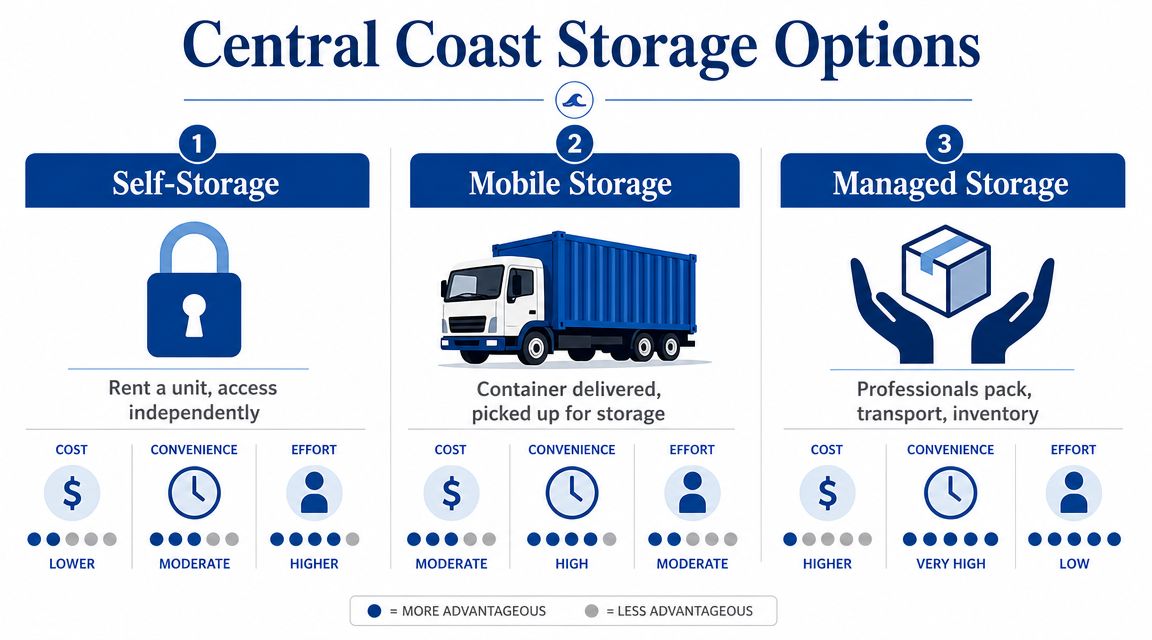
Self-storage is familiar. You hire the unit, organise the truck, do the loading, and come and go during the facility's access hours. It suits people who want control and don't mind the labour. It's often useful for business stock, archived files, or households that know they'll need to get items in and out regularly.
Mobile storage can be handy when access at the home is straightforward. The container comes to you, you load it, and it goes away for storage. That can save a trip on moving day, but you still need to think about driveway space, loading safety, weather, and whether your street allows easy truck access.
Practical rule: If you'll need to open the storage more than once or twice, convenience matters more than the lowest advertised rate.
Managed storage is usually the best fit when storage is part of a relocation, not a separate decluttering job. Your goods are packed and loaded once, then handled again only when they're delivered out. That reduction in double-handling is a big deal for furniture, whitegoods, artwork and fragile items.
What works well and what usually causes trouble
A friend's garage sounds cheap until moisture, security, access or accidental damage become your problem. That option can work for a few sealed cartons or outdoor gear. It's usually a poor choice for lounges, mattresses, timber furniture, electronics or anything you care about keeping in good condition.
Self-storage became mainstream fairly recently, with roughly 350 million square feet of new space added over the last decade according to RentCafe's self-storage industry overview. For Central Coast households, that matters because storage is now part of ordinary relocation planning between places like Sydney, Newcastle and Lake Macquarie, not a niche service.
If you're weighing up local options, our guide to self-storage in Gosford is a useful next step because location and access can change the value of a storage deal very quickly.
How to Accurately Estimate Your Storage Needs
The quickest way to overspend on storage is to guess the size. The second quickest is to underestimate and then scramble to fit everything in.
When people hear cubic metres, it can sound technical. It's really just the amount of space your belongings take up. Think of it as the room your furniture and cartons occupy once they're stacked properly inside a truck or storage unit.
Start with furniture, not cartons
Most households do this backwards. They count packing cartons first because boxes are easy to picture. The bulky items usually decide the unit size. Beds, dining tables, fridges, lounges and bookcases take up the footprint that matters.
A rough estimate also changes depending on whether the items can be dismantled. A bed frame taken apart and tied neatly is very different from a fully assembled one. The same goes for modular lounges, office desks and outdoor settings.

A practical way to judge the space
Use this as a starting point only, then adjust for bulky furniture, appliances and awkward access.
- Smaller homes: A one-bedroom unit or apartment often fits into a compact storage space if packing is efficient and furniture is dismantled.
- Family homes: A three-bedroom home in Erina or Woy Woy usually needs far more room, especially if there's a full garage, outdoor furniture or children's equipment involved.
- Business moves: Offices can be deceptive. Desks may stack well, but filing cabinets, monitors, archive cartons and compactus units add up quickly.
The expensive mistake isn't only hiring too much space. It's hiring too little, then paying in time, stress and extra handling to make it work.
Access changes the size decision
A unit that looks right on paper can still be wrong if the access is awkward. If you're moving out of a Gosford apartment with lift bookings, body corporate rules and a narrow loading zone, you don't want to discover halfway through that everything needs to be repacked tighter. The same applies in Newcastle heritage buildings or Sydney apartment blocks with strict move-in windows.
That's why we always treat volume and access as one problem, not two separate ones. Stairs, lifts, driveway slope, shared corridors and parking permits all affect how efficiently the job can be loaded.
If you're only storing furniture for a settlement gap or renovation period, this guide to short-term furniture storage will help you think in practical terms rather than just unit labels.
What removes the guesswork
A proper in-home or virtual assessment is the cleanest way to avoid paying for the wrong space. A removalist can spot details that are often overlooked straight away. Tallboys that don't stack well, oversized lounges, gym equipment, fragile artwork, or a garage full of tools and outdoor gear.
That matters because the storage unit is only one part of the cost. If the estimate is off, the whole move runs less efficiently.
Uncovering the True Cost of Cheap Storage
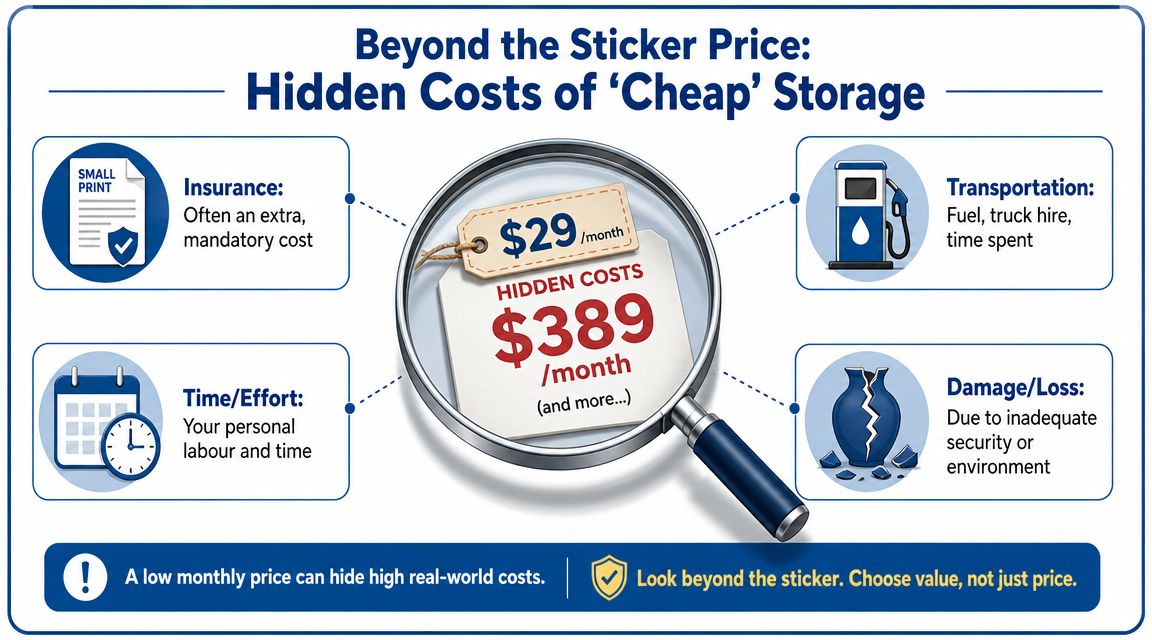
The headline monthly rate is the visible part of the iceberg. Everything underneath is where cheap storage often stops being cheap.
Australian consumer guidance notes that storage agreements can include hidden access fees, compulsory insurance, and minimum rental periods, which means a low advertised rate can be a poor guide to the actual cost of storage. That's especially relevant in NSW, where tight housing movement often pushes people into short-term storage during relocations, as noted by Citadel's discussion of storage pricing and hidden charges.
The hidden costs people miss first
These usually show up after you've already committed.
- Insurance requirements: Some contracts require cover as part of the rental.
- Administration charges: Small fees don't look like much until they stack up.
- Access limits: Cheap can mean inconvenient access hours or extra conditions.
- Minimum terms: A short gap between homes can still trigger a longer billing period.
Then there's the practical side. You may need a trailer, van or truck hire. You may need a padlock, trolleys, blankets, mattress covers or extra packing materials. If the unit is further away than you'd like, every visit costs time and fuel.
Distance can wipe out the saving
A facility that looks cheaper online can become poor value if it's out of your way. That matters on the Central Coast because people often move between suburbs with very different access conditions. A house in Bateau Bay is one thing. An apartment in Gosford CBD, a townhouse in Charlestown, or an office in Sydney with loading dock times is another.
If you need to visit the storage more than once, location matters just as much as price. The cheaper monthly rate gets eaten up by repeated travel, lost time and extra lifting. If you're hiring helpers or taking time off work, the gap gets wider again.
Cheap storage can be expensive if it adds another full moving day to your week.
Damage has a cost too
A rushed DIY load into storage often creates the most expensive problems. Timber gets scratched. Fridges are laid down incorrectly. Glass ends up under pressure. Sofas pick up marks because there weren't enough quilted pads or the load wasn't stacked properly.
That's not just frustrating. It changes the whole value equation. A unit that saved money on paper can cost more if items come out damaged or dirty.
For longer holding periods, it's worth reviewing the trade-offs in long-term storage planning, especially if you're storing full households rather than a few overflow items.
Smart Packing and Loading Strategies to Minimise Space
If you want cheaper storage on the Central Coast, reduce the space before you rent the unit. That's the lever you can control most directly.
The easiest savings usually come from preparation, not bargaining. A well-packed load fits into a smaller footprint, stacks more safely, and comes out in better condition at the other end.
Pack for shape, not just protection
People naturally pack item by item. Storage works better when you pack for stackability.
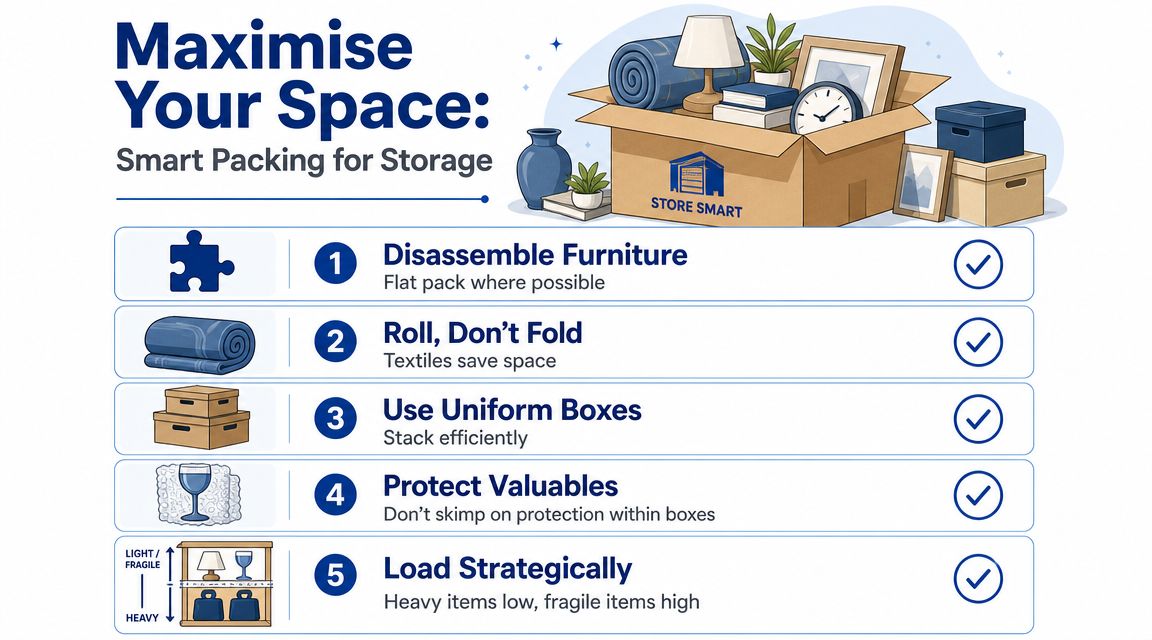
- Disassemble furniture: Bed frames, table legs and modular pieces should come apart where practical. Put screws and brackets in a labelled bag and tape that bag to the item.
- Use uniform cartons: Same-sized moving cartons stack neatly and reduce wasted air gaps.
- Roll soft items: Doonas, towels and clothes often store better rolled or vacuum-packed than loosely folded.
- Nest where you can: Pots, bowls and smaller containers should sit inside each other with padding between them.
Load the unit like a wall, not a pile
The best storage loads are steady and deliberate. Build a solid base with heavier cartons low down, then create flat layers. Keep fragile goods higher and away from pressure points. Leave a narrow walkway only if you know you'll need access.
Soft furnishings help more than people realise. Pillows, blankets and linen can protect furniture edges and fill awkward gaps without needing extra bulk materials. For pre-move decluttering, these DIYAuctions moving preparation tips are worth a look because fewer low-value items means less storage space to pay for.
Packing note: Don't save space by packing fragile items badly. Replacing a broken lamp or chipped table costs more than one extra carton done properly.
What not to do
Avoid random bagging. Loose shopping bags and mixed containers waste space and collapse under weight. Don't leave drawers full if the furniture will become too heavy to handle safely. And don't push items hard against the storage door if you'll need to reopen it later.
If you're sourcing materials yourself, our guide to storage boxes for removals will help you choose cartons that stack properly instead of buckling halfway through the load.
Timing Your Move for Maximum Storage Savings
Storage pricing moves around more than generally believed. It isn't always a fixed shelf price.
Industry guidance for operators recommends watching vacancy, unit turnover and rental duration, then adjusting offers to improve occupancy. In plain English, facilities often use introductory discounts or flexible pricing to fill slower-moving units, which is why asking about promotions or being flexible with your move-in date can help, as outlined in this occupancy-focused storage management guide.
Flexibility gives you leverage
If your dates are locked, you take what's available. If you've got a bit of room to move, you can ask better questions.
Try asking whether the facility has certain unit sizes they're keen to fill, whether a slightly different start date changes the offer, or whether there's any benefit in lining up the storage booking outside the busiest moving days. End-of-month periods are often more hectic because tenancies and settlements tend to cluster there.
The Central Coast pattern matters
Local timing isn't just about the calendar. It's also about traffic, access and building rules.
A Friday afternoon run between Sydney and the Central Coast is very different from an early weekday slot. Newcastle apartments can need lift bookings. Strata buildings in Gosford may limit move times. Beachside suburbs can be awkward during busy holiday periods, especially where parking is tight and driveways are steep.
Booking early helps because it gives you options. Waiting until the last minute usually means you're choosing from what's left, not what fits your move best.
Ask the storage provider what dates and unit sizes are moving slowly. You're not asking for a favour. You're asking a sensible question about inventory they may want to fill.
Short stay or longer hold
If your storage need is only bridging a handover, don't treat it like long-term warehousing. The smarter move is often to align the storage period as tightly as possible with the relocation itself. The less dead time in the middle, the less chance of paying for extra days, extra trips or extra handling.
Why Integrated Moving and Storage Coordination Saves You More
When storage sits inside the moving plan, the whole job gets simpler. That's a key advantage.
The average self-storage tenancy in a mature market lasts about 14 months, with occupancy at 91.6% across 52,301 facilities and more than 2.1 billion square feet of rentable space, according to Neighbor's self-storage industry statistics. For people relocating around the Central Coast, that benchmark is useful because it shows storage is often a temporary bridge rather than a permanent solution. That's why matching duration to the move matters more than chasing the lowest sticker price.
One handling plan beats two separate jobs
The biggest saving is often not financial on the surface. It's operational.
When you split moving and storage into separate DIY tasks, you load the goods, unload them into storage, reload them later, then unload them again at the new property. Every extra touch raises the chance of damage and adds time, labour and fatigue. That's especially true with fridges, washing machines, timber furniture, artwork and awkward items like pianos or oversized lounges.
With an integrated arrangement, the storage is treated as part of the relocation chain. That can mean fewer handling points, clearer inventory control, and a simpler timeline for delivery back out when the home or office is ready.
Protection, access and insurance all need to line up
A proper plan also considers the conditions around the move itself. Apartment relocations may need lift bookings and body corporate approvals. Houses on narrow streets may need careful truck positioning. Offices may need loading dock times, shared area protection and after-hours access. The storage choice has to fit those realities.
A coordinated provider can be useful. Gentle Giant Removals & Relocations handles removals across the Central Coast, Newcastle, Lake Macquarie and Sydney, and can coordinate storage as part of the move rather than leaving you to organise transport, loading and rehandling separately. That matters because full insurance coverage, safe loading methods, quilted protection, and timing control all work better when one team manages the chain from pickup to redelivery.
If you'd like to see the moving-and-storage process in action, this short video gives a practical overview.
Where people usually save the most
The savings usually show up in a few places at once.
| Area | DIY separate bookings | Coordinated moving and storage |
|---|---|---|
| Handling | Multiple load and unload stages | Fewer touch points |
| Time | More trips and more admin | One schedule to manage |
| Risk | Greater chance of scratches and breakage | More controlled handling |
| Access planning | You organise permits, lifts and timing | Planned alongside the move |
That doesn't mean every job needs a fully managed storage service. If you're storing a few cartons and sports gear, self-storage may be perfectly fine. But for full-house relocations, apartment moves, office moves, or any job with a settlement gap, integrated coordination is often the lower-cost option once you count your time, fuel, effort and damage risk properly.
For people comparing suburbs and routes, our article on storage and access planning around Hoxton Park also shows how quickly location and coordination can affect the actual cost of a job.
If you need practical advice on storage as part of an upcoming move, Gentle Giant Removals & Relocations can help you work out the safest and most cost-effective option for your Central Coast, Newcastle, Lake Macquarie or Sydney relocation. You can request a free moving quote or a free in-home assessment to get a clearer idea of space, access and timing. If your move is urgent, give us a call and we'll talk through the storage and relocation plan with you.