
If you're standing in a narrow hallway with a fridge at one end and a steep stairwell at the other, the wrong trolley turns a simple relocation into a dangerous drag. That's the trap with a hand truck for stairs, because the model that looks fine on the driveway can be the one that slips, tips, or overloads on the steps.
In Sydney, Newcastle, Lake Macquarie and the Central Coast, we see the same problem in terraces, apartment blocks and older coastal homes. The stairs, turns, landings and access restrictions matter just as much as the item weight, and that's why choosing the right equipment, and the right removalist, starts with the route, not the load.
Why Standard Hand Trucks Fail on Stairs
A standard hand truck is built for flat ground. Once you put it on stairs, the weight shifts in a way that changes the whole job, because each step creates a new tipping point and the load wants to move away from the operator. That's why a stair-climbing hand truck exists in the first place, it's designed to keep the load controlled as the wheels and toe plate negotiate each riser.
What goes wrong on a staircase
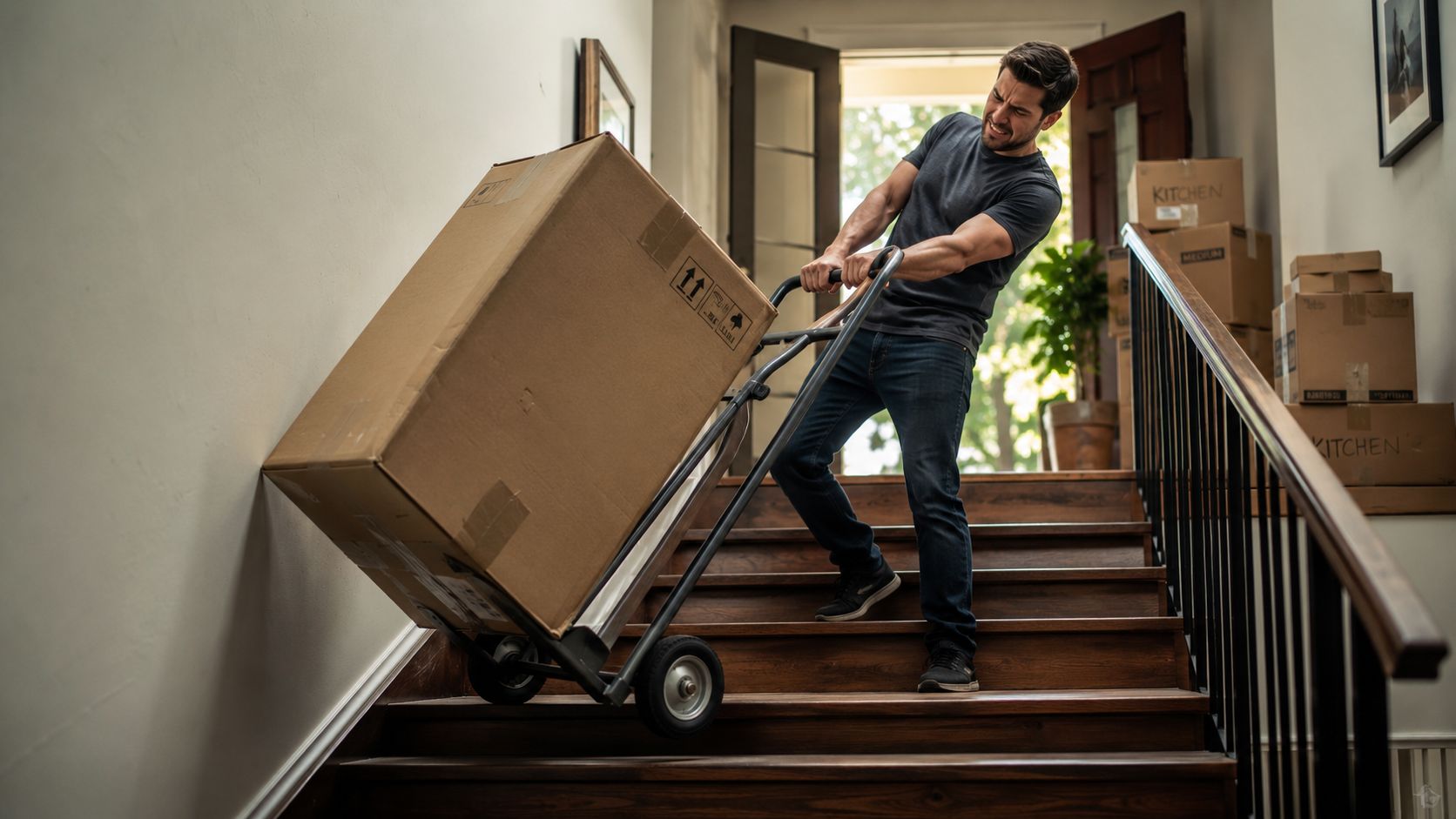
On a level floor, the operator can roll and balance the load with steady force. On a staircase, the load centre moves beyond the stair edge during each transition, which increases the dynamic load and the tipping moment. That's the practical reason a trolley that feels stable on a garage floor can become awkward on a narrow internal staircase in a Sydney terrace or a Newcastle apartment.
For homeowners, the risk isn't just fatigue. A slip can damage the stair nosing, mark walls, or put a heavy appliance into an uncontrolled drop. Dense items such as file boxes, a small fridge, or a washing machine deserve extra caution because they don't forgive a misstep.
Practical rule: if the stairs are narrow, steep, or awkward to turn on, don't assume a regular trolley will cope. Match the equipment to the access, not just the item.
In older parts of NSW, that matters a lot. Inner Sydney terraces, heritage apartments in Newcastle, and coastal homes on the Central Coast often have tighter stair geometry than people expect. If the operator can't keep the load plate close to the riser and maintain stable wheel contact, the job is already working against them.
Understanding Stair-Use Ratings vs Flat-Ground Capacity
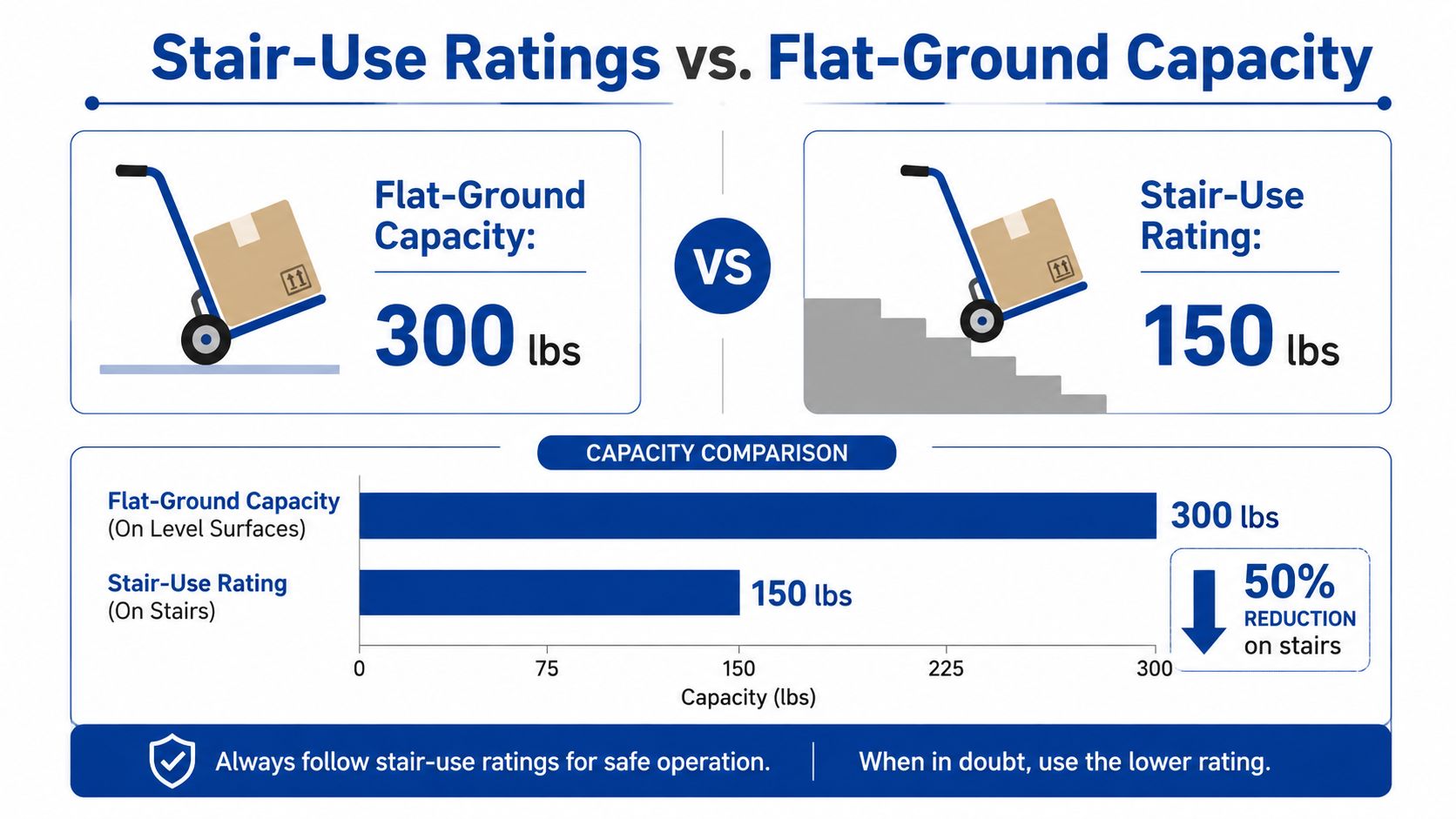
The biggest mistake people make is reading the first capacity number they see and assuming it applies everywhere. It doesn't. A commercial model can be rated at 330 lb on level surfaces but only 150 lb for stair use stair-climbing hand truck specifications, and that gap exists because stairs impose a very different kind of stress on the operator and the frame.
Why the stair rating is the real limit
When the load rises step by step, the truck experiences more tipping force and more sudden loading than it does on the floor. The operator has to manage the balance point through every transition, which is why the stair-use figure is the number that matters. For a house move in Sydney or Newcastle, that means a box of files or a compact appliance may be acceptable on flat ground but not necessarily safe on the stairs.
That's also why a generic payload number can be misleading for relocation planning. A heavy item that looks manageable on the driveway may be the wrong fit for a steep staircase, especially if the load is dense and the landing is tight. If you want a useful comparison between load planning systems, the logic is similar to the way fleet teams treat payload compliance in heavy vehicles, where the governing limit depends on the operating condition, not just the headline number, as explained in this guide to HGV payload compliance.
On NSW moves, I'd rather see a client use a lighter stair load with control than push a borderline load and hope the staircase behaves. The stair-use rating protects the crew, the property and the item itself.
Comparing Tri-Wheel, Powered and Convertible Designs
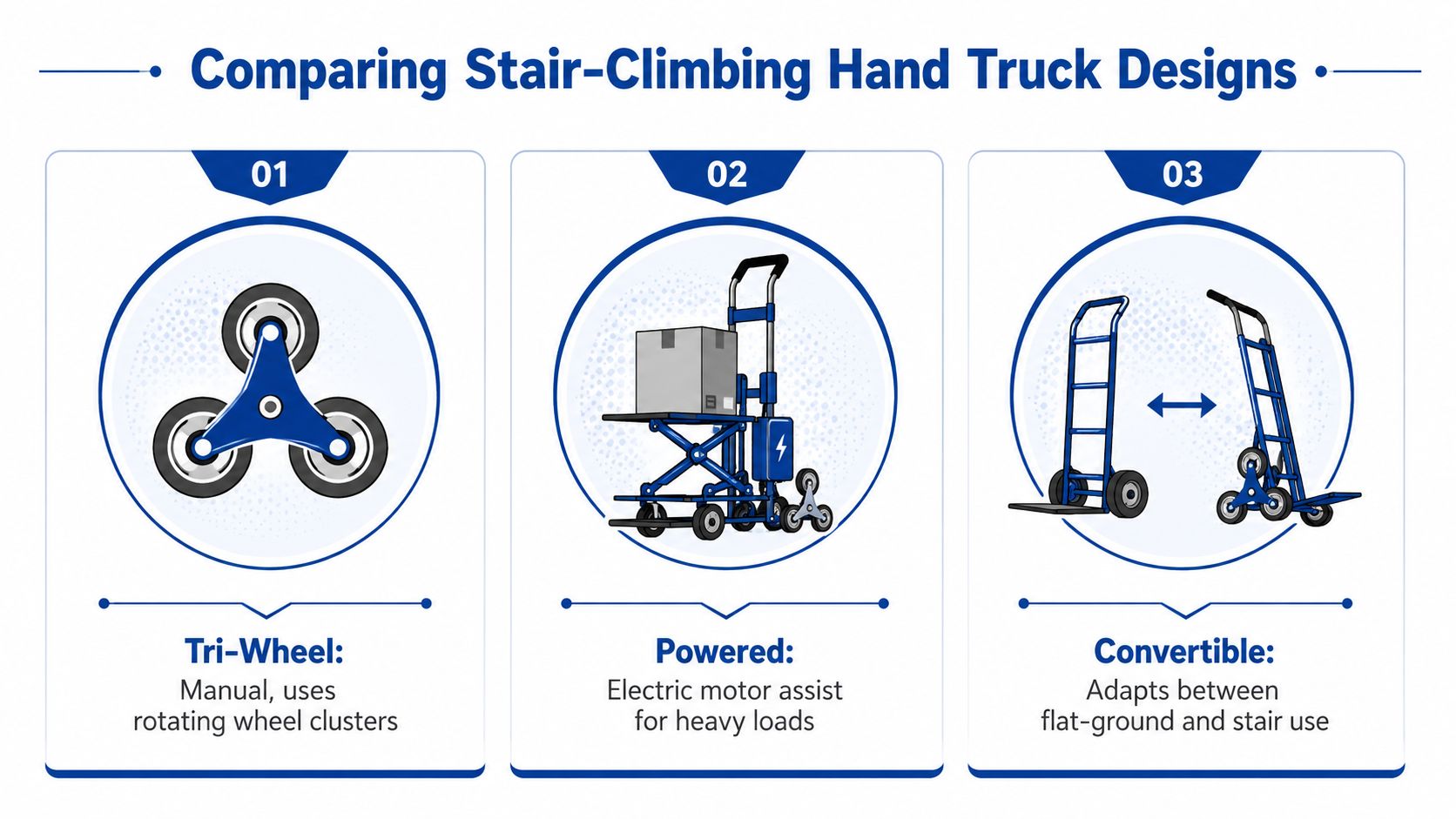
Not every hand truck for stairs works the same way, and that's where people get caught out. A tri-wheel model is manual, a powered unit adds motor assistance, and a convertible design tries to bridge flat ground and stair use without giving up too much everyday convenience. Each has a place, but each also has a limit.
Tri-wheel and multi-wheel manual models
Manual tri-wheel units use rotating wheel clusters to climb steps. They're straightforward, don't need charging, and suit lighter jobs where the operator can keep a steady rhythm. They're a sensible choice for compact apartment items, but they still rely on the person doing the pushing and balancing.
Powered units for heavier work
Powered stair climbers are built for more demanding loads and can climb at 22 steps per minute on the slow setting and 30 steps per minute on the fast setting, with one listed model showing a maximum step height of 9.84 in, a 3-hour charging time, and a 70 dB noise level powered stair-climbing hand truck specifications. That noise level matters in shared Sydney apartment buildings, where body corporate rules and neighbour considerations can shape the move window. A powered model can be the better fit for repetitive stair work, but it's still not universal, and some units only suit stairs up to 8.27 inches high and slopes within 35 degrees powered stair-climbing hand truck specifications.
Convertible designs and mixed access
Convertible units make sense when you're moving between flat surfaces, ramps and stairs. They're useful in buildings with loading docks, uneven entries, or mixed access points, but they're not a magic fix for every staircase. I'd treat them as a flexibility tool, not an automatic answer.
A powered stair climber can be the right tool and still be the wrong tool for your stairs. Measure the access before you trust the brochure.
If you're comparing styles for a move across Central Coast, Newcastle or Sydney, start with the staircase and the building rules, then choose the design that fits those constraints.
Matching Wheel Size, Handle Height and Frame Material to Your Stairs
Once the design type is sorted, the next decision is about geometry. Wheel size, handle height and frame material change how the truck feels on the steps, especially on steep entries, tight landings and older staircases where every inch counts.
Wheel diameter affects control
Commercial stair-climbing hand trucks commonly use wheels in the 6–8 inch range, while heavier-duty units often move into 8–10 inch wheels commercial stair-climber specifications heavy-duty stair-climbing hand truck specifications. Bigger wheels reduce the step-to-step angle change and soften impact losses, which helps on uneven treads and older NSW stairs. That's one reason a 725 lb stair-climbing truck with 10 inch rubber wheels and a 64 inch handle height feels very different from a 500 lb aluminium-frame version with 5 inch wheels and a 59 inch handle height heavy-duty stair-climbing hand truck specifications.
Handle height changes leverage
Handle height around 59–64 inches gives the operator more control, which matters on steeper entries and when the landing gives you very little room to reset heavy-duty stair-climbing hand truck specifications. A taller handle can make control easier, but it also demands more awareness in low doorways, narrow halls and tight apartment turns.
Frame material changes the feel
Steel frames are common where rigidity matters, while aluminium reduces weight and can be easier to manage over repeated landings commercial stair-climber specifications heavy-duty stair-climbing hand truck specifications. There's always a trade-off, because a heavier frame can feel more planted but asks more of the operator on every lift, pivot and landing.
A practical example is a Central Coast terrace with a narrow internal stair and a steep final rise. In that situation, the safer choice usually favours control and power over raw capacity.
Do Stair-Climbing Hand Trucks Really Reduce Injury Risk
The short answer is yes, but not in the simplistic way product ads suggest. Ergonomics guidance from the University of Waterloo says stair-climbing hand trucks can eliminate manual lifting and pulling forces and work efficiently for compact or lighter loads, but they still require workers to position the load onto the platform and don't remove every handling step University of Waterloo ergonomics guidance.
The real trade-off
That means the safety benefit is real, but it's partial. You're reducing strain, not deleting the task. For older clients, apartment moves and repetitive short-haul work in Sydney or Newcastle, that distinction matters because the setup time and the residual manual handling still need to be managed properly.
A stair climber can be the better option than a two-person carry when the item is awkward, the stairs are narrow, or the route includes multiple flights. It can also be overkill for a very light item that two people can safely carry with less setup. That judgement call is where experience helps, because the best tool is the one that reduces risk without adding new ones.
Useful mindset: choose equipment that lowers strain, then confirm it also fits the access. A safer tool that doesn't fit the building is still the wrong tool.
If you're weighing the equipment against professional help, it's worth reading our what is a removalist guide and comparing how crews plan access, carry loads and protect the property. The right call depends on the staircase, the item, and how many times the load needs to move.
Safe Operating Techniques for Stair Moves
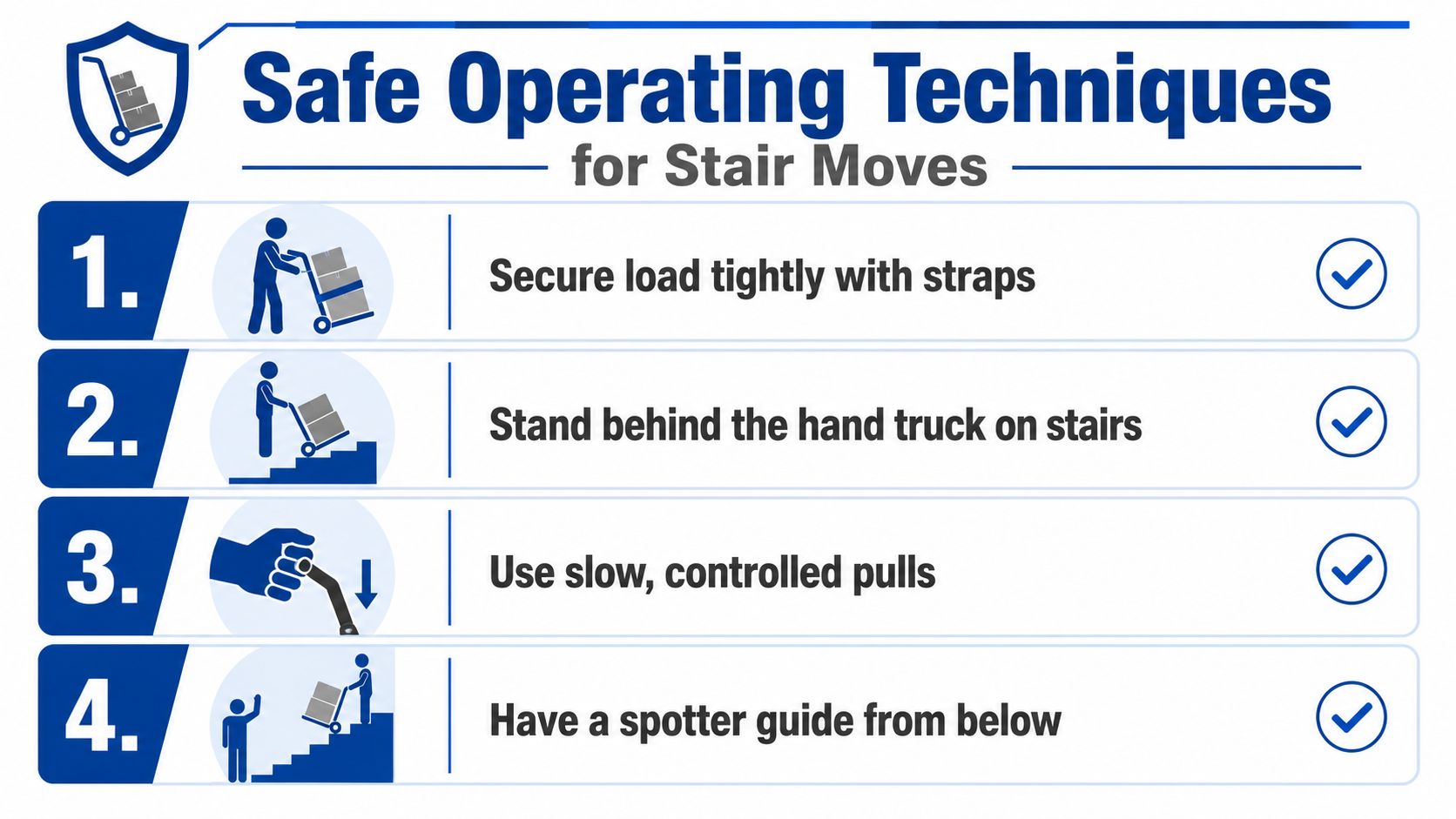
A stair-climbing hand truck only works well when the operator treats it like controlled lifting equipment, not a shortcut. The first job is to secure the load properly, because a shifting item changes the balance at the worst possible moment. Some commercial models use strap-and-buckle retention to keep the load aligned as the truck climbs, and that's not a detail to skip over heavy-duty stair-climbing hand truck specifications.
What good stair handling looks like
Keep the load plate close to the riser so the truck stays balanced against the step edge. Maintain stable wheel contact, move slowly, and don't rush the transition between steps. On narrow internal stairs, especially in terraces and apartments, tight control matters more than pace.
For heavier items, two-person handling can be the safer choice. One person manages the truck, while the other guides from below and watches the clearances on the walls, railings and landings. That approach is especially useful where the stairwell turns sharply or the item is tall enough to obstruct the operator's view.
The final point is landing management. Landings are where people lose rhythm, because they're resetting balance after a climb or descent. If the landing is cramped, use extra time and don't force the turn.
For furniture protection, padding and wrap matter as much as the truck itself, so our furniture protection guide is worth a read before moving day. Good packing materials and careful handling reduce scuffs, dents and scraped walls.
When to Rent, Buy or Hire Professional Removalists
Renting a stair-climbing hand truck makes sense for a one-off move with straightforward access. Buying one can work for regular use, but only if you move often enough to justify storage, maintenance and learning the equipment. For many NSW homes and businesses, hiring professional removalists is the cleaner option because the crew already has the right equipment, the right technique and the right insurance.
The hidden cost is access complexity
Once you add lift bookings, body corporate requirements, shared area restrictions, parking permits and tight move-in windows, the job becomes more than just moving weight. Sydney apartment buildings can be especially restrictive, and Newcastle's heritage apartments often add narrow stairs and awkward access on top of that. A DIY stair truck doesn't solve those building rules.
The other issue is coordination. If you're moving between multiple locations, or you're trying to keep a business relocation on schedule, the equipment choice is only one part of the job. The team still has to load, protect, transport and place everything without blocking access or holding up the building.
If you're comparing DIY with a crew, our removalists versus self-move guide gives a practical way to think through the trade-offs. For a difficult staircase, full insurance coverage and experienced handling often deliver better value than trying to manage the load yourself.
Planning Your Stair Move Across Central Coast, Newcastle and Sydney
Good stair planning starts with the staircase itself. Measure the rise, check the width, look for tight turns, and think about where the load needs to rest on the way up or down. That matters in Terrigal, Gosford, Lake Macquarie, inner Sydney and Newcastle because access can change from one property to the next even on the same street.
What to confirm before moving day
Ask about the stair rating, not just the headline capacity. Confirm whether the truck suits your step height and slope, whether the building needs a booking or permit, and whether the move has to happen in a specific window because of strata rules. If you're relocating interstate, you'll also want a broader plan for loading, timing and route coordination, which is why our local and interstate removals guide can help you think through the sequence.
Seasonal timing matters too. Holiday periods, weekend traffic and wet weather can all complicate access, especially on coastal streets and busy Sydney roads. A few extra minutes of planning can save a lot of strain at the staircase.
If the access looks marginal on paper, treat it as marginal in practice. The safest move plan is the one that respects the stairs before the first item leaves the truck.
For homeowners, renters and businesses in the Central Coast, Newcastle and Sydney, the smartest next step is a free in-home assessment and a clear conversation about stairs, parking and insurance. If the job looks tight, ask for help early, because the right plan is always easier than a rushed one.
If you're planning a move with stairs, tight access or a tricky apartment entry, Gentle Giant Removals & Relocations can help you choose the right approach and protect your belongings from start to finish. Visit Gentle Giant Removals & Relocations for a free quote or request a free in-home assessment, and if your move is urgent, call the team so they can talk you through the safest option for your stairs.