
You’re probably staring at cupboards, wardrobes, the garage, and that one spare room that became a holding bay for everything you didn’t know what to do with. That’s normal. Most households on the Central Coast, in Newcastle, or heading into Sydney don’t struggle with the move itself first. They struggle with deciding what deserves to come along.
The smartest moves start well before moving day. In New South Wales, decluttering before moving can reduce moving costs by up to 30 to 50%, and cutting possessions by 20 to 30% can save an average of $550 on removal fees, according to Surewise’s summary of NSW moving data. That matters when you’re trying to keep the truck size down, shorten labour time, and avoid paying to transport things you don’t even want in the next home.
A good declutter also makes the physical move safer. Clearer walkways, lighter loads, fewer awkward pieces, and better-labelled packing materials all reduce the risk of damage to belongings, walls, lifts, and shared areas. If you’re moving from a house in Terrigal, an apartment in Gosford, or a townhouse in Newcastle with tight access, the less clutter you carry, the easier every stage becomes.
Your 8-Week Decluttering Timeline for a Smoother Move
A rushed declutter usually turns into two problems. You keep too much because you’re tired, and then moving day takes longer than it should. The fix is simple. Start early and work in passes, not in one heroic weekend.
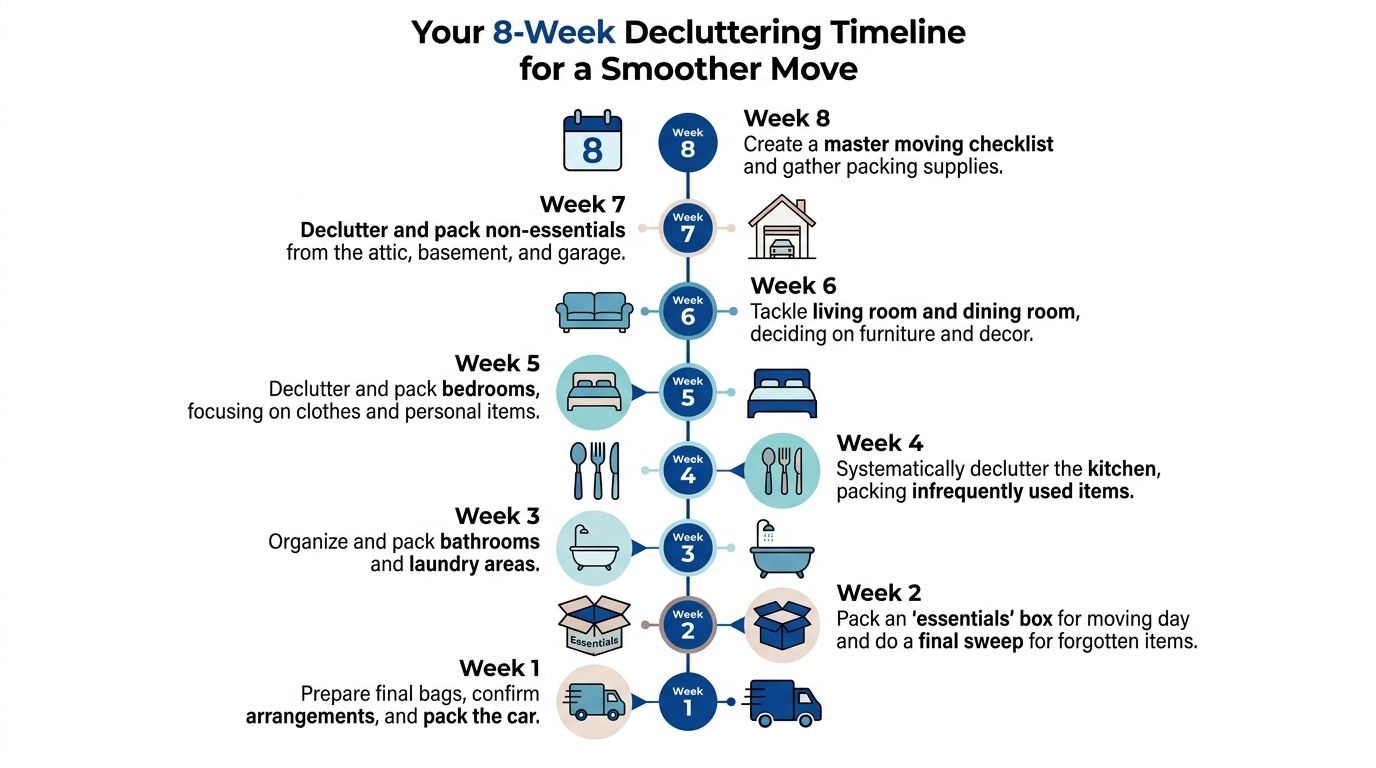
Weeks 8 to 6 build momentum
Book your relocation date first. Once the date is locked in, every decision gets easier because you’re working to a real deadline, not a vague plan. If you still need supplies, sort your packing materials early and look at practical options like free moving box ideas and supply planning before the rush begins.
The first two weeks should focus on low-emotion areas. Start with the garage, shed, linen cupboard, spare room, and any overhead storage. These spaces are usually full of things you can decide on quickly, and quick decisions are how you build rhythm.
By week 6, move into the living areas. Furniture is the big decision here. If the new place has a smaller lounge, narrower hallway, or apartment lift access, stop guessing and start measuring.
Practical rule: If a piece is hard to access, hard to lift, awkward to place, and doesn’t suit the new floor plan, deal with it now, not the night before the truck arrives.
Weeks 5 to 3 sort the everyday rooms
Week 5 is ideal for bedrooms and wardrobes. Clothes are often a major source of unnecessary volume. Keep what fits, what you wear, and what suits the new home. Pack off-season clothing and leave only what you’ll use before moving day.
Week 4 is the kitchen. This is one of the slowest rooms if you leave it too late. Duplicate utensils, old containers without lids, gadgets used once a year, and chipped crockery add surprising bulk. Keep daily-use kitchenware accessible and pack infrequently used items first.
Week 3 is bathrooms, laundry, and household consumables. Expired products, half-used cleaning supplies, worn towels, and old cords tend to hide here. Be careful with disposal. Chemicals, paint, fuel, and batteries shouldn’t go into general rubbish. Local council collection and hazardous waste rules matter here.
Weeks 2 to 1 finish without panic
The final fortnight is about control. You’re not making big emotional decisions now. You’re tightening the job.
Use week 2 for a final sweep. Pack your essentials separately, check every cupboard and drawer, and make sure anything staying with the house is clearly separated from what’s moving.
Week 1 is logistics. Confirm access, parking, and timing. If you’re in a strata building in Sydney or Newcastle, check lift bookings, loading bay rules, and move-in windows. If the street is narrow or parking is limited, organise permits or a practical loading plan early.
A simple countdown looks like this:
| Week | Priority | Focus |
|---|---|---|
| 8 | Planning | Book date, list rooms, gather packing materials |
| 7 | Easy wins | Garage, shed, storage, spare room |
| 6 | Bulk items | Living room, dining room, furniture decisions |
| 5 | Personal items | Bedrooms, wardrobes, linen |
| 4 | Heavy-use room | Kitchen, pantry, appliances |
| 3 | Utility spaces | Bathroom, laundry, cleaning supplies |
| 2 | Final pass | Essentials, forgotten cupboards, last donations |
| 1 | Access and readiness | Parking, lift bookings, pathways, car packing |
This pace works because it spreads the effort. It also leaves room for real-world interruptions that always happen. School commitments, work deadlines, settlement changes, weather on the Coast, traffic into Sydney, or delays with keys.
If you want to know how to declutter before moving house without burning out, this is the part that matters most. Start early, keep each week focused, and don’t save the hard decisions for the final few days.
The Decisive Framework Keep Sell Donate or Dispose
The challenge isn't a lack of motivation. They need a decision method. Without one, every drawer turns into a debate and every shelf becomes “maybe later”.
The simplest working system is Keep, Sell, Donate, or Dispose. Four outcomes. Every item gets one.

Keep only what suits the next home
“Keep” doesn’t mean “I own it already”. It means the item earns space in the new place.
That’s where a floor plan helps. Professional organisers in Australia report that a systematic room-by-room purge using a 3-bin system of Pack, Donate, Trash can increase efficiency by 40%, and using the new home’s floor plan helps prevent a 32% post-move regret rate from over-packing, as noted in this Australian decluttering guidance.
If you’re moving from a larger house in Lake Macquarie or the Central Coast into a smaller villa or apartment, the question isn’t whether the furniture is still good. The question is whether it fits the available wall space, circulation room, and access points.
Keep items that meet these tests:
- Fits the new layout. It works with the measurements and access.
- Gets regular use. You’d notice if it disappeared.
- Is worth protecting. It has practical, financial, or sentimental value.
- Travels safely. It can be packed and moved without unreasonable risk.
Sell when the item is bulky and still wanted by someone else
A lot of guides push donation first. In practice, selling the right bulky items can make more sense.
According to Good Housekeeping’s cited moving data, strategically selling bulky items through platforms such as Gumtree can offset 15 to 20% of moving costs for 70% of households, while excess volume can increase removalist fees by 25 to 40%. That’s a real trade-off. A second fridge, oversized outdoor setting, spare bed frame, or bulky entertainment unit might be worth more sold locally than moved.
For Central Coast to Sydney or Newcastle relocations, this often works best for furniture that’s still useful but wrong for the next address. If the new place has stairs, a small lift, narrow terrace access, or body corporate restrictions, selling early can save headaches later.
If you want a fuller planning list around admin, bookings, and timing, this Australian relocation checklist is a practical companion to the decluttering process.
Donate quickly when value matters more than return
Donation is the right choice for many everyday items. Clothing in good condition, kitchenware, books, linen, and small household goods can move on fast if you don’t need to recoup money from them.
Local options like Vinnies are useful because they keep the process moving. That matters more than squeezing a small sale out of low-value items. If you try to list everything, you can lose a week and still be surrounded by clutter.
Donate the middle-value items. Sell the bigger-ticket bulky items. That split usually keeps momentum going.
A donation pile should be clean, serviceable, and ready to leave the house. Don’t create a “charity corner” that sits there until moving day.
Dispose properly and don’t hide rubbish inside the move
The dispose category is where a lot of households stall. Broken furniture, expired pantry goods, worn-out cords, dead appliances, old paint tins, garden chemicals, and mystery garage items can’t all go into standard rubbish.
Use local council clean-up options for hard waste. Use approved drop-off points for e-waste, chemicals, batteries, and paint. If you’re in strata, don’t leave disposal items in common areas, car parks, or bin rooms without approval. That creates building issues and can delay your move-out.
This short video is a useful reset if you’re struggling to make decisions at item level:
The method works because it removes ambiguity. Once every item has one of four outcomes, the house starts changing quickly. That’s when decluttering stops feeling emotional and starts feeling useful.
A Room-by-Room Decluttering Strategy
A room-by-room pass works best once you’ve already set your timeline and your decision rules. The house becomes easier when you don’t wander from drawer to drawer. Pick a room, finish it, then move on.
A practical example helps. Say you’re moving from a three-bedroom home in Terrigal to an apartment in Newcastle. You’ve got less storage, stricter access, and probably a lift booking to think about. That means volume matters, and so does what shape that volume takes.

Start with the garage, shed, and spare room
These are usually the least sentimental areas. They’re also where old paint, broken tools, camping gear, sports equipment, and half-finished projects pile up.
Be careful here. Garage clutter often includes hazardous items that need special disposal. Keep pathways clear while you work, especially if children or older family members are around.
Use a simple approach:
- Group by function. Garden tools together, sports gear together, camping gear together.
- Pull out duplicates. Two shovels might be useful. Five usually isn’t.
- Separate hazards early. Chemicals, fuel, batteries, and paint should go aside for proper disposal.
Bedrooms should be practical before they’re sentimental
Bedrooms look easier than they are. Wardrobes, linen, bedside drawers, under-bed storage, and old keepsakes all slow people down.
The best shortcut is to start with what gets used weekly. Keep enough clothes for your current season, work, and daily life. Cull damaged hangers, worn linen, unmatched socks, and clothing you haven’t touched in a long time.
If you’re packing as you go, this guide on how to pack for a move will help you protect what stays without creating extra work later.
Bedrooms go faster when you separate daily-use items from “just in case” items before you touch sentimental things.
Children’s rooms need a lighter hand. Involve kids where you can. If they choose what comes with them, unpacking tends to go better because the new room already feels familiar.
Kitchens shrink badly if you don’t edit them hard
Kitchens carry weight fast. Plates, pots, appliances, pantry items, cleaning products, and drawers full of duplicates all add up.
The easiest wins are usually obvious once everything is out on the bench. Duplicate utensils, novelty gadgets, spare serving ware, takeaway containers without matching lids, and expired pantry items don’t deserve truck space.
A quick checklist helps here:
| Area | What to question | What usually stays |
|---|---|---|
| Pantry | Expired food, duplicates, bulk buys | Current staples |
| Drawers | Duplicate utensils, blunt tools | Everyday cooking tools |
| Cupboards | Rarely used serving ware | Daily plates, bowls, mugs |
| Bench appliances | One-use gadgets | Appliances used regularly |
Living areas and home offices need measurement, not hope
A sofa can look perfectly fine in your current lounge and be completely wrong for the next place. The same goes for desks, bookshelves, TV units, and display cabinets.
In living rooms, focus on bulk first. Ask whether the item suits the new dimensions, the access path, and how you’ll live in the new home. In apartments and townhouses, turning circles, stairwells, and lifts matter just as much as floor area.
Home offices often hide paper clutter, dead tech, cables, and furniture that no longer fits modern work habits. Keep important documents secure and separate. Shred what you no longer need. Bag loose cords and label them straight away.
For many households, the most effective method is still the simplest one. As noted earlier in the Australian organising guidance, a room-by-room purge with a 3-bin system improves efficiency, and using the floor plan keeps you from taking too much. That’s one of the clearest answers to how to declutter before moving house in a way that holds up on moving day.
Special Considerations for Seniors and Complex Moves
Some moves aren’t just about logistics. They carry history.
A senior downsizing from a long-held family home in the Central Coast often isn’t deciding between objects. They’re deciding between memories, routines, and identity. That’s why speed can do harm here. For the 22% of Australians over 65 who relocate, forced decluttering can increase stress by 40%, according to this guidance on supported decluttering for older Australians.

Slow decisions are often better decisions
A rushed family clean-out usually goes the wrong way. One person pushes for efficiency. Another freezes. The older person feels cornered, and the whole process turns tense.
A better approach is to reduce the pressure around each choice. Work in short sessions. Sit down for the sentimental categories. Keep practical categories moving so progress is visible without forcing painful decisions too early.
One method that helps is memory mapping. Take photos of meaningful items before donating them. That preserves the story even when the item itself can’t come to the new home.
Some possessions are really memory triggers. Photographing them can make it easier to let go without feeling like the memory is being thrown away.
Support matters in downsizing, disability, and routine-based households
Special needs moves often need more structure than people expect. Routine changes, noise, unfamiliar faces, and disrupted spaces can make the decluttering stage harder than the truck day itself.
The same is true when a household includes mobility issues. Narrow hallways, stairs, steep driveways, uneven garden paths, and bathroom access become planning issues early, not on the day. That includes whether items should be moved at all, whether packing is best handled by family or professionals, and how to keep walkways safe during preparation.
If your family needs extra planning around pace, communication, and familiar routines, these downsizing tips for seniors offer useful prompts for conversations that can otherwise become difficult.
For moves involving older clients, reduced mobility, or high-emotion downsizing, this guide to moving for seniors can help you think through support needs before the packing starts.
The practical side still matters
Empathy doesn’t replace logistics. It supports them.
A senior move still needs the same core planning as any other relocation. Clear access. Safe pathways. Protection for fragile pieces. Careful handling for family photos, antiques, and heirlooms. Full insurance coverage matters here because the value of these items often isn’t just financial.
This is also where one practical service can make a real difference. Gentle Giant Removals & Relocations offers customized support for aged and special needs clients, along with packing, careful handling, and relocation planning across the Central Coast, Newcastle, Sydney and beyond. For the right household, that kind of structure can take pressure off family members who are trying to manage both emotions and logistics at once.
From Decluttered to Ready for the Removalist
A decluttered house still isn’t ready for moving day until the remaining items are staged properly. Good preparation turns into a faster load, a safer carry, and fewer avoidable delays.
What slows a crew down isn’t usually effort. It’s obstacles. Loose items on floors, half-filled bags, unlabelled tubs, blocked hallways, missing lift bookings, and last-minute surprises around parking are what chew through time.
Pack for access, not just storage
Packing is about more than getting things into cartons. The way you stage the house affects how efficiently the crew can work.
Group packed items by room and keep them out of traffic areas. Leave clear walking paths from the front door to the truck. If some items aren’t going, mark them clearly and keep them in a separate room. That one step prevents confusion and accidental loading.
DIY packing can work well if you’re organised and have time. Professional packing tends to make more sense when you’re managing a larger home, fragile items, a tight schedule, or a complex access situation. Either way, use proper packing materials, not a mix of worn cartons and soft bags that collapse under stacking pressure.
Confirm building access before the truck arrives
This matters more in apartments and busy metro areas than people expect. Sydney buildings often require lift bookings, loading dock windows, and body corporate notice. Newcastle heritage apartments can have tight stairwells and awkward common entries. Central Coast coastal areas can bring steep driveways, soft verges, and weather exposure.
A quick pre-move checklist is worth doing:
- Parking and permits. Check whether the truck can legally and safely park near the property.
- Strata rules. Confirm lift times, protection requirements for shared areas, and any move-in restrictions.
- Access notes. Mention narrow streets, long carries, stairs, or gated entries before the day.
- Fragile and high-value items. Identify artwork, glass, antiques, and instruments early so handling is planned properly.
The cleaner the access and the clearer the staging, the more your decluttering effort pays off on the day.
Decide early what should go to storage
Storage can help, but it shouldn’t become a place where decisions go to hide. If you’re putting things into storage because settlement dates don’t line up or you’re waiting on space in the new property, that’s sensible. If you’re storing items because you couldn’t decide, you may just be postponing the cost.
This article on reclaiming space and avoiding costly self-storage is a useful reminder that storage works best when it solves a timing issue, not when it replaces decluttering.
If temporary storage is part of your plan, sort it before moving day and keep a clean inventory. Seasonal items, documents, keepsakes, and selected furniture can be stored sensibly when they’re packed, labelled, and separated by priority. This short-term storage guide can help you decide what belongs in storage and what should travel straight to the new home.
A final note on safety. Don’t leave loose tools, cleaning chemicals, open-top bags, or unsecured items where children, pets, or older relatives are walking through the home. The final day or two before a relocation is when households are busiest and most distracted. That’s exactly when trip hazards and accidental damage happen.
Your Fresh Start Awaits
A good move rarely starts with the truck. It starts with fewer unnecessary decisions on the day.
When you approach how to declutter before moving house with a clear timeline, a simple decision framework, and a room-by-room plan, the whole relocation becomes easier to manage. You spend less time packing things you don’t need, less energy carrying them, and less money moving them. Just as important, you arrive at the new place with a cleaner start.
That matters whether you’re moving from Gosford to Newcastle, downsizing on the Central Coast, heading into a Sydney apartment, or planning an interstate relocation from NSW. The practical details change from job to job, but the principle stays the same. A lighter, better-organised load is safer to handle, easier to place, and faster to settle into.
It also gives your removalist a fair chance to do the job properly. Clear pathways, labelled packing materials, confirmed access, and realistic preparation all support an On Time, Every Time approach. They protect your belongings, your property, and the crew moving everything through stairs, lifts, driveways, and shared spaces.
If you’re not sure where to start, start small and start today. One cupboard, one wardrobe, one shelf. Momentum matters more than perfection.
And if the move has extra layers such as strata requirements, narrow access, storage timing, fragile items, business downtime, or support for a senior family member, it helps to talk it through with someone who understands local conditions across the Central Coast, Sydney, Newcastle, and Lake Macquarie.
If you’d like practical help planning your move, get a free quote from Gentle Giant Removals & Relocations. We can help with local, intrastate and interstate relocations, packing services, storage coordination, and move-day planning for houses, apartments, offices, seniors and complex access jobs. For urgent moves, call the team directly and ask about current availability, or request a free in-home assessment online.