
The quote comes through, then the calendar pressure starts. You're lining up keys, cleaners, school schedules, maybe a lift booking in a Sydney apartment, and suddenly the transport side feels bigger than the move itself. That's usually when people hear the term backloading and wonder whether it's a smart shortcut or a risky compromise.
For plenty of Central Coast, Sydney, Newcastle and Lake Macquarie relocations, moving interstate backloading can be a practical way to cut costs without cutting corners. The catch is that it only works well when the job is planned properly, packed properly, and managed by a removalist who's honest about timing, access and protection from the start. If you're weighing up your options, our local and interstate removals guide is a helpful place to compare how different move types work in real life.
Your Guide to Interstate Backloading
A common scenario looks like this. You're leaving a unit in Sydney for a house on the Central Coast, or heading north from Newcastle with family furniture, work gear and a few fragile pieces you don't want bounced around. You get a quote for a dedicated truck, then start looking for a smarter option that still feels professional.
That's where backloading earns its place. Instead of booking an entire truck just for your relocation, you use available space on a truck that's already travelling that route. You pay for the space your goods take up, not the whole vehicle, which can make interstate moving far more manageable if your dates have some breathing room.
It isn't right for every move. But when the route, timing and load size line up, it can be one of the most sensible ways to handle an interstate relocation. The key is understanding the trade-offs before you commit.
What Exactly Is Interstate Backloading?
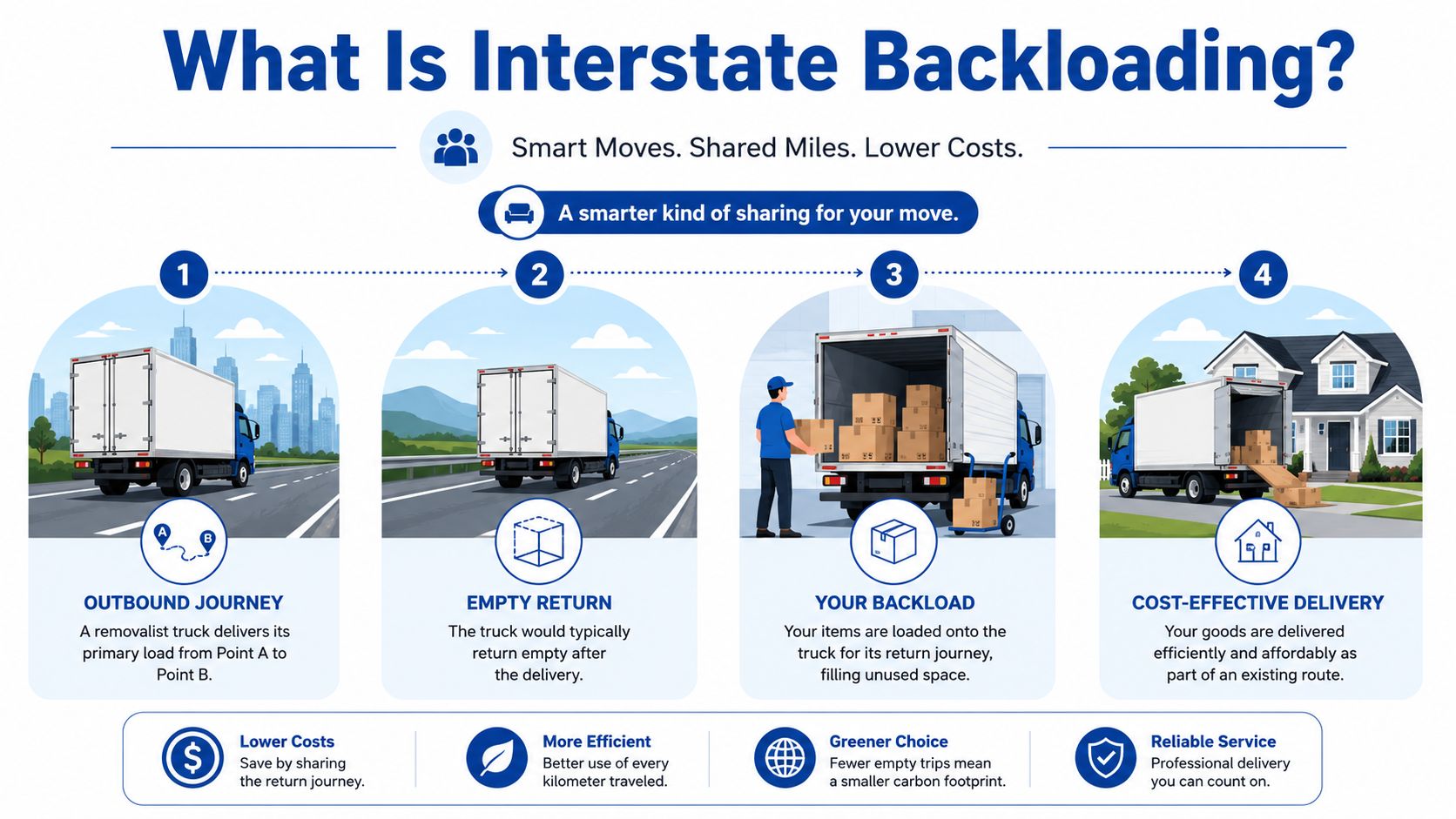
Think of backloading as a carpool for your furniture. A truck completes one job, then instead of returning with empty space, it carries another customer's belongings on the return route. That second load is the backload.
If a truck has delivered household goods from the Central Coast or Sydney to another interstate destination, that return leg has value. Rather than waste the trip, the removalist can load your items into the available space and deliver them along the way. That's why backloading usually costs less than booking a dedicated truck just for your relocation.
How it differs from a dedicated move
A dedicated move is simple. The truck is yours for that job, the schedule is tighter, and the route is built around your dates. That suits clients with strict settlement times, office relocations that can't afford downtime, or homes with complicated access where every hour matters.
Backloading works differently. Your goods travel as part of an existing run, so the schedule has to fit the broader route. That's why flexibility matters. The reward for that flexibility can be substantial. Backloading in Australia typically saves movers 40% to 60% off standard interstate shipping rates, and a standard move that normally costs $3,800 can be reduced to $1,520 by using empty space on return-journey trucks, especially on major routes like Sydney to Brisbane, according to this backloading cost analysis.
Practical rule: Backloading saves money because you're sharing an existing trip, not creating a new one.
Why people choose it
For many households, the biggest appeal is obvious. You're not paying for unused truck space. On busy eastern seaboard corridors, that can make a real difference to the budget, especially for apartment relocations, partial household moves, or jobs where only part of the home is travelling interstate.
There's also an efficiency benefit. The truck space gets used instead of running empty. For customers who don't need a truck at a precise hour, that's often a sensible trade.
A simple local example helps. If someone is relocating from a Newcastle apartment to a Sydney address and their delivery can happen within an agreed window rather than a fixed minute, backloading can be a good fit. The move still needs careful loading, clear labelling and secure protection, but the transport model itself is more economical because the route already exists.
Is Backloading the Right Choice for Your Move?
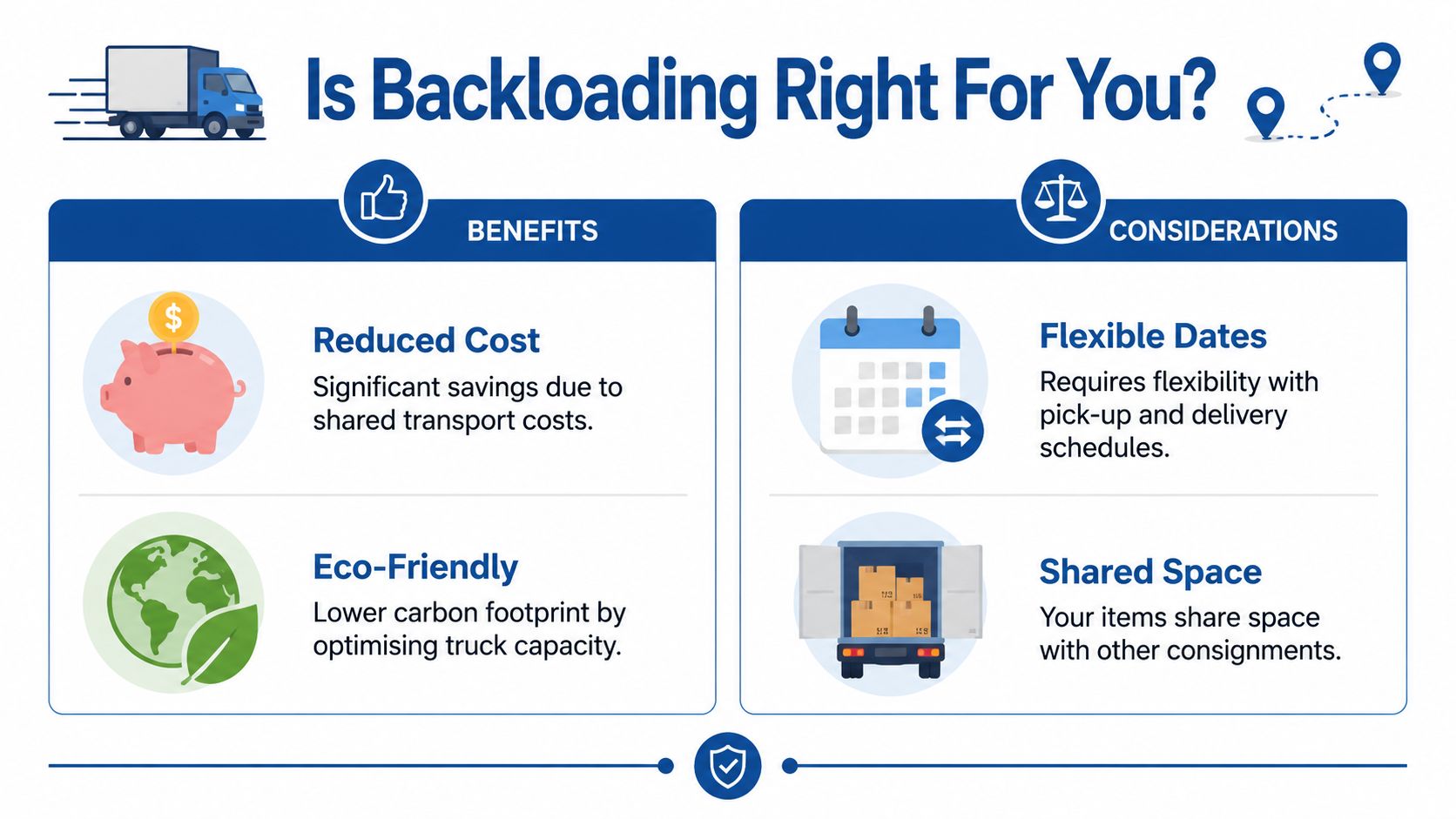
Backloading is a good option for some relocations and the wrong fit for others. The trick is being honest about your dates, your load, and how much certainty you need around delivery.
If you've got a modest household load, flexible access, and a bit of room around your move-in date, backloading often makes sense. If you've got settlement on one day, body corporate restrictions, a narrow loading zone in Sydney, or a large fragile collection that needs isolated handling, a dedicated truck can be the safer call. If you're comparing lower-cost options, this guide to affordable interstate moving companies helps you assess value without focusing only on the cheapest quote.
When backloading usually works well
A student leaving a share house in Newcastle for Lake Macquarie with a bed, desk, a few appliances and packed cartons is a classic fit. So is a couple moving from a Gosford unit to Sydney when the building has a bookable lift and a delivery window rather than one fixed hour.
Backloading also suits staged relocations. Some families send the non-essential items first, then keep a smaller local load with them until final handover. That can work especially well when you're waiting on access confirmation for a strata building or trying to avoid peak traffic through Sydney.
When a dedicated service is the better choice
Some moves need tighter control. A large family home with a strict settlement deadline usually doesn't leave enough room for timing changes. The same goes for offices where downtime affects staff, clients and equipment setup.
There are also handling reasons to choose a dedicated truck. Oversized artwork, delicate antiques, specialist commercial equipment, or items that need very specific loading positions are often better moved without shared consignments around them.
Shared space doesn't mean poor service. It does mean the loading plan has to be more disciplined, and the client has to accept less control over exact timing.
A quick side by side view
| Move situation | Backloading | Dedicated move |
|---|---|---|
| Flexible move-in window | Usually a good fit | Also works |
| Strict settlement date | Often unsuitable | Better choice |
| Small to medium load | Often ideal | Can be excessive |
| Large whole-home relocation | Possible, but depends on schedule | Often better |
| High-value fragile collection | Needs careful assessment | Often preferred |
| Apartment with tight lift booking | Only if timing aligns | More predictable |
The best decisions usually come from asking one plain question. Do you want the lowest practical transport cost, or do you need the highest level of timing control? Once you answer that, the right move type tends to become obvious.
Understanding Backloading Costs and Timelines
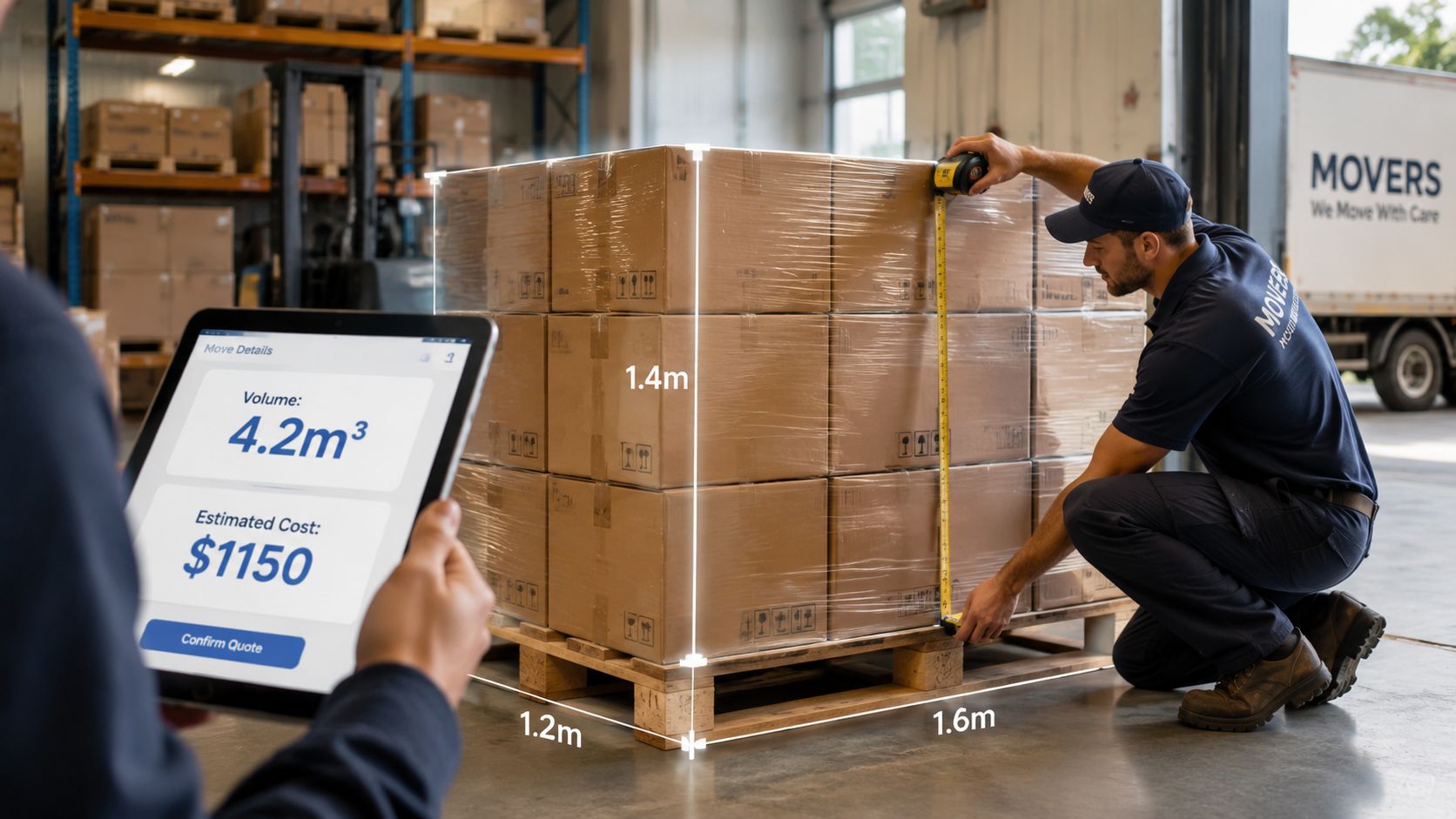
Backloading prices are mainly built around volume, which means how much space your belongings take up in the truck. Removalists usually measure that in cubic metres, which is just the amount of room your goods occupy from floor to ceiling. A sofa, fridge, washing machine and stacked cartons can fill space quickly, even when the item count doesn't look huge on paper.
What affects cost
Distance matters, but it isn't the only factor. Access can shift the job from straightforward to awkward very quickly. A house in one of the Central Coast's coastal areas with steep drive access is different from a ground-floor home in Lake Macquarie. A Newcastle heritage apartment with narrow stairwells takes a different loading plan from a modern building with service lift access.
The route also matters. The cost of interstate backloading varies by volume and distance. Small loads on routes like Sydney to Melbourne may cost $300 to $600, while larger loads on a Sydney to Adelaide route at around 10 m³ can be $1,650 to $1,900. The average cost per cubic metre is approximately $168, according to this interstate backloading pricing guide.
That gives you a benchmark, not a universal answer. Your actual quote still depends on what's being moved, how it's packed, how easy it is to load, and whether pickup or delivery needs extra care because of parking, stairs, long carries or building restrictions.
The timing trade-off people often miss
Backloading is a situation where people either feel well prepared or badly caught out. With backloading, you're usually booking into a route, not reserving a truck that runs solely to your clock. That means pickup and delivery windows are broader.
For households, that can mean coordinating keys, overnight essentials and utility connections more carefully. For businesses, it can affect reopening plans, workstation setup and staff access. The hidden cost of a cheap quote isn't always the transport itself. It can be the disruption if the timing hasn't been discussed properly at the start.
Worth checking early: Ask how the delivery window will be communicated, who updates you if another stop changes timing, and whether your building has move-in restrictions on weekends or after-hours.
A reliable operator won't pretend backloading offers the same precision as a dedicated truck. They'll give you realistic windows, explain where flexibility is needed, and build around the access limits of your property.
Here's a useful overview if you're trying to estimate how volume affects spend before you request quotes:
Why local conditions matter
Sydney traffic can turn a narrow booking window into a problem if the loading zone isn't approved. On the Central Coast, holiday periods can tighten availability and slow access in busy coastal areas. In strata buildings, body corporate rules can affect when common areas may be used, whether lift protection is required, and how long a truck can stay at the kerb.
If you want a rough starting point before speaking to a removalist, a moving company cost calculator can help you think in terms of space, distance and access, rather than guessing from the number of rooms alone.
How to Prepare for a Successful Backloading Relocation
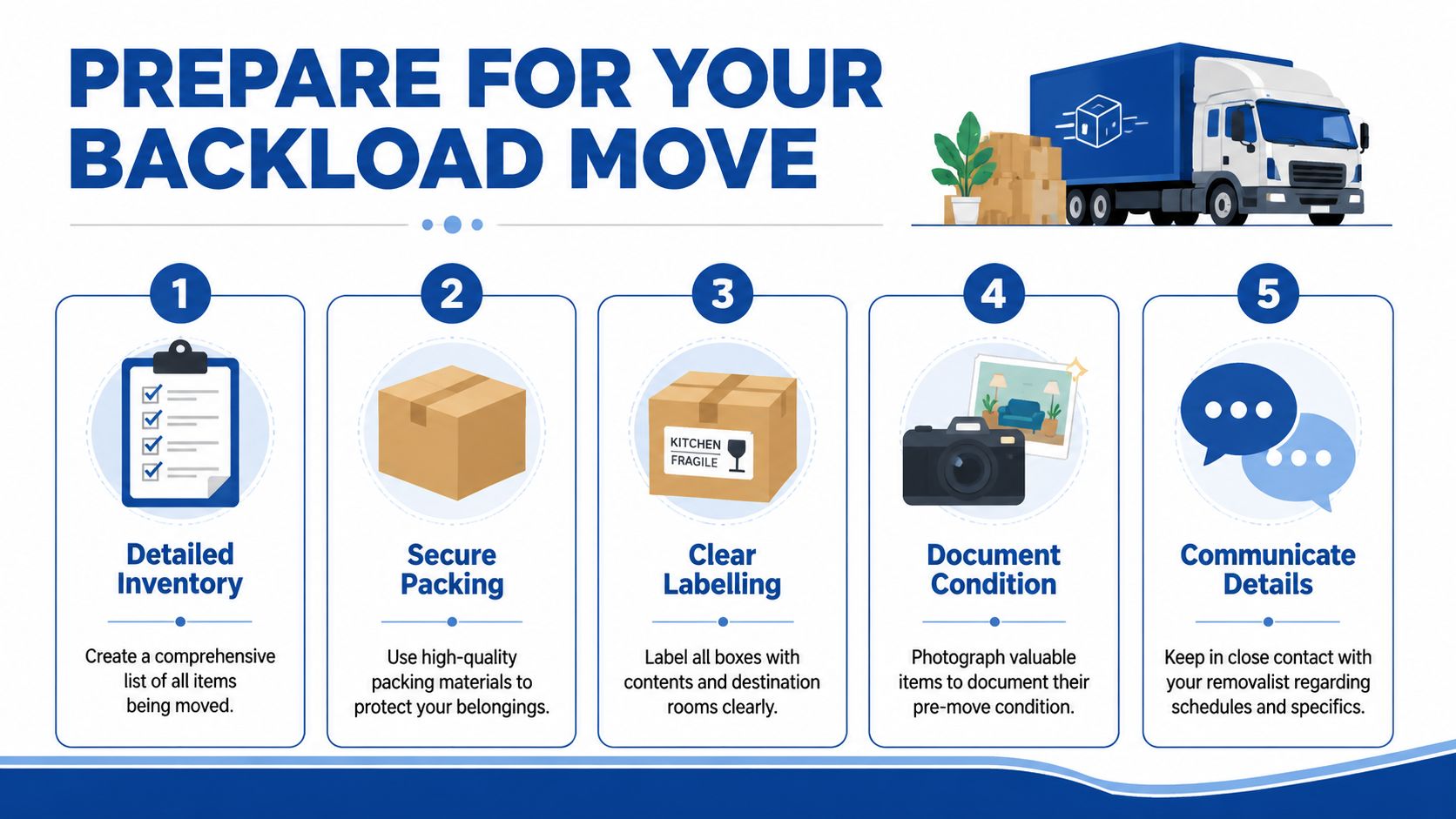
Good backloading jobs are built before the truck arrives. Shared transport can work beautifully, but only if your inventory is clear, your packing is solid, and your timing is organised early enough to fit the route.
Book early and reduce what you're taking
Backloading rewards preparation. A minimum 4 to 6 week advance booking is recommended to secure preferred dates, and customers who declutter and reduce move volume by 15% to 20% can save significantly. Data for the Brisbane to Central Coast route shows costs of $217 to $300 per cubic metre, according to this route planning reference.
That matters because less volume usually means a lower transport cost and an easier loading plan. If you remove the spare furniture, old gym gear and cartons you don't want to unpack in the new place, you're not just saving space. You're reducing handling time and making the truck layout cleaner.
If you're still building your checklist, this guide on planning your interstate move is a useful companion for sorting timelines, documents and pre-move admin.
Pack for shared transport, not just for a short local drive
Backloading isn't rough by nature, but your belongings are sharing a truck. That means packing materials matter more, not less. Use double-walled cartons where needed, strong tape, wrap for breakables, mattress protectors, and proper protection for timber, glass and whitegoods.
Labelling should be simple and visible. Put your name, destination suburb, and room name on every carton. If the load includes refundable-deposit boxes, porta robes, or specialty packing materials, tell the removalist in advance so they can plan stacking and protection properly.
A practical packing routine looks like this:
- Start with a room-by-room inventory: Write down what's travelling and note any fragile or high-value pieces.
- Photograph delicate items before packing: This helps with condition records and makes insurance conversations easier if needed.
- Separate essentials: Keep chargers, medication, important papers, keys, basic kitchen items and a change of clothes with you.
- Disassemble only what should be disassembled: Flat-pack frames, removable table legs and shelving can save space. Don't take apart items that can become unstable or easy to lose parts from.
- Confirm access details in writing: Stairs, lifts, narrow streets, low awnings, parking permits and body corporate bookings all affect the day.
A vague inventory creates vague loading. That's when mix-ups happen.
Decide what to DIY and what to leave to professionals
DIY packing can work if you're organised and starting early. It's often fine for linen, books, clothing and everyday kitchenware. The trouble starts when people pack artwork, monitors, mirrors, marble tops or awkward lamps using whatever tape and cartons are on hand.
Professional packing services make the most sense when the move includes fragile items, time pressure, or a property with difficult access. A trained crew will use quilted pads, wrap and tie-down methods that match shared transport, and they'll load in a sequence that protects both your belongings and the truck balance. If you're weighing that option, a specialist guide to packing service for moving can help you decide where the extra support is worth it.
Don't overlook insurance and building logistics
Even with careful handling, interstate transport carries risk. Full insurance coverage matters because accidents, weather and road variables can't be controlled completely. Ask exactly what's covered, what isn't, and whether owner-packed cartons are treated differently from professionally packed items.
Apartment and strata relocations need extra attention. Check whether your Sydney building requires lift bookings, loading dock reservations, floor protection, or approved moving hours. Some Newcastle and Central Coast complexes also restrict truck access at certain times or require advance notice to building management. Those details can make or break a smooth delivery window.
Finding a Trusted Backloading Removalist
A backloading quote should never be judged on price alone. Shared transport only works when the removalist is organised enough to control labelling, loading order, communication and access at both ends of the journey.
Questions worth asking before you book
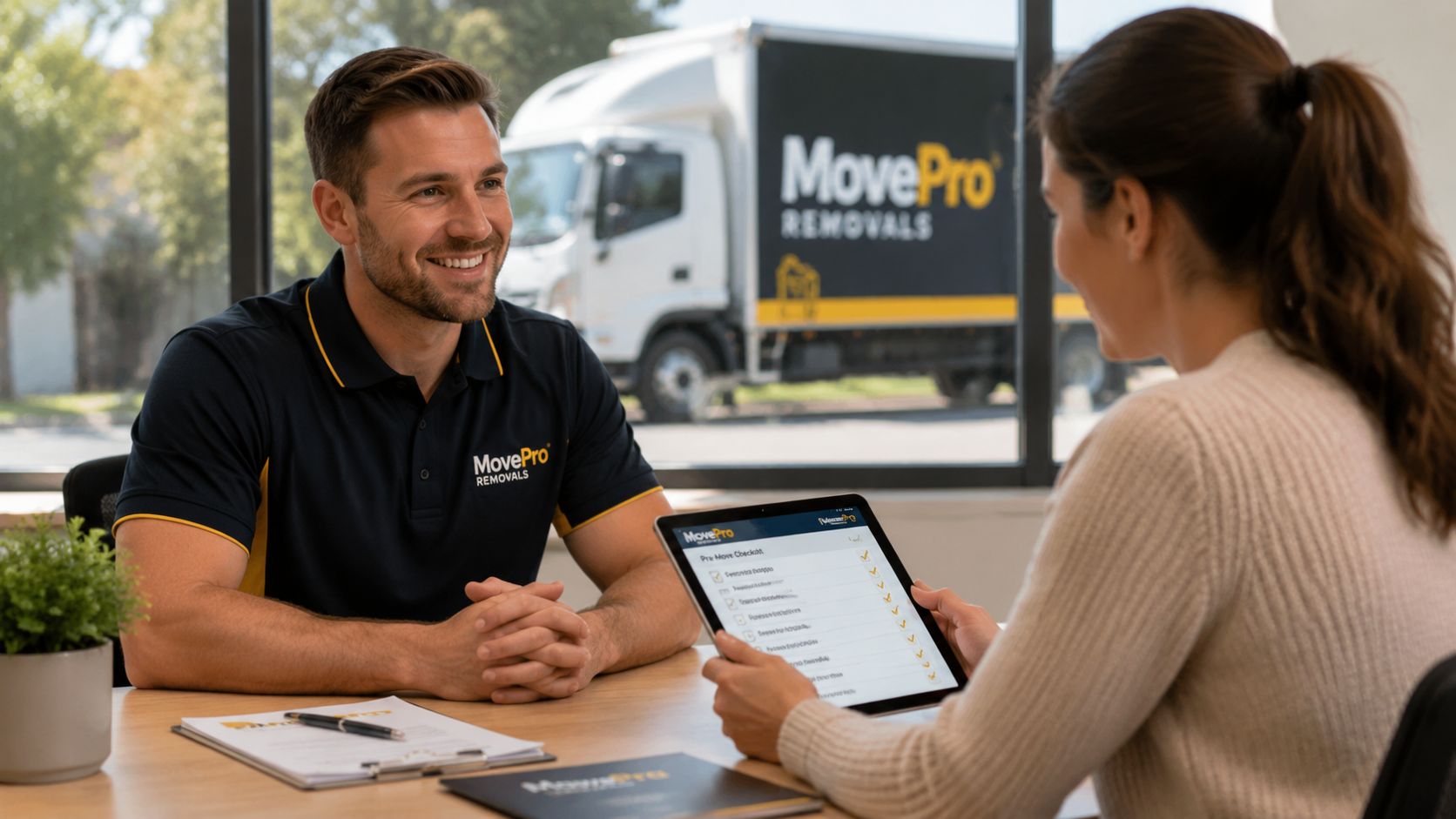
Ask how they manage inventories on shared loads. Ask how often they update clients on pickup and delivery windows. Ask what happens if access changes at the destination, or if a strata building in Sydney requires a different arrival time.
You should also ask about insurance, protective materials and loading methods. A careful operator will be able to explain how quilted pads, wrapping, tie-downs and truck zoning are used to stop one customer's goods from affecting another's.
These questions usually reveal a lot:
- How do you identify each customer's items on a shared truck?
- What's your process if the delivery window changes on the road?
- Do you handle lift bookings, loading dock requirements or body corporate coordination?
- What protection do you use for furniture, whitegoods and fragile pieces?
- Is full insurance coverage available, and what does it include?
Signs you're dealing with a professional
Good removalists don't dodge the awkward parts of the conversation. They'll tell you if your move is a poor fit for backloading. They'll ask about stairs, street access in Terrigal or The Entrance, parking around busy Sydney streets, and whether your Newcastle building has heritage access constraints.
They'll also talk plainly about timing. “Flexible” should still come with a process. You want someone who gives a realistic window, confirms key milestones, and has a clear point of contact when the truck is in transit.
The best backloading jobs don't feel cheap. They feel organised.
Think beyond the truck
Some moves include extra planning around pets, children, elderly family members, or business continuity. If you're relocating with a cat, for example, transport day needs a separate routine from furniture day, and Pet Magasin's cat relocation strategy is a handy read for keeping that side of the move calmer.
It also helps to read carefully through interstate moving company reviews so you know what to look for in communication, care and follow-through. The best review patterns usually mention reliability, not just friendliness.
Backloading can be an excellent option. But it works best when the removalist treats it as a professional logistics job, not spare space with a bargain label.
If you'd like specific advice for a Central Coast, Sydney, Newcastle or Lake Macquarie relocation, Gentle Giant Removals & Relocations can help you weigh up whether backloading or a dedicated service suits your move. We handle residential and commercial relocations, packing, access planning, and interstate scheduling with a safety-first approach, full insurance options, and an On Time, Every Time mindset. For urgent moves, call the team directly. If you're still comparing options, request a free moving quote or a free in-home assessment and get practical guidance before you lock anything in.