
Backloading on the Central Coast usually costs $542 to $1,392, with a median price of $1,130. If you're trying to keep moving costs down around the Central Coast, Sydney, Newcastle or Lake Macquarie, backloading is often one of the smartest options when your dates have some wriggle room.
A lot of people ask this question when they're staring at a lease end date, a settlement period, or a growing pile of packing materials in the spare room. You might be moving from Gosford to Newcastle, from Terrigal into Sydney, or heading the other way after leaving the city. The price matters, but so does knowing why one quote is lower than another, when the cheaper option works well, and when it causes headaches.
Backloading is one of those services that sounds vague until you see how it works in real life. Once you understand truck space, timing, access, and what removalists price, it becomes much easier to judge whether a quote is fair. If you want the plain-English version of the process first, this guide to what backloading removals means in practice is a useful place to start.
What is Backloading and How Does It Save You Money
A common one around here is a small move from Gosford to Newcastle, or a unit from Sydney back up to the Central Coast. The truck is already running that corridor, and instead of booking the whole vehicle, you buy only the space your furniture uses.

That is backloading in plain English. Your goods share a truck with another job on a route the removalist was already planning to service. If you want a clearer breakdown of how that works day to day, this guide to what backloading removals means in practice explains the process well.
The saving comes from one simple thing. You are not paying for empty truck space, extra kilometres with no freight on board, or a dedicated run built around your move alone. On busy local corridors like Central Coast, Sydney and Newcastle, that can make a real difference because trucks are often heading up or down the M1 anyway.
Shared truck space is only part of the story, though. Good backloading still needs proper wrapping, careful stacking, clear labelling and separation between households. Any operator can offer a cheap rate. The better operators know how to load a mixed truck without turning a washing machine, dining table and boxed kitchen into a claims problem by the time it reaches Lake Macquarie or Hornsby.
That is the trade-off people miss.
Backloading usually saves money because the removalist is using capacity that would otherwise go to waste. The hidden cost is flexibility. If your apartment building in Parramatta only allows a two-hour loading window, or your settlement in Woy Woy cannot move by a day, the cheaper quote can stop being the better option very quickly. Around the Central Coast corridor, I see this all the time. The route suits the truck, but the timing does not suit the property access.
Route planning has a big effect on whether backloading stays affordable. Removalists who schedule runs properly can group nearby jobs, reduce empty return legs and keep labour productive across the day. The benefits of route management explain that side of the logistics well, and it is one reason some companies can offer sensible backload pricing while others cannot.
Backloading works well for smaller households, part loads, and anyone with a bit of date flexibility. It works less well for urgent moves, difficult access, strict strata bookings, or customers who want a truck to go direct with no other freight on board. That does not make backloading risky or second-rate. It just means the cheapest move on paper is not always the cheapest once timing pressure, storage, missed key handovers or building rules are added in.
Typical Backloading Costs on the Central Coast Sydney and Newcastle
A customer in Gosford might ring up and say, "I've only got a one-bedroom unit, so this should be cheap." Sometimes that's true. Sometimes the unit has a steep driveway, no loading zone, and a lift booking that gives the crew a very small window to work in. That is why backloading prices around the Central Coast, Sydney, and Newcastle corridor can look similar on paper but land quite differently in the final quote.
The starting point is still cubic metres. That is the amount of truck space your goods take up. A neat one-bedroom apartment in Erina usually needs far less space than a four-bedroom house in Belmont, and truck space is the main thing you are buying with a backload.
For interstate backloading into or out of the Central Coast, costs average $116.31 per cubic metre from Gold Coast and $148.87 per cubic metre from Melbourne, based on Central Coast interstate backloading route data. Those figures are useful as a guide, not a promise. In real jobs across this corridor, access, timing, and how neatly the load fits the run can shift the result up or down.
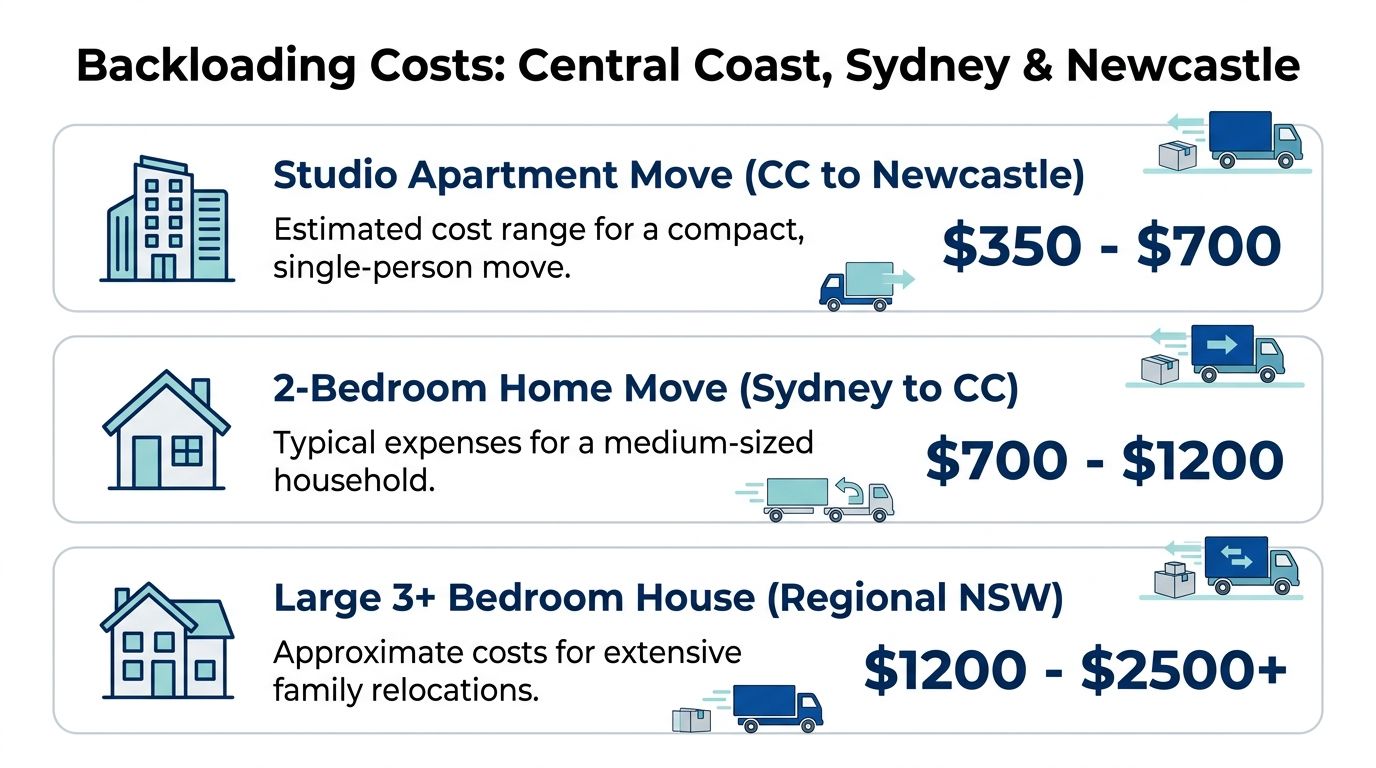
Local examples people can picture
A small move from Terrigal to Newcastle often prices well if the goods are compact and both addresses are easy for the truck. That route is common, so a removalist has a better chance of fitting it into existing work.
A larger move from Lake Macquarie into Sydney usually costs more, even under a backload arrangement. The extra furniture takes more space, and Sydney access can add crew time very quickly. A terrace in the Inner West with stairs and limited parking is a different job from a level driveway in Warners Bay.
Interstate jobs vary even more. A move can still be good value, but the savings depend on whether your load suits an existing run and whether your dates can move a little. If your job goes beyond this corridor, this guide to interstate backloading moves explains how that side of pricing usually works.
How removalists usually think about volume
Here's the practical version of how pricing tends to scale:
| Move type | Why the quote changes |
|---|---|
| Small flat or partial load | Less truck space used, often easier to slot into an existing route |
| Standard home relocation | More cubic metres, more labour, more wrapping and loading time |
| Large family home | Higher space use, more complex loading, and often tighter delivery planning |
A couple moving from Woy Woy to a unit in Sydney's Inner West might use modest truck space but still pay more than expected because the building rules are tight. Lift bookings, basement height limits, and loading dock time matter. A family moving from Warners Bay to Newcastle may have simpler access, but the volume is much higher, so the truck allocation grows.
When people ask how much backloading costs, the honest answer is that truck space sets the base price, but the pick-up and delivery conditions often decide whether the quote stays sharp.
Why local conditions change the final figure
This corridor has its own quirks. Central Coast homes often have easier driveway access than inner-Sydney apartments, but coastal properties can come with steep blocks, tight turns, soft ground after rain, or long carries from the street. Newcastle has plenty of older homes and units where stairs, narrow hallways, and awkward entries slow the job down.
These are not invented extras. They are the sort of details that change how long the crew is on site, how the truck is packed, and whether the move can stay on the planned run without delays. Around the Central Coast, Sydney, and Newcastle corridor, that is often the hidden cost people miss when they compare backloading quotes on price alone.
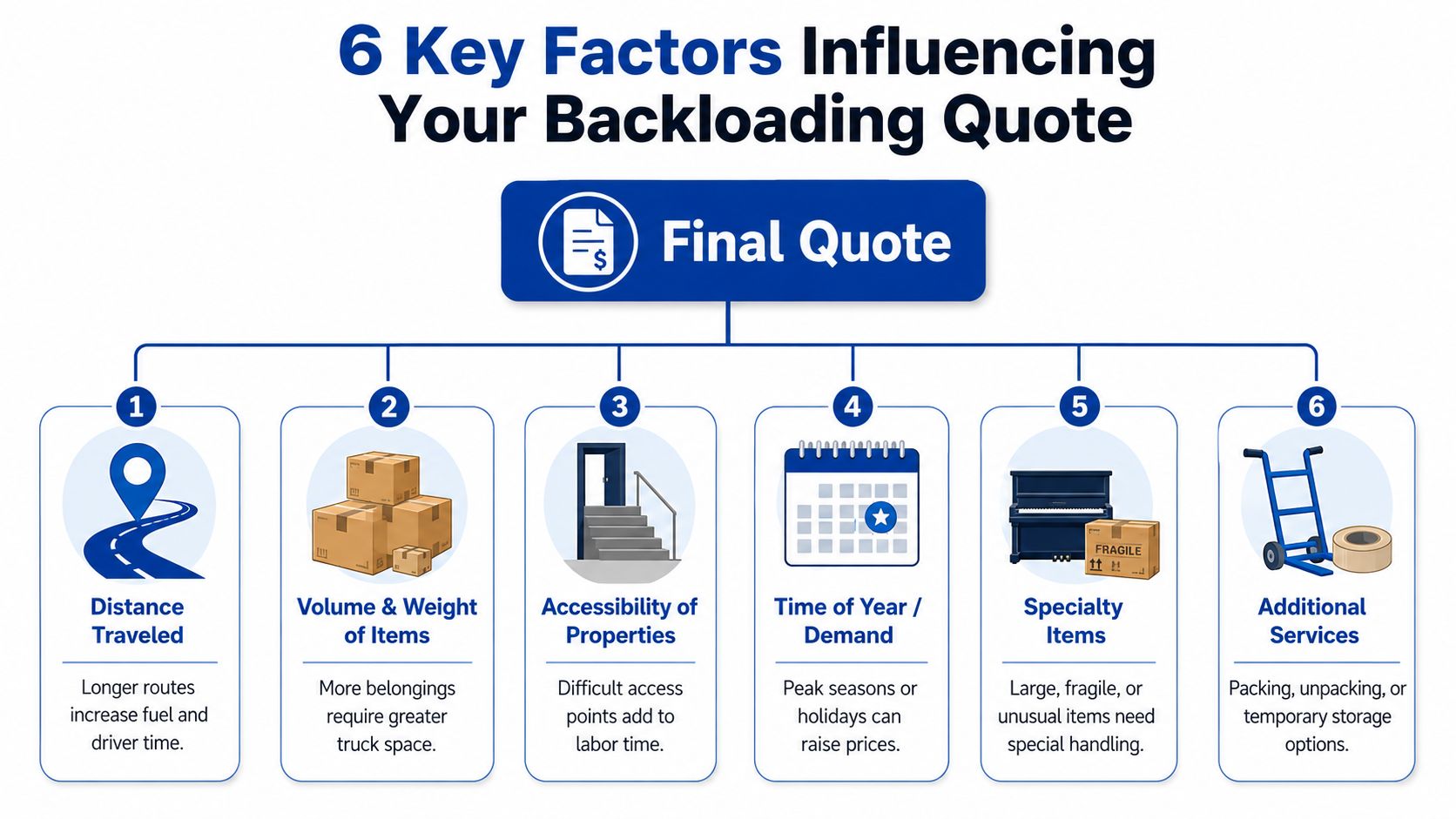
The 6 Key Factors That Influence Your Final Quote
No two backloading quotes are identical because no two moves are identical. The final number depends on a mix of space, timing, labour, access, risk, and service level.
Volume comes first
A cubic metre is the amount of truck space your goods occupy. If you strip the house back before quoting, the price usually improves because the truck allocation shrinks with it.
That sounds obvious, but people often get quotes before they've sorted the garage, the linen cupboard, or the furniture they don't want anymore. If you want a realistic benchmark for how removalists think about broader pricing, this guide to the cost of removalists in Sydney helps put the moving parts into context.
Distance changes more than fuel
A Central Coast to Newcastle relocation and a Melbourne to Central Coast backload are completely different jobs. Longer routes affect driver hours, scheduling, and how many other jobs can be combined on the same run.
Distance also affects timing risk. The longer the corridor, the more likely one delay earlier in the run changes another client's collection or delivery window.
Flexibility can save you money, and inflexibility can cost you
This is the hidden part many people miss. Existing guides rarely talk about the flexibility tax. Recent 2026 interstate data shows smaller loads on Sydney to Melbourne routes cost $300 to $600 only if flexible, while urgent or fixed-date moves on the same route jump to $800 to $1,200, creating a 200% hidden cost gap, according to interstate backloading cost data on flexible versus fixed-date moves.
If your lease ends on a hard date, or your strata only allows one specific move-in slot, backloading may still be possible. It just won't always be cheap.
Fixed dates reduce the removalist's ability to match your load with existing truck space. Once that flexibility disappears, so do a lot of the savings.
Access at both properties matters
Local knowledge is particularly helpful. A house in Killarney Vale with clear driveway access is one thing. A fourth-floor apartment in Sydney with lift bookings, loading dock rules and a strict body corporate window is another.
Access issues that commonly affect quotes include:
- Stairs and long carries increasing labour and fatigue risk
- Narrow streets or limited parking making truck positioning harder
- Lift bookings and strata rules restricting when crews can move
- Shared areas requiring extra protection for walls, floors and entries
Parking permits can also come into play, particularly in busier Sydney streets. If permits or loading zones need to be arranged, that should be discussed before move day, not when the truck arrives.
Packing choices affect both cost and damage risk
DIY packing can save money if it's done well. If it's rushed, overloaded, or loosely packed, it often creates more handling time and more chance of damage.
Professional packing usually makes sense for kitchens, artwork, glassware, and households that are time-poor. For people packing themselves, using proper packing materials, keeping cartons consistent in size, and clearly marking fragile items makes a real difference.
Insurance and specialty items shouldn't be an afterthought
A cheap quote isn't much use if it ignores protection. Full insurance coverage matters, especially for interstate transport, shared truck loads, and valuables that need careful handling.
Specialty items also change the job. Pianos, antiques, delicate electronics, and oversized furniture usually need a clearer loading plan, extra wrapping, and sometimes different equipment. That isn't over-servicing. It's basic risk control for your belongings, the property, and the crew.
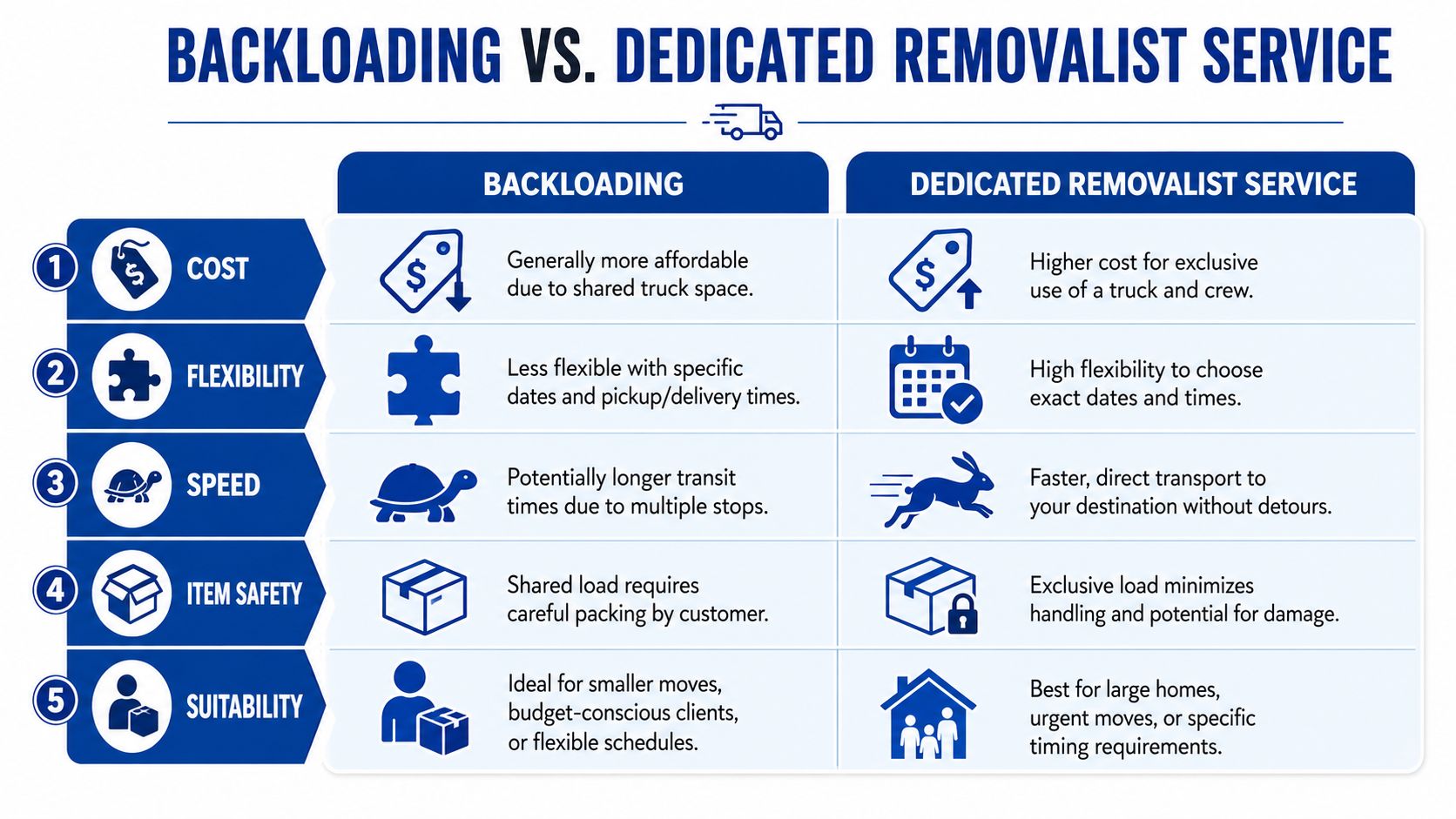
Backloading vs A Dedicated Removalist Service
A lot of Central Coast moves come down to one practical question. Do you want the lowest reasonable price, or do you need the truck to run to your exact timetable?
Backloading usually costs less because you are taking space on a truck that is already travelling through the Sydney, Central Coast, and Newcastle corridor. That can work very well if your dates have some breathing room. A dedicated removalist service costs more because the truck and crew are booked for your job alone, with a direct plan from pickup to delivery.
Where backloading wins
Backloading suits moves where flexibility is worth more than precision. That often means smaller households, partial loads, single-bedroom units, or jobs where the customer can work within a pickup and delivery window rather than locking in one exact hour.
On this stretch of the coast, it also makes sense for common runs between Gosford, Wyong, Newcastle, Hornsby and greater Sydney. Those routes give removalists more chance to fill unused truck space, which is where the saving comes from.
The hidden trade-off is time certainty. A cheap backload can stop feeling cheap if you need extra storage, take more time off work, or miss a lift booking because the delivery window shifts by a day. That part gets missed in a lot of generic pricing guides.
If you're weighing up whether to pay for a truck and crew at all, this comparison of removalists versus a self-move gives a useful baseline.
Where a dedicated service wins
Dedicated service is the better fit when dates are tied to something concrete. Settlement, lease end, school start, booked loading dock, building manager rules, or business downtime all change the calculation.
In those jobs, control has real value. Your goods stay on one run, the schedule is clearer, and there is less risk of the move being pushed around by another customer's timing. For apartments in Parramatta, inner Sydney, or busy Newcastle complexes, that certainty often matters more than getting the lowest quote.
Large family homes also tend to suit dedicated trucks better. Once the load gets bigger, or the inventory includes fragile furniture, gym gear, or multiple whitegoods, a direct service is often simpler to manage from start to finish.
| Consideration | Backloading | Dedicated removalist service |
|---|---|---|
| Budget | Usually lower if your dates can move | Higher because the truck and crew are allocated to your move |
| Timing | Pickup and delivery windows are broader | Booking times are more precise |
| Transit style | Shared truck space with other jobs | Direct transport for your load |
| Best fit | Small to medium moves with flexible timing | Large, urgent, or tightly scheduled moves |
A simple example. A tenant moving from Erina to a house in Newcastle with a few days of flexibility is often a good backloading candidate. A family leaving a Sydney apartment on the same day their lease ends, with a booked lift from 10 to 2, is usually better off paying for a dedicated service.
Protection matters in both options
Shared space does not mean rough handling. A professional crew should still wrap furniture, secure fridges and washers, separate consignments properly, and load the truck so nothing shifts in transit.
The primary difference is not care. It is flexibility versus control.
You can still trim costs on either option by reducing volume before the move. Bulky but compressible items like spare bedding, winter clothes, and linen can sometimes be packed down with Alivate vacuum bags, which may help if you're close to a higher volume bracket.
Practical Tips to Reduce Your Backloading Costs
A lot of Central Coast customers focus on the truck price and miss the part that usually blows the budget. Poor prep. If a load from Terrigal to Newcastle takes longer to carry out than expected, or a unit move into Sydney needs extra handling because the lift booking was missed, the cheap quote stops looking cheap pretty fast.
The best savings usually come before the truck arrives.
Start by cutting volume hard. Backloading works best when you're only paying for the space you use, so old flat-pack furniture, broken outdoor gear, unused garage storage, and duplicate household items should be the first things to go. I tell people to be ruthless with anything they would not bother buying again after the move.
If you want a rough starting point before you book, a removalist cost calculator for move size and pricing can help you estimate how much space your job may take up. It is not a final quote, but it helps you see where trimming a few bulky items can make a real difference.
Packing also changes cost, but only if it is done properly. Loose bags, overfilled boxes, and half-packed tubs waste truck space and slow the crew down. Good cartons stack better, protect your goods properly, and make shared loads easier to secure on the truck.
Soft items are one of the few places where compression can help. If you're trying to reduce wardrobe or linen bulk, Alivate vacuum bags can be useful for clothing, doonas and spare bedding. They are handy for saving space, but they do not replace proper wrapping for breakables, TVs, artwork, or anything with corners that can get knocked around.
The other big cost saver is giving accurate information early. Backloading quotes in the Central Coast, Sydney and Newcastle corridor often change because of access, not distance. A house in Wamberal with a steep driveway, a Gosford unit with basement clearance limits, or a terrace in inner Newcastle with no legal parking out front can all add time and handling.
Send the details that affect the job from day one:
- Photos of large items such as fridges, lounges, dining tables and anything awkward to carry
- Entry and access photos showing stairs, driveways, gates, lifts, and the walk from the truck to the front door
- Timing limits such as lift bookings, strata rules, school zone parking limits, or settlement deadlines
- A realistic date window if you want the better backload rates available on returning trucks
One honest warning. Flexibility saves money, but too much inflexibility creates hidden costs that many guides skip over. If you need a fixed afternoon pickup in Sydney, same-day delivery to the Central Coast, and exact timing around keys or cleaners, you may spend more trying to force a backload to behave like a dedicated service.
That is why the cheapest move on paper is not always the lowest-cost move in practice. The sweet spot for backloading is a well-packed, clearly described load with a bit of breathing room on dates. That is where people usually save money and avoid the usual moving-day headaches.
Getting a Reliable Backloading Quote You Can Trust
A reliable quote should feel thorough, not vague. If a removalist doesn't ask about access, timing windows, parking, specialty items, or whether you're in a house or strata apartment, they're missing details that affect both price and execution.
Flexible dates are a core part of backloading. Removalists typically need a 1 to 2 week window to match your load with an existing return trip, and that flexibility can deliver 30% to 50% savings compared with dedicated services, as explained in this overview of how backloading works with flexible date windows.
Signs the quote is properly built
A solid quote usually covers the practical issues that cause trouble on moving day:
- Access details included such as stairs, lifts, long carries, narrow streets and parking
- Insurance discussed upfront so you know what protection applies in transit
- Scope clearly described including packing, loading, transport, unpacking or specialty handling
- Timing clearly explained especially if the route depends on a flexible backload window
For people interested in transport planning more broadly, this logistics example on container haulage from Felixstowe shows the same underlying principle. Scheduling, route availability and site access all shape the final job, even when the cargo is completely different.
What to do before you say yes
Ask how the load will be protected, whether lift bookings or permits need to be arranged, and what happens if building access changes. If the quote seems unusually low, check what isn't included. That's often where headaches start.
For a second check on the numbers, a removalist cost calculator can help you sense-check whether the quoted scope lines up with your home size and route.
A trustworthy quote doesn't just give you a price. It shows that the removalist has thought through the job.
If you'd like advice specific to your move, Gentle Giant Removals & Relocations can provide a free moving quote or a free in-home assessment across the Central Coast, Sydney, Newcastle and Lake Macquarie. For urgent moves, it helps to call and speak with the team directly so access, timing, packing services, insurance, and any strata or parking issues can be sorted early.