

You're probably reading this with a lease date in one hand and a growing list of problems in the other. The new office is locked in, staff are asking what happens to their desks and screens, and someone has just mentioned lift bookings, parking permits, internet cutover, and after-hours access in the same sentence.
That's the point where a business usually realises an office move isn't just transport. It's operations, safety, timing, building access, and getting everyone back to work fast. Around the Central Coast, Sydney, Newcastle, and Lake Macquarie, the move itself is only one part of the job. The real work is coordinating everything around it so you don't lose days to avoidable disruption.
If you're choosing an office moving company, the practical questions matter most. Who's handling the packing materials. Who's checking the loading dock. Who's speaking with strata or building management. Who's protecting workstations, boardroom tables, compactus units, and confidential files. And who's making sure your team can walk into the new office and start using it.
The Foundations of a Smooth Office Move
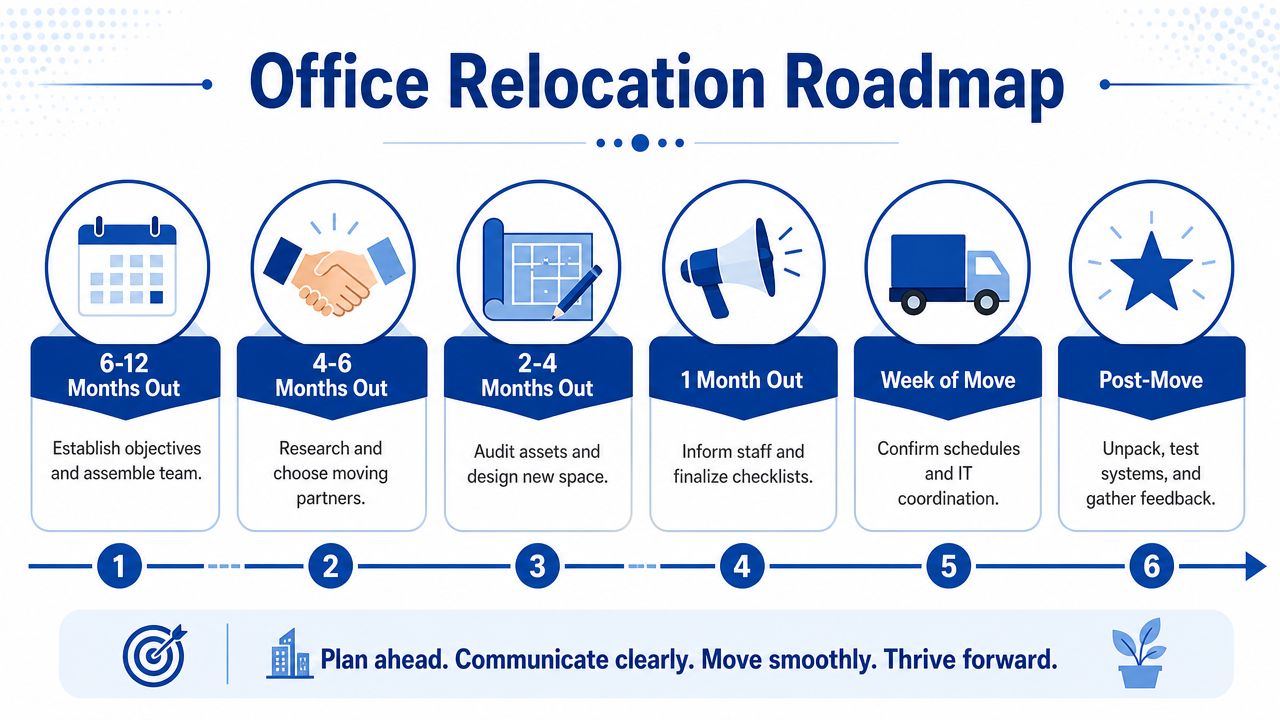
A smooth office relocation starts earlier than is commonly expected. Practical planning guidance recommends starting at least 3 months ahead for a standard office and 6 months ahead for a larger or IT-heavy site, because success is usually judged by productivity and technology downtime rather than whether the truck arrived on time alone, as outlined in office relocation planning guidance.
If you're moving a mid-sized office from North Sydney to Gosford, that lead time disappears quickly. Sydney CBD buildings often need lift bookings and loading dock times confirmed well in advance. On the Central Coast, access might be easier at the destination, but the challenge shifts to sequencing the move so phones, internet, desks, and staff all land in the right order.
Start with people, not packing
The businesses that cope best usually appoint a small internal move team early. One person handles building access and landlord communication. Another takes responsibility for IT coordination. Department leads confirm what furniture, files, and equipment are moving.
That approach stops the common problem where everyone assumes someone else is handling it.
A useful starting point is to map the move across these areas:
Operations and timing
Decide your cutover date, preferred moving window, and whether the physical move will happen after-hours or on a weekend.Assets and inventory
Record desks, chairs, filing units, printers, screens, cables, and anything with a serial number or assigned user.Building access
Check lift access, stairwells, loading zones, street parking, permit requirements, and any body corporate restrictions.Staff communication
Tell your team what they're responsible for packing, what gets professionally packed, and what happens on the first day in the new office.
Practical rule: If no one owns the communications plan, staff fill the gap with guesses, and that's when labels go missing, files get mixed up, and people arrive at the new office unsure where to sit.
Build a move plan that reflects real NSW conditions
Generic office checklists rarely account for local access conditions. In Sydney, traffic and loading windows can control your day more than distance does. In Newcastle, older commercial buildings and heritage conversions can mean tighter stair access, smaller lifts, and stricter protection requirements for shared areas. On the Central Coast, business parks may be easier to access, but coastal weather and spread-out routes still affect timing and sequencing.
A master plan should include room-by-room destination labels, a floor plan for the new site, key-holder contacts, and an issue escalation list for moving day. It also helps to line up specialist help early if your IT setup is complex. For businesses that need a clearer view of what proper technical planning looks like, Constructive-IT's IT relocation support is a useful example of how structured IT coordination fits into a wider relocation program.
If your move is Sydney-focused, our guide to office relocations in Sydney is worth reading before dates are locked in. It helps you spot timing and access problems before they become expensive ones.
Choosing Your Commercial Relocation Partner
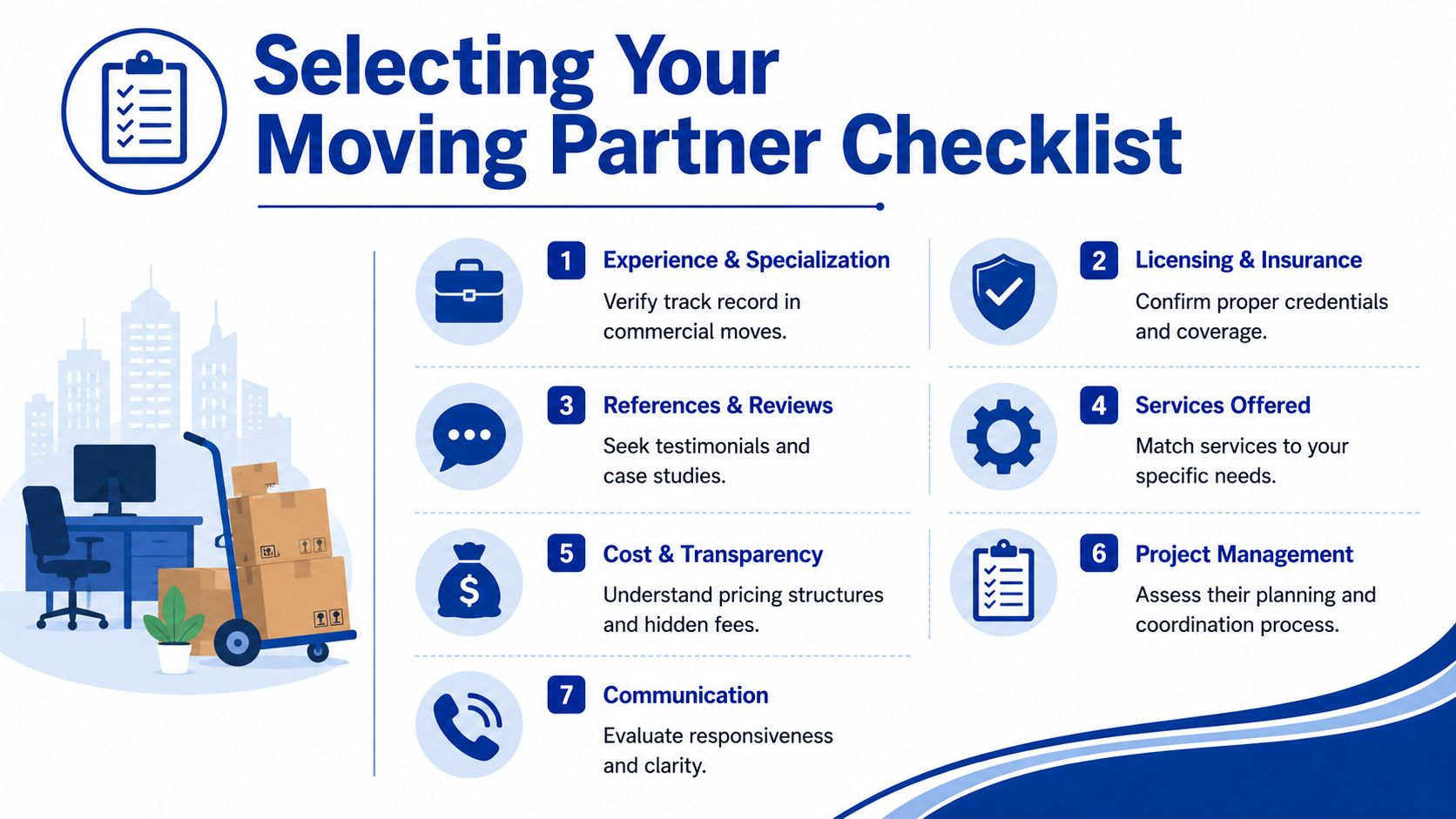
Choosing the right office moving company matters more than most businesses realise. A poor operator can still sound convincing on the phone. The problem is that office moves expose every weakness fast. Weak planning shows up in missed lift bookings, damaged workstations, confused staff, and trucks arriving without the right equipment.
Independent guidance for commercial clients flags several warning signs when vetting a provider, including missing physical addresses, generic email accounts, unmarked trucks, and vague company histories, and it strongly emphasises the value of an on-site survey and a binding quote in commercial moving company vetting advice.
Why the site inspection matters
An office move can't be priced properly from a quick phone chat alone. A removalist needs to see the access at both ends, the furniture volume, the loading path, and any awkward items like boardroom tables, safes, compact shelving, large printers, or breakroom appliances.
That's especially true in local areas with very different access conditions. A tenancy in Parramatta or the Sydney CBD might involve loading dock bookings, concierge rules, protective floor coverings, and strict time windows. A site in Newcastle could involve narrow lanes, older buildings, or stairs that change how the job is staged. In Lake Macquarie or the Central Coast, parking may be easier, but multi-tenant complexes still often require notice periods and shared-area protection.
An on-site assessment doesn't just protect the removalist. It protects your business from assumptions.
Questions worth asking before you sign
You don't need a long procurement process to make a good decision. You do need clear answers.
Ask about these points before accepting a quote:
Insurance cover
Confirm what's covered in transit, what full insurance coverage applies to, and how claims are handled if something is damaged.Commercial experience
Ask whether they regularly handle office relocations, not just household jobs.Crew and equipment
Check whether they have trained staff, furniture protection, trolleys, straps, computer crates, and the right truck size for your move.Access coordination
Make sure they're comfortable working with strata managers, building supervisors, lift bookings, and loading dock procedures.Move-day supervision
Find out who will lead the job on site and who your point of contact is if something changes on the day.
A professional answer usually sounds clear and boring. That's a good sign. Vague promises are not.
What reliable looks like in practice
A good office moving company will talk about risk before you ask. They'll want to know about stairs, lifts, narrow streets, staff parking conflicts, fragile items, and whether your team is doing any of the packing. They'll also ask what needs to be live first at the destination. Reception. Sales. IT. Accounts. That order matters.
If you're not sure what a professional removalist does compared with a basic transport provider, this plain-English guide on what a removalist is helps clarify the difference. For commercial work, that difference usually comes down to planning, protection, accountability, and timing.
Budgeting Your Move and Protecting Your Assets
Most office move budgets go wrong in one of two ways. The first is focusing only on the truck and labour. The second is underestimating the cost of disruption if desks, files, or equipment don't arrive ready to use.
When businesses choose a full-service relocation, they're usually buying control. According to moving services market data from Mordor Intelligence, full-service relocation accounted for 64.20% of revenue in 2025, which reflects how much demand sits in turnkey work rather than transport-only jobs. For office relocations around Sydney, Newcastle, and the Central Coast, that fits what we see on the ground. Many businesses would rather have one provider handle packing, loading, transport, and unpacking than coordinate several moving parts themselves.

What actually drives the cost
Office relocation quotes vary because the workload varies. A small professional suite with desks, chairs, and archive files is a very different job from a fit-out with workstations, meeting rooms, filing systems, kitchen equipment, and fragile tech.
The main cost factors are usually:
| Factor | Why it matters |
|---|---|
| Volume in cubic metres | Cubic metres means the amount of space your items take up in the truck. More volume usually means more labour, more truck space, or more than one run. |
| Access conditions | Stairs, tight lifts, basement loading, narrow streets, and long carry distances all slow the job and change crew requirements. |
| Distance and route | A move from Sydney to Newcastle has different scheduling pressures from a move within Gosford or Lake Macquarie. |
| Service level | Packing, unpacking, furniture disassembly, reassembly, and workstation placement all add labour but often reduce downtime. |
A quote should also make clear who is supplying packing materials, whether confidential files need special handling, and whether unwanted furniture removal or disposal is part of the scope.
Cheap can cost more
An office move is one of those jobs where the cheapest quote can become the most expensive outcome. If your team spends days packing poorly, if screens arrive unprotected, or if key staff can't work because the layout wasn't staged properly, the saving disappears quickly.
Insurance sits right in the middle of that decision. You want to know what protection applies in transit, during handling, and while furniture and equipment are being moved through shared areas. Full insurance coverage matters because offices contain business-critical items, not just replaceable furniture.
For businesses reviewing security as part of the relocation, especially where files, stock, or high-value equipment are involved, these effective theft protection strategies are a sensible companion read. Security planning and transport planning usually overlap more than people think.
If you want a clearer picture of what transport cover means in practical terms, our guide to goods insurance in transit explains where insurance fits into a professional move.
Managing Your Technology and Sensitive Equipment
The biggest worry in most office relocations isn't the desks. It's the moment someone asks, “When will the internet be live, and who's reconnecting the server?” That concern is justified. Downtime is where office moves hurt.
Practical relocation guidance consistently points to the same issue. The strongest local gap in office moving advice is concrete downtime control and IT coordination, and best practice is to minimise lost work hours by coordinating server and telecom moves carefully, often by scheduling the physical relocation during non-operating hours, as noted in office relocation downtime guidance.
Treat IT as a separate move inside the move
Your furniture move and your technology move should be linked, but they shouldn't be treated as the same task. Computers, switches, phones, printers, servers, and meeting-room gear need their own sequence, their own owners, and their own testing plan.
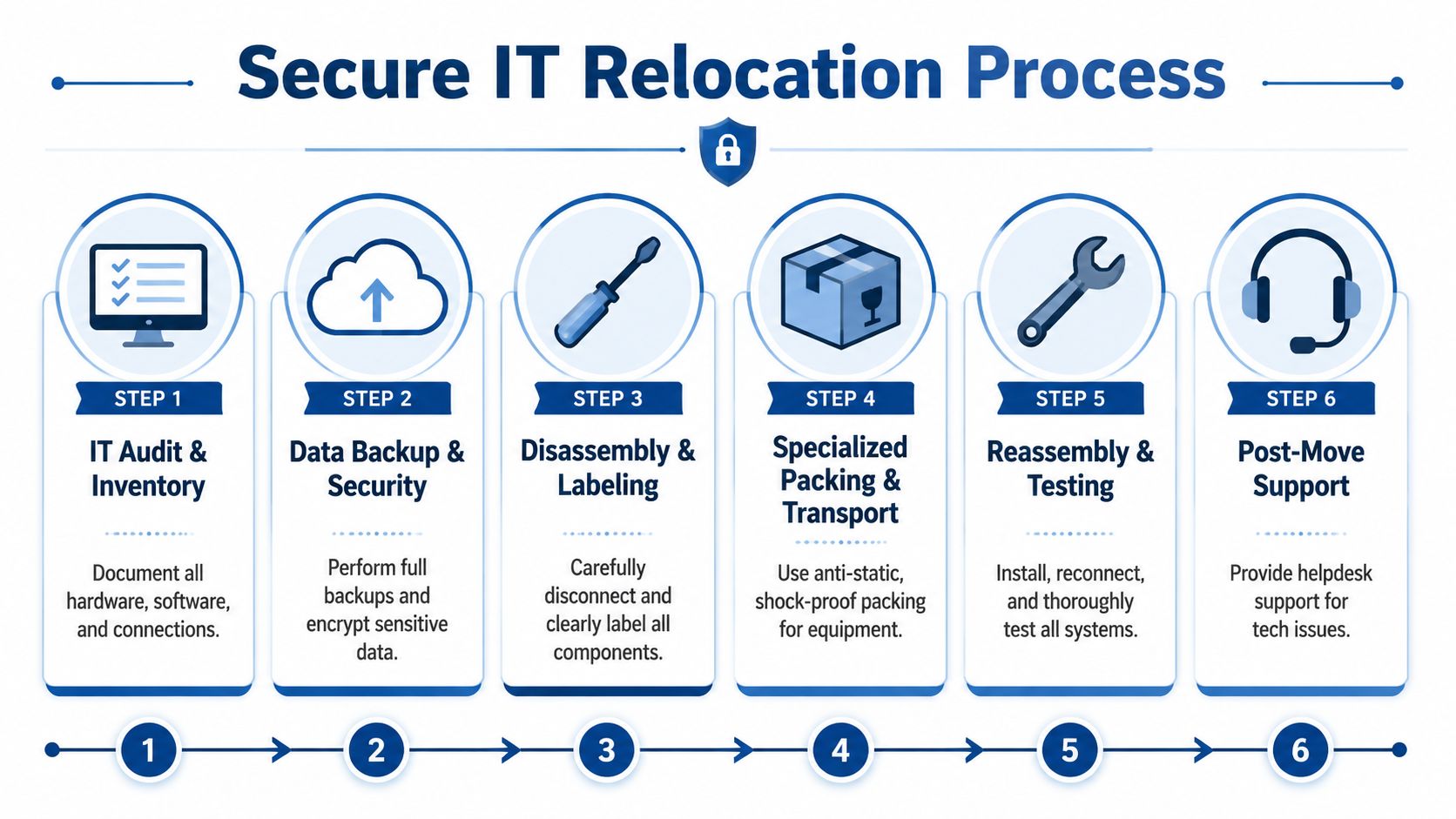
A reliable process usually looks like this:
Back up data first
Don't start unplugging anything until your IT team confirms backups and access to recovery systems.Label every connection
Screens, docks, phones, keyboards, cables, power supplies, patch leads, and ports need clear labels tied to a desk or user.Pack with the right materials
Anti-static protection, padded wrapping, secure crates, and upright handling all matter with electronics.Prepare the destination before arrival
Power, internet, patching, cabinet space, and cooling need to be ready before the equipment turns up.Test before staff return
Check phones, printing, Wi-Fi, login access, shared drives, and meeting room systems before the office is declared live.
Practical note: The safest IT move is usually the one that happens when your staff are off the clock and your technical team has uninterrupted time to shut down, reconnect, and test.
Here's a short visual walkthrough that helps explain the sequence:
The local details that trip people up
Building rules often affect IT more than furniture. A Sydney tower may only allow server or comms equipment through a certain dock after-hours. A Newcastle site might need advance approval for contractors in secure areas. On the Central Coast, the destination may be easier to access, but if the NBN or business-grade service isn't ready, the easier loading path won't help much.
That's why internet cutover should be confirmed early. If you're reviewing connectivity options as part of the move, this guide to the best business internet providers Australia is useful for comparing what your new site may need.
For the physical protection side, many of the same rules used for delicate office screens and electronics overlap with the methods in our guide on how to pack fragile items for moving. The materials differ by item, but the principle is the same. Protect first, move second.
Mastering the Physical Logistics of Your Move
Moving day runs well when the physical work has been simplified before the truck arrives. That means less clutter, better labels, and a clear decision about who is packing what.
Some businesses choose a hybrid model. Staff pack personal items and desk contents, while the removalist handles furniture, archive files, fragile items, and shared equipment. That can work well. What usually doesn't work is asking your team to pack the whole office on top of their normal workload and hoping it all stays organised.

A practical packing system
The easiest office moves to unload are the ones that were labelled for the destination, not the origin. Don't just mark a carton “Accounts”. Mark it with the staff name, the destination room, and whether it should be opened first or later.
A simple approach that works well is:
Use colour coding by department
Reception, sales, accounts, management, and IT each get their own label colour.Number workstations and rooms
If desk 14 is going to workstation 14 at the new site, reassembly gets much quicker.Separate priority items
Day-one items such as phones, chargers, stationery, kitchen basics, and key files should be packed and identified separately.Protect fragile and awkward pieces properly
Screens, glass tops, artwork, and loose components need proper wrapping, not leftover office supplies.
The truck should be loaded in reverse order of urgency. Items needed first at the new office should be among the last items loaded so they come off first.
Professional packing versus DIY
DIY packing can reduce the scope of the relocation, but it comes with trade-offs. Staff aren't trained to wrap monitors, secure pedestal drawers, protect table edges, or stack cartons safely for transport. They also tend to overfill cartons with files, which creates injury risk and box failure.
Professional packing is often worth it when:
Your team needs to stay productive
Pulling staff into packing for several days can cost more than it saves.You have fragile or high-value items
Boardroom furniture, artwork, screens, and shared tech need proper protection.Access is tight
Buildings with lifts, long corridors, stairs, or limited booking windows leave little room for slow or messy packing.The move has to happen fast
After-hours and weekend relocations rely on having everything ready to go.
This is also where local knowledge helps. Sydney's busy traffic can force very strict loading windows. Newcastle's inner-city streets can make truck placement harder than expected. Some strata and commercial buildings require lift protection, advance certificates, and notices to other occupants. A removalist who works these areas regularly is less likely to be surprised on the day.
Loading order matters too. If you've ever wondered why some trucks unload cleanly and others turn into a scramble, our guide on how to pack a moving truck explains the thinking behind weight distribution, access, and protection. The same logic applies to office relocations, just with more coordination and higher stakes.
Where businesses want one provider to handle the operational side, Gentle Giant Removals & Relocations is one local option that provides commercial moving, packing materials, furniture protection, and coordinated office relocations across the Central Coast, Newcastle, Lake Macquarie, and Sydney.
Executing the Move and Setting Up for Success
Moving day should feel controlled, not chaotic. By that point, the crew should know the access rules, the floor plan, the priority items, and who signs off each stage. Your side should have one decision-maker available, plus clear contacts for building management and IT.
A small move-day kit helps more than people expect. Keep keys, swipe cards, chargers, staff contacts, internet details, basic stationery, cleaning supplies, and any urgent files with a nominated staff member, not on the truck. The same goes for items you'll need before everything is unpacked, such as reception equipment or first-day meeting materials.
What the first day back should look like
The best first day in a new office is structured. Furniture goes to the pre-agreed position. IT checks live systems in order of business priority. Staff arrive to labelled desks, working power, and clear instructions about what's been unpacked and what's still being finalised.
A useful early review is simple:
Check access and safety
Walk paths are clear, furniture is stable, and shared areas are protected and tidy.Check business-critical systems
Internet, phones, printing, logins, and meeting room tech are working.Check post-move issues quickly
Any missing labels, damaged items, or room layout changes are dealt with before they become longer disruptions.
When an office move is treated as a coordinated change rather than a transport task, the new site starts functioning faster. That's the true measure of a good relocation. Not how busy the day looked, but how quickly your business gets back to normal.
If you're planning an office relocation across the Central Coast, Sydney, Newcastle, or Lake Macquarie, Gentle Giant Removals & Relocations can help with practical planning, site assessments, packing support, access coordination, and the physical move itself. If you'd like a clear scope before you commit, request a free quote or a free site assessment. For urgent moves, a phone call is often the fastest way to lock in a plan.